

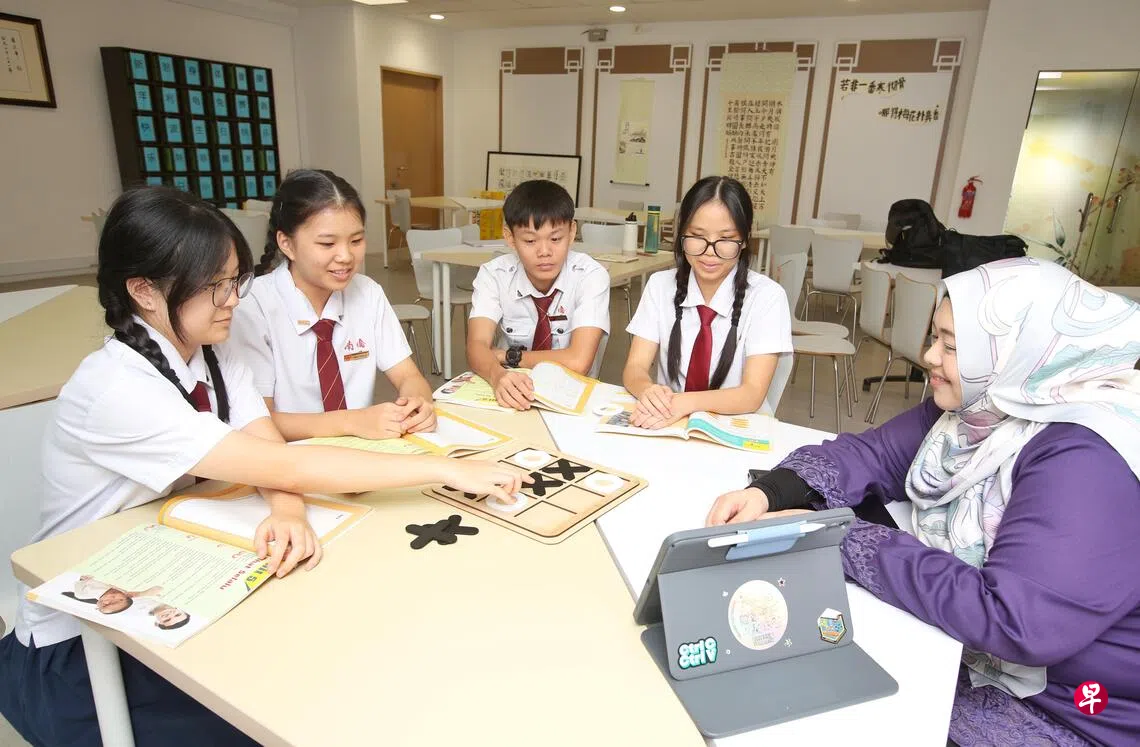
When 15-year-old Ong Si Xuan Corrine greets her elderly neighbours in Malay, they are delighted to learn that she studies the language at school. They readily converse with her in Malay and encourage her to keep learning. This has shown Ong how a shared language can bring people closer together.
Ong is a Secondary 3 student at Nan Chiau High School (NCHS) and will sit the Secondary 4 examination for the Malay Special Programme (MSP) next year.
In recent years, at least 20 students from each cohort at the Special Assistance Plan (SAP) school, which has roots as a Chinese-medium school, have completed the four-year programme and sat the examination. Last year, more than 80% scored an A or B.
The Ministry of Education (MOE) introduced the MSP in 1986 to allow non-Malay secondary school students to study Malay as a third language and learn about the culture of another ethnic community.
The programme has developed and expanded over the years, and is now offered on campus at 12 secondary schools. Seven of these are SAP schools, which focus on nurturing bilingual and bicultural talent in Chinese and English: NCHS, Anglican High School, Chung Cheng High School (Main), Dunman High School, Hwa Chong Institution, Nan Hua High School and Nanyang Girls' High School.
Students outside the 12 designated schools who are interested in studying Malay can attend classes at the Ministry of Education's zonal centres. The four existing zonal centres are the MOE Language Centre in Bishan, Bukit Batok Secondary School, Tampines Secondary School and Zhonghua Secondary School. From next year, National Junior College (NJC) will become the fifth zonal centre, giving more students the opportunity to study Malay.
In response to queries from Lianhe Zaobao (LHZB), MOE said about 1,800 secondary school students are currently enrolled in the MSP, with 40% attending classes at zonal centres. NJC's addition next year will provide another 80 to 90 places annually.
A ministry spokesperson did not disclose enrolment figures for previous years, but earlier reports put the annual average at 1,700 students between 2019 and 2023.
Malay teacher: Fun lessons and practical use are key to language learning
Nur Maizurah, who teaches the MSP at NCHS, told Lianhe Zaobao (LHZB) that almost all her students start from scratch.
Besides textbooks, she uses cartoons, videos and other materials to expand their vocabulary and gradually develop their listening, speaking, reading and writing skills, before introducing them to Malay culture. She also organises games with challenges around the school to make learning more engaging.
“I believe if we instill the joy for learning the language,” said Nur, “students will be more motivated and self-directed to learn more.”
Nur also firmly believes that students should have opportunities to put what they learn into practice. She has therefore encouraged the school to work with mosques and nursing homes, allowing students to strengthen their Malay communication skills by taking part in breaking-fast activities and interacting with elderly people.
Students have also created Malay e-books for pupils at St. Joseph's Institution Junior and read to them in Malay.
Ong and her classmate Sim Tze Ron Lucas, 15, said that although learning an additional language meant putting in more effort than their peers, they had gained a great deal from it.

For Sim, knowing another language has made it easier to communicate in a multicultural environment. He now feels more confident speaking Malay.
Ong also believes that living in multiracial Singapore means she should make the most of opportunities to learn the languages of other ethnic communities.
“If I need it for work in future, or when I meet people from countries in the region, I will be able to communicate in Malay, a language they are familiar with, and connect with them more warmly.”
Methodist Girls' School student Janis Ho Zhi Ying, 15, also chose to study Malay to communicate effectively with people from different cultural backgrounds. The fact that her school does not offer the MSP has not weakened her resolve. Once a week, she heads to Bukit Batok Secondary School after her own lessons to attend Malay classes.
Ho said: “Two schoolmates and I have been learning Malay together since Secondary 1. We encourage one another and have also made friends from other schools. The teachers at the centre guide us with care, which gives me more motivation to keep going.
“I am not just learning a language, but also gaining a better understanding of Malay culture, including traditional clothing, food and festivals. It is very meaningful.”
Students who wish to enrol in the MSP must have a Primary School Leaving Examination score of 24 or better. Those who complete the four-year course and pass the examination receive two bonus points when applying to junior colleges.
