

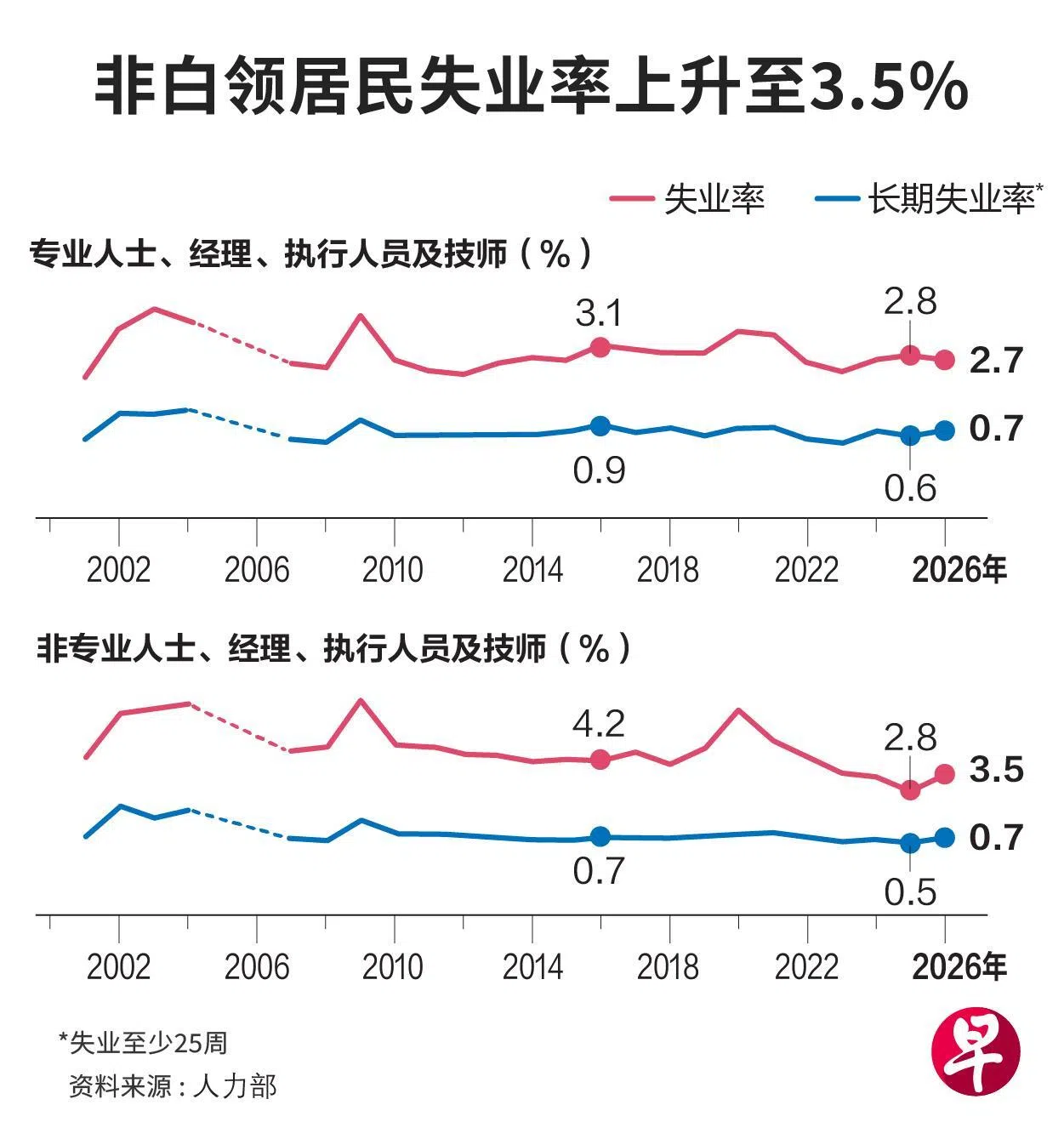
Singapore’s overall resident unemployment rate remained low, but unemployment rates varied across occupational groups. The rate for professionals, managers, executives and technicians (PMETs), commonly known as white-collar workers, held broadly steady, while that for non-PMETs rose from 2.8% last year to 3.5%.
An academic interviewed said this could be linked to more companies undergoing digital transformation and business restructuring.
Share of employed residents in white-collar jobs rises to 65.2%
Advance estimates from the Labour Force in Singapore 2026 report, released by the Ministry of Manpower (MOM) on Friday (27 November), showed that the proportion of professionals, managers, executives and technicians (PMETs) among employed residents continued to rise from 64.2% in 2025 to 65.2% in 2026, as residents’ educational qualifications continued to improve.
The unemployment rate for PMETs was 2.7%, while the rate for non-PMETs returned to 2023–2024 levels. Long-term unemployment rates edged up for both groups, from 0.6% to 0.7% for PMETs and from 0.5% to 0.7% for non-PMETs. A person is considered long-term unemployed after being out of work for at least 25 weeks.
MOM’s director of manpower research and statistics, Ang Boon Heng, said at a media briefing on Friday that the increase in non-PMET unemployment was mainly attributable to softer hiring conditions in certain sectors and the employment challenges faced by older non-PMET residents. However, it was not necessarily a long-term trend, as the group’s long-term unemployment rate had not risen as much as its unemployment rate.
The report said the increase in the long-term unemployment rate was driven mainly by residents aged 50 and over, particularly those in their 50s. This may partly reflect an increase in retrenchments among residents in this age group and the continued challenges they faced in re-entering employment.
Dr Xu Le, a lecturer in the Department of Strategy and Policy at the National University of Singapore (NUS) Business School, said in an interview that the rise in non-PMET unemployment reflected diverging labour market demand for different types of talent and skills. She said this could be linked to more companies undergoing digital transformation and business restructuring.
“In this process, companies’ demand for people with specialist knowledge, technical capabilities and higher-value skills remains relatively stable, while demand for workers performing repetitive, routine tasks may decline.”
NTUC urges early support to help workers acquire new skills
National Trades Union Congress (NTUC) Assistant Secretary-General Patrick Tay said in a LinkedIn post that non-PMET workers were the first to feel the impact of changes in the labour market. The 0.7 percentage-point increase in their unemployment rate was significant.
He said: “We cannot wait until workers are retrenched before we step in. Reskilling and job redesign must reach workers early, so they remain employable.”
Tay also encouraged workers to use the skills training and career coaching resources available, and urged employers to share the gains with employees and keep investing in their people, even amid economic uncertainty. Tripartite partners must also identify workers at risk of falling behind and step in early.
MOM said in a statement that the government would continue to support employers’ transformation efforts and help workers upgrade their skills through various schemes.
MOM will release the final Labour Force in Singapore 2026 report in January 2027.
