

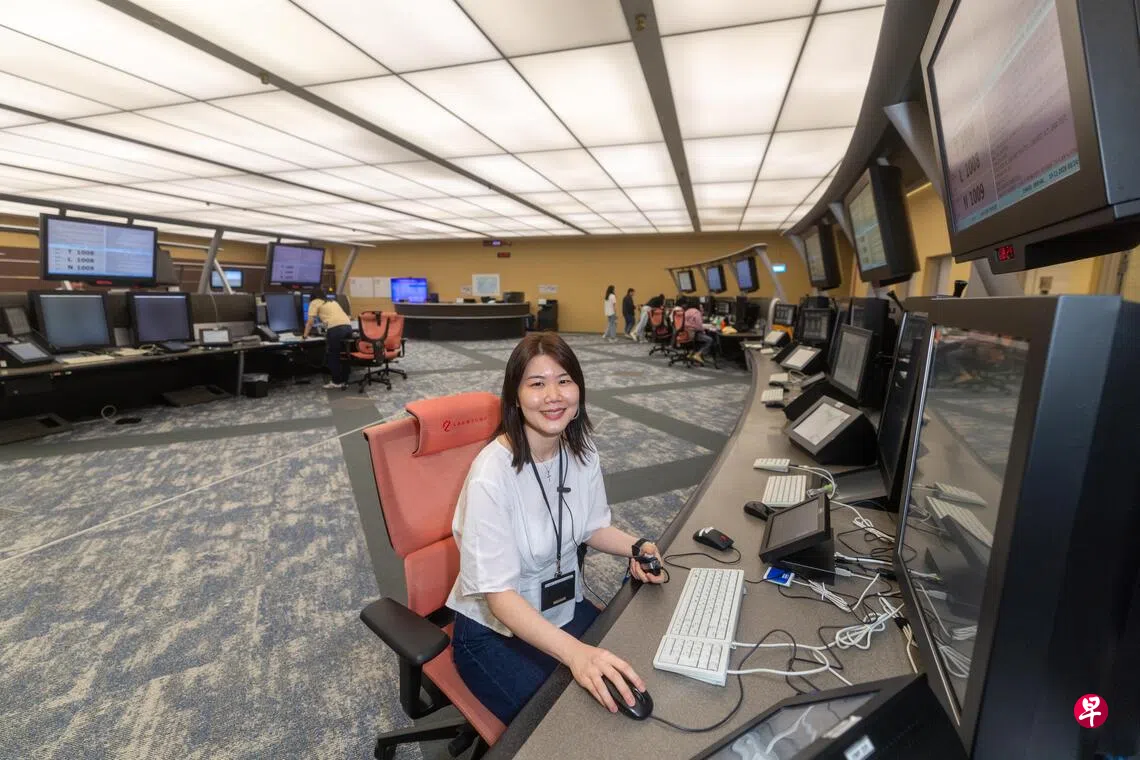
Penny Ng is an air traffic control officer, but she says: “I don't see airplane at all.”
Nor does she work in the control tower at Changi Airport.
Mention air traffic control officers, and most people might picture staff in Changi Airport’s control tower, watching aircraft take off and land through its windows. But for 35-year-old Ms Penny Ng, the working day involves looking not at actual aircraft, but at dots on a radar screen. She uses these dots and flight data to track aircraft movements and issue instructions to pilots.
There are three main categories of air traffic controllers. While aerodrome controllers do work in the control tower, the other two groups — approach controllers and area controllers — work at the Singapore Air Traffic Control Centre near Changi Village, some distance from the airport. Lianhe Zaobao recently had a rare opportunity to visit the centre and learn about the controllers’ daily work.
Ng, who has been in the profession for nine years, told Lianhe Zaobao that the biggest public misconception about the job is that all air traffic controllers work in airport control towers.
Another common misconception is that air traffic controllers must wear uniforms. Friends, relatives and people she meets for the first time, such as private-hire car drivers, are often curious when they learn what she does. Their reactions have also made her realise just how interesting and unusual her job is.
Ng majored in accountancy at university and worked in external audit at an accounting firm after graduating in 2014. After slightly over two years, she wanted a career change, seeking something more operational and dynamic that would not require her to use a laptop every day.
Her love of travel and aircraft prompted her to explore the aviation industry. She eventually joined the profession and began training in 2017, obtaining her ATC licence in June 2018. Today, besides carrying out daily air traffic control duties as an approach controller, she is also an instructor, guiding trainees from time to time. She also contributes to a project to develop the next air traffic management system, providing input from a user’s perspective.
Bad weather and emergencies test controllers’ ability to respond
Although air traffic controllers’ daily work is not as dramatic as Hollywood films suggest, it still presents challenges. Bad weather and unexpected incidents are a particular test of their ability to respond.
Ng explained that pilots may request changes to their flight paths when they encounter thunderstorms or clouds, leading to busy radio communications. If a passenger suddenly falls ill or an aircraft develops a technical fault, controllers must also coordinate swiftly to give the flight priority to land.
“We have bad weather quite often around Singapore, and sometimes pilots get nervous too. When they see a weather patch ahead, they want to deviate. Some want to turn left, others want to turn right. That leads to a lot of radio congestion. They are all trying to get our attention, and that is when controllers need to stay calm and composed.”
She explained that controllers accommodate pilots’ requests while ensuring flight safety. If a request cannot be met, they suggest other viable routes.
She acknowledged that coordination becomes more challenging when traffic is heavy and the situation is complex. But once air traffic returns to normal, the whole team feels relieved and gains a sense of achievement.
Despite the heavy responsibility and shift work, Ng said the job has one major advantage: “We don’t bring work home, the moment we walk out, that’s it.”
Unlike Ng, who made a mid-career switch, 27-year-old Ryan Lee joined the Civil Aviation Authority of Singapore in March last year as a probationary air traffic control officer after obtaining a degree in mechanical engineering. Like Ng, he had no aviation background, and this is his first job. He first came across air traffic control through documentaries and video games, and decided to enter the profession after learning more about it.
After a lengthy period of training, he obtained his ATC licence in August this year and began working independently. He admitted that he was nervous when he first started handling live traffic on his own, knowing that an instructor was no longer sitting beside him to guide him. But he subsequently realised how well his training had prepared him, which gave him greater confidence.
Asked what soft skills air traffic controllers need, Ng and Lee both said sound judgement, adaptability and teamwork are essential.
Ng stressed that while technical skills can be acquired through training, the ability to remain calm and composed and respond flexibly to unexpected situations is crucial.
Lee said: “Teamwork is extremely important because we never work in isolation. We need to work closely with the people around us, particularly when situations change quickly. We also need to be decisive because there are times when we must make decisions quickly and confidently.”
Ng encouraged those interested in joining the profession to give it a try, even if they have no aviation background. But she cautioned that training requires a substantial commitment, and prospective entrants should think carefully about whether they are genuinely interested in the job and willing to take on its responsibilities.
Lee encouraged young people to keep an open mind and be willing to learn. He said that although the training journey may seem long and there will be challenges along the way, becoming an air traffic control officer is rewarding. The profession allows officers to contribute to aviation safety while continuing to learn and grow.
“If you enjoy a challenge and are curious about air traffic control, why not give it a try?”
