

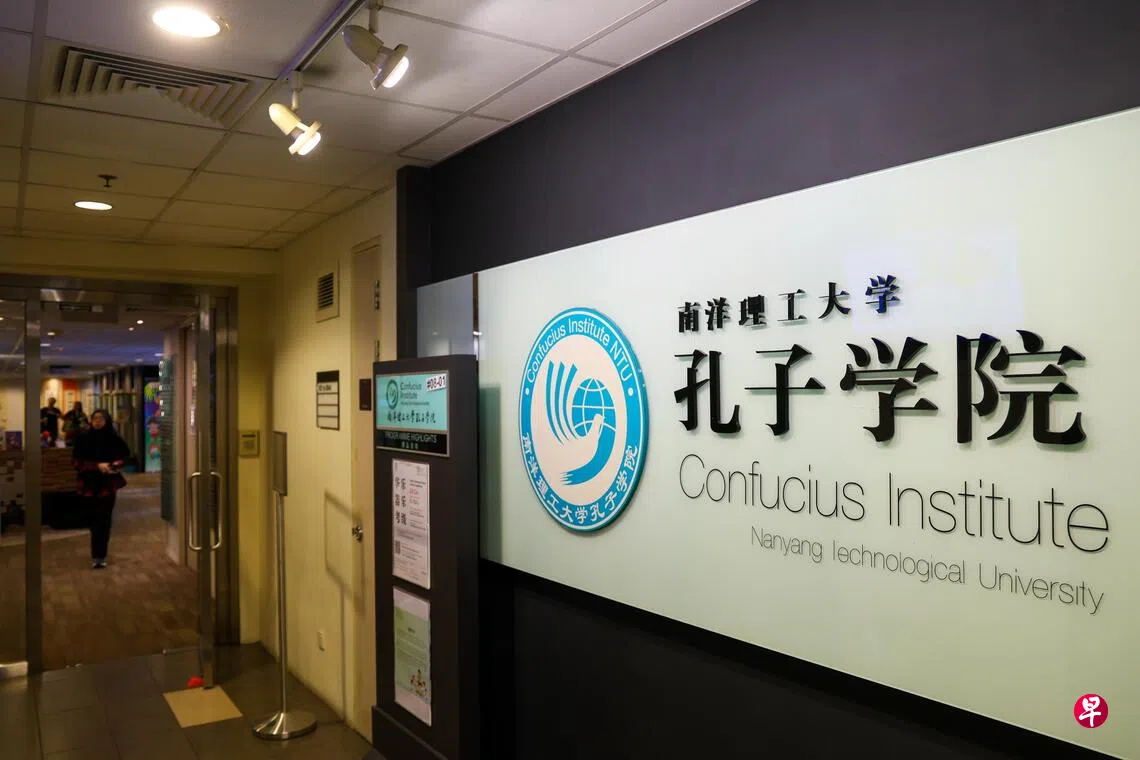
The 21-year-old Confucius Institute at Nanyang Technological University will stop offering all courses from February next year as it transforms from an educational and cultural institution into a research institute, with plans to conduct research in areas such as artificial intelligence and digital innovation.
Some of the institute’s adult courses that qualify for government fee subsidies are expected to resume under NTU’s Academy for Professional and Continuing Education (PACE). NTU will announce later which courses will resume and when.
The institute’s website states that no new classes will be offered for any of its courses. In an email to students in late August this year, it pledged that existing courses would not be affected and that all enrolled students would complete their courses as scheduled.
Established in July 2005, the Confucius Institute at NTU is an educational collaboration between the Singapore and Chinese governments.
In response to queries from Lianhe Zaobao, an NTU spokesperson said NTU’s previous agreement with its Chinese partner, Shandong University, on the Confucius Institute ended on 26 July this year. The universities have since signed a new agreement to establish a research-centric institute.
“The Confucius Institute at NTU and Shandong University have come a long way in delivering many educational programmes over the last 20 years. We now want Confucius Institute at the two universities to explore collaboration that better reflects and integrates the challenges the world faces today – in research, AI, digital innovation, and academic exchange.”
NTU said it was committed to completing all planned activities and programmes before the Confucius Institute transitions to a new chapter.
Dr Neo Peng Fu, who has been director of the Confucius Institute at NTU since 2014, will step down at the end of January next year. NTU did not respond to Zaobao’s question about his successor.
Confucius Institutes have recently returned to the centre of international controversy, after the Pentagon last month designated those based at US universities as national security threats. In response, China voiced opposition to what it described as US efforts to stigmatise the institutes.
Responding to suggestions linking the discontinuation of courses at NTU’s Confucius Institute to this international development, Dr Neo told Zaobao that such speculation was groundless.
He stressed that NTU not only had full autonomy over the courses offered by the institute, but also complete control over curriculum design, the hiring of teaching staff, teaching practices, the assessment and evaluation of course quality, and appointments to the institute’s management. This arrangement is relatively unusual among Confucius Institutes worldwide.
“The courses we have offered over the years have been closely aligned with the practical needs of Singapore society… Our Chinese partner, Shandong University, has shown full understanding and respect, and given us its wholehearted support and cooperation. The institute has also achieved the autonomy in running its programmes that we sought.”
Dr Neo revealed that course revenue covered an average of about 80% of the institute’s annual operating expenses.
NTU formally signed a cooperation agreement with China’s National Office for Teaching Chinese as a Foreign Language, known as Hanban, in 2005. The Chinese government body previously oversaw Confucius Institutes worldwide. After it was dissolved in 2020, management of the Confucius Institute brand passed to the Chinese International Education Foundation, established by Chinese universities, businesses and other organisations. Individual Confucius Institutes are run by their Chinese and overseas partner institutions.
Since its establishment, the Confucius Institute at NTU has offered 39 courses for young children, adults and retirees in four broad categories: teacher training, language, culture and academic studies. Most qualify for subsidies under national schemes such as SkillsFuture Credit.
Courses and training contribute to Chinese-language teaching in Singapore
Dr Neo said the institute’s priority was to help Singaporeans, especially the younger generation, gain a strong command of Chinese. Since 2006, more than 1,000 students have completed one of its flagship courses, the Specialist Diploma in Teaching Chinese as an International Language. They include Chinese-language teachers at language centres and international schools, contributing to the promotion of Chinese-language teaching in Singapore.
In recent years, the institute has also worked with the National Silver Academy and Active Ageing Centres to offer a range of courses promoting seniors’ physical and mental well-being. It has also published 155 preschool teaching resources and books on culture.
Dr Neo stressed that the decision to turn the Confucius Institute at NTU into a research institute followed amicable discussions with Shandong University. “We drew up a blueprint for a new partnership with Shandong University with the aim of optimising NTU’s allocation of resources, making full use of its research strengths, and integrating the university’s human and physical resources.”
Dr Neo said that, from a broader perspective, the institute was adapting to changing times. He hoped the public would continue to support it after its transformation. “The Confucius Institute at NTU has lived up to the expectations of the university and society, and successfully fulfilled its mission over the 20 years since its founding.”
Responding to queries, the NTU spokesperson said: “Like all university programmes, we review our commitments periodically against institutional priorities and resources.” Several of the institute’s courses are important to NTU, which hopes they can continue and is discussing the arrangements with Shandong University. Adult courses that NTU plans to transfer to PACE may include the Specialist Diploma in Teaching Chinese as an International Language and business Chinese courses.
In its response to Zaobao, NTU did not explain why these courses would no longer be offered by the Confucius Institute. It also did not respond to questions about how the institute’s research would benefit the public after its transformation, or about future funding arrangements between NTU and Shandong University for the institute.
