

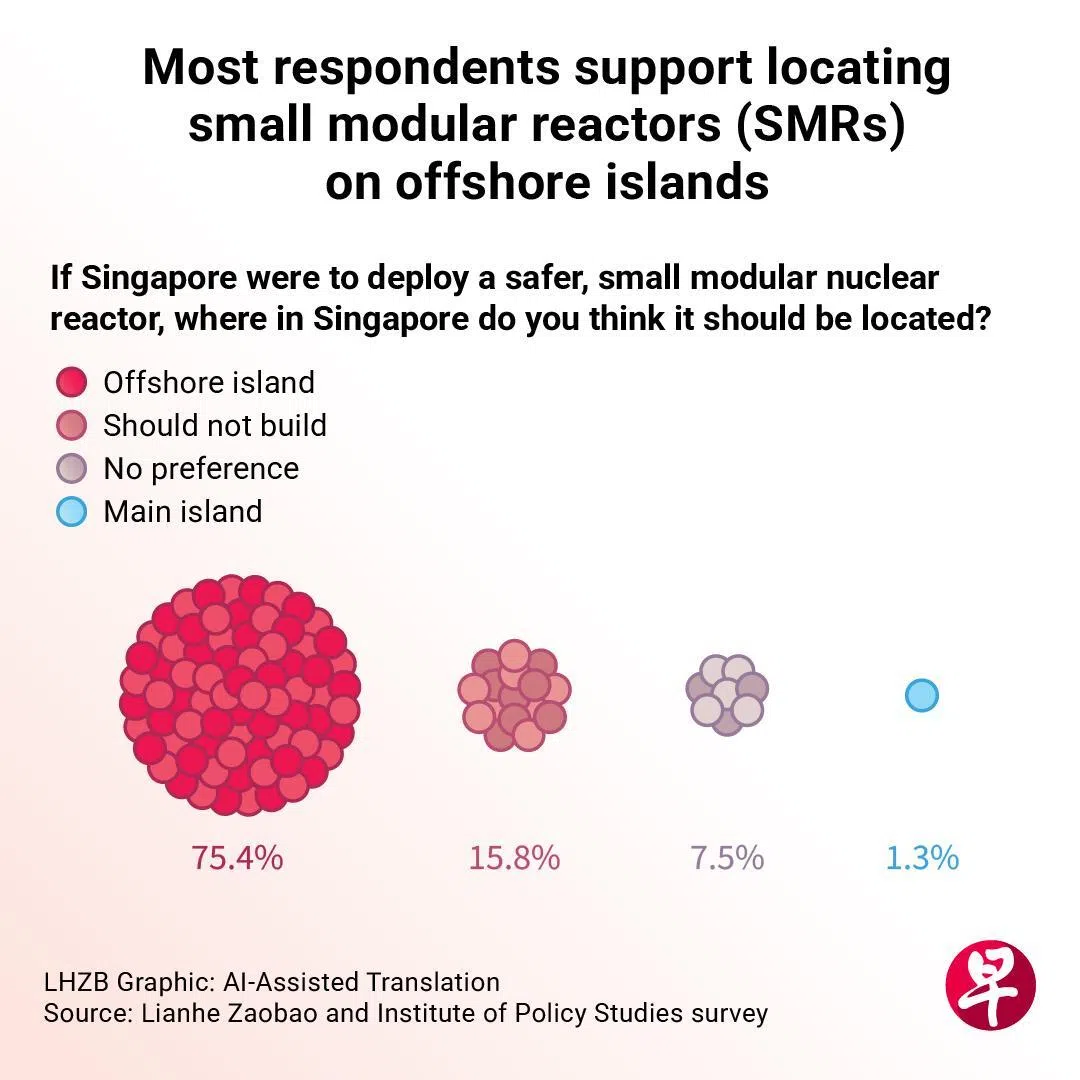
If Singapore were ultimately to decide to deploy safer small modular reactor technology for a nuclear power plant, 75.4% of respondents would support locating it on an offshore island, while just 1.3% would favour the main island.
A total of 1,145 local residents took part last month in an online survey conducted jointly by Lianhe Zaobao (LHZB) and the Institute of Policy Studies (IPS). On the location of a nuclear power plant, the vast majority favoured an offshore island, 7.5% had no preference and 15.8% opposed building one.
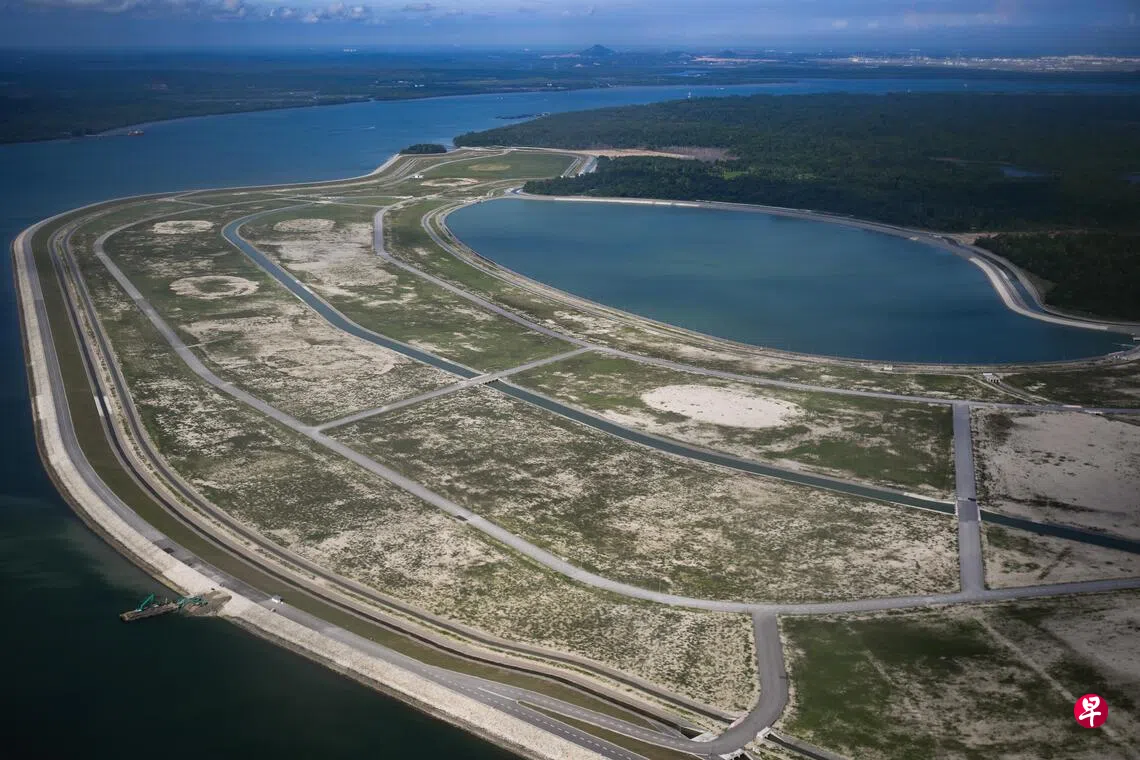
The government recently announced plans to combine several small islands south of Jurong Island to develop the Western Islands and create a cluster of energy infrastructure on Pulau Tekong, fuelling speculation that these moves were paving the way for the selection of a nuclear power plant site.
Lim Wei Ming, a 40-year-old fitness trainer who supports locating a nuclear power plant on an offshore island, said in an interview that as Singapore pushes ahead with electrification and more electric vehicles take to the roads, it needs to explore more energy options, including nuclear power, to meet growing electricity demand.
“Singapore has few natural disasters, so building a nuclear power plant here would be relatively safe,” said Lim. “But to reassure everyone, it would be best to build it on an offshore island. If something did go wrong, there would at least be a little more time to respond.”
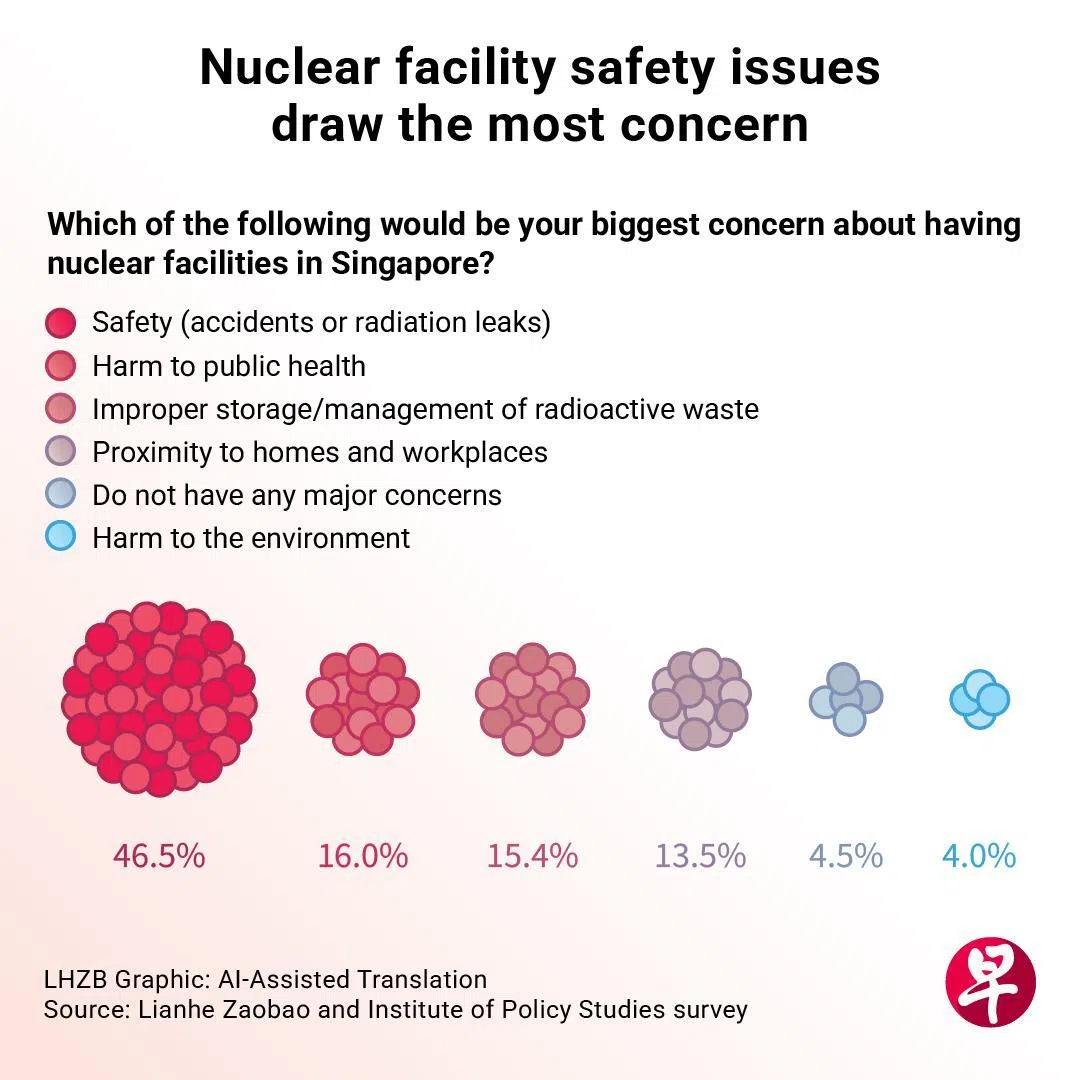
According to LHZB’s poll, residents’ biggest concern about having nuclear facilities in Singapore was safety, such as accidents or radiation leaks (46.5%). This was followed by harm to public health (16%), improper storage or management of radioactive waste (15.4%), proximity to homes and workplaces (13.5%), and harm to the environment (4.0%).
Assistant Professor Tan Soo Jie-Sheng, director of the Institute for Environment and Sustainability at the Lee Kuan Yew School of Public Policy, said in an interview, “In principle, nuclear facilities could be located on the main island, an offshore island or even a floating platform. However, the suitability of each option would depend on several considerations.”
According to Tan, safety would be the foremost consideration, followed by economic considerations. He explained that site selection would require an assessment of the opportunity cost of land, the nuclear power plant’s impact on surrounding economic activity and the potential economic consequences of an accident.
He believed the preference among most respondents for locating a nuclear power plant on an offshore island partly reflects the perception that physical separation from densely populated areas provides greater safety. “Even if an offshore island is relatively close to the mainland, having fewer people living immediately around a nuclear facility may offer psychological reassurance.”
However, Tan pointed out that perceived safety is not necessarily the same as actual safety. “The risks depend on reactor design, geographical conditions, emergency preparedness and how radioactive materials might spread in an accident. Offshore siting alone does not guarantee substantially lower risks.”
The lingering shadow of past nuclear accidents
The lessons of past nuclear accidents remain a major hurdle for many respondents when considering nuclear energy. In the poll, 73.3% said their views on nuclear energy had been influenced by Japan’s Fukushima nuclear accident in 2011 and the Chernobyl nuclear disaster in 1986.
In 2011, a tsunami triggered by an earthquake in Japan damaged the Fukushima nuclear power plant, forcing about 160,000 people to evacuate. Even today, 15 years later, some areas remain exclusion zones.
As for the Chernobyl nuclear plant, a report by the United Nations in 2005 estimated that the explosion at the Chernobyl nuclear power plant directly and indirectly caused nearly 4,000 deaths.
Nearly 12% say nothing could convince them nuclear energy is safe
Although statistics show that the death rate from nuclear power generation is far lower than that from energy sources such as coal, oil, hydropower and natural gas, the enormous destructive power of nuclear disasters often evokes deeper fears. Some 11.9% of respondents said nothing could convince them that nuclear energy is safe.
Dr Mathew Mathews, head of IPS Social Lab and principal research fellow at IPS, said that although the public widely recognises the benefits of nuclear energy, perceived risks may become more decisive when people consider actual deployment.
“The benefits of nuclear energy are generally long-term and at a more collective level such as energy security compared to how personal a nuclear accident can be to individuals and their families.”
