

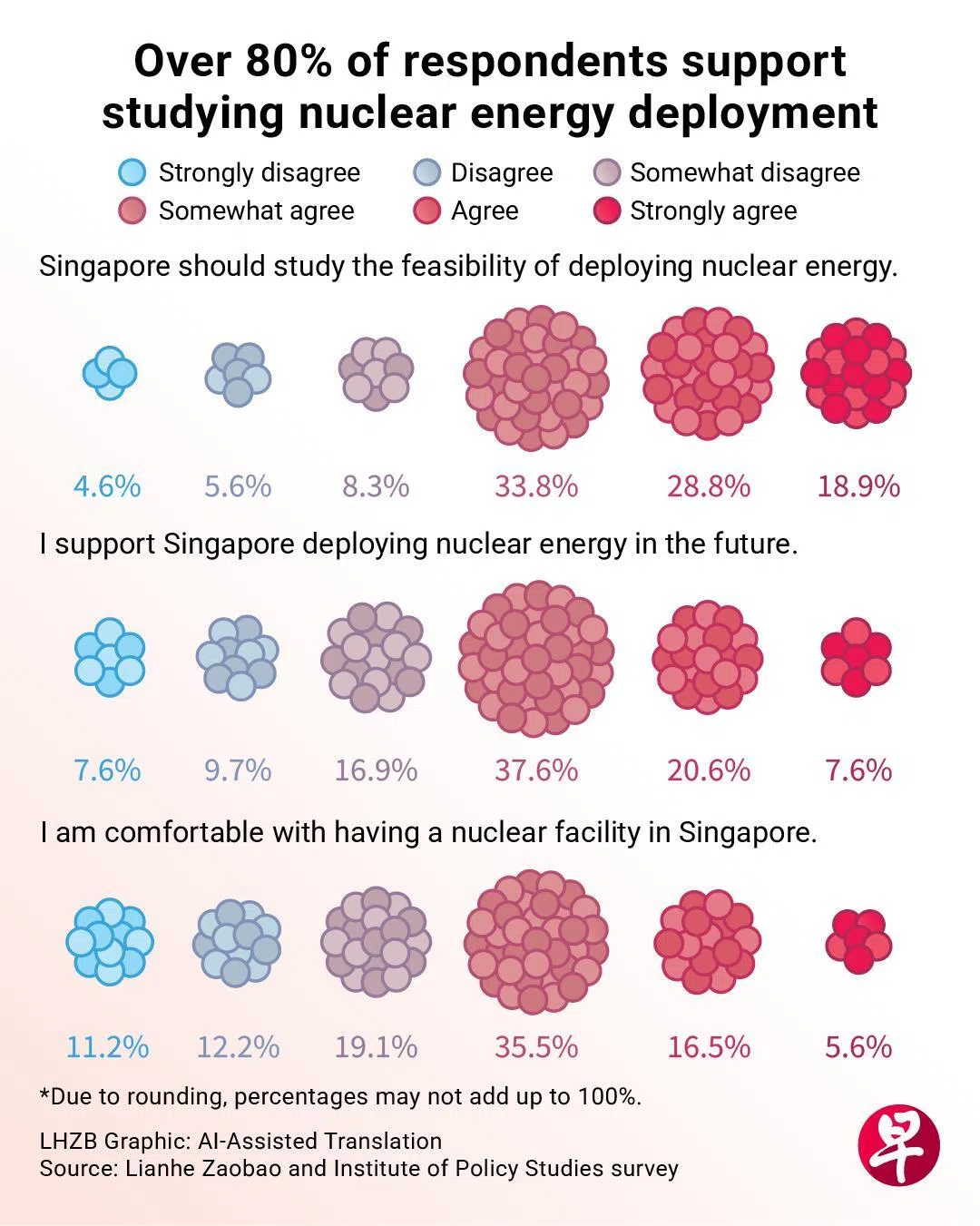
One of the alternative energy options Singapore is actively exploring is nuclear energy. A Lianhe Zaobao (LHZB) poll found that 81.5% of residents surveyed support the government studying the feasibility of deploying nuclear energy, but only 65.8% support building a nuclear power plant.
Fewer than a quarter of respondents have some knowledge of nuclear energy. Even among those who believe it would benefit Singapore, many also worry about the risks it poses.
The online survey, conducted jointly by LHZB and the Institute of Policy Studies (IPS), polled 1,145 local residents aged 21 and above on their attitudes towards and concerns about deploying nuclear energy.
Conducted from 9 to 21 October, the survey had a respondent profile representative of Singapore’s population in terms of age, education and background.
The government has stepped up efforts in recent years to develop nuclear expertise. It also plans to undergo an International Atomic Energy Agency assessment next year to review Singapore’s capabilities for deploying nuclear energy in the future.
According to the poll, more than 80% of respondents believe Singapore should study the feasibility of deploying nuclear energy.
However, the proportion fell to 65.8% when they were asked whether they support Singapore deploying nuclear energy in the future. Only 57.6% were comfortable with having a nuclear facility in Singapore.
Respondents have limited knowledge of small modular reactors
Respondents generally have limited knowledge of nuclear energy and small modular reactors (SMRs), which are a key focus of Singapore’s studies. Only 23.1% of respondents considered themselves moderately, very or extremely knowledgeable about nuclear energy. Just 10.9% reported similar levels of knowledge about SMRs.
SMRs are a new generation of nuclear reactors with modular designs, smaller footprints and advanced passive safety systems.
Unlike the active safety systems in older nuclear power plants, passive safety systems rely on natural physical processes such as gravity, convection and natural circulation to shut down and cool reactors automatically in an emergency. They do not require an external power supply to activate control valves or electric pumps to inject cooling water. This helps reduce the risk of accidents.
To strengthen energy resilience and advance decarbonisation, several Southeast Asian countries, including Indonesia, Vietnam, Thailand and the Philippines, have been actively exploring nuclear energy deployment in recent years.
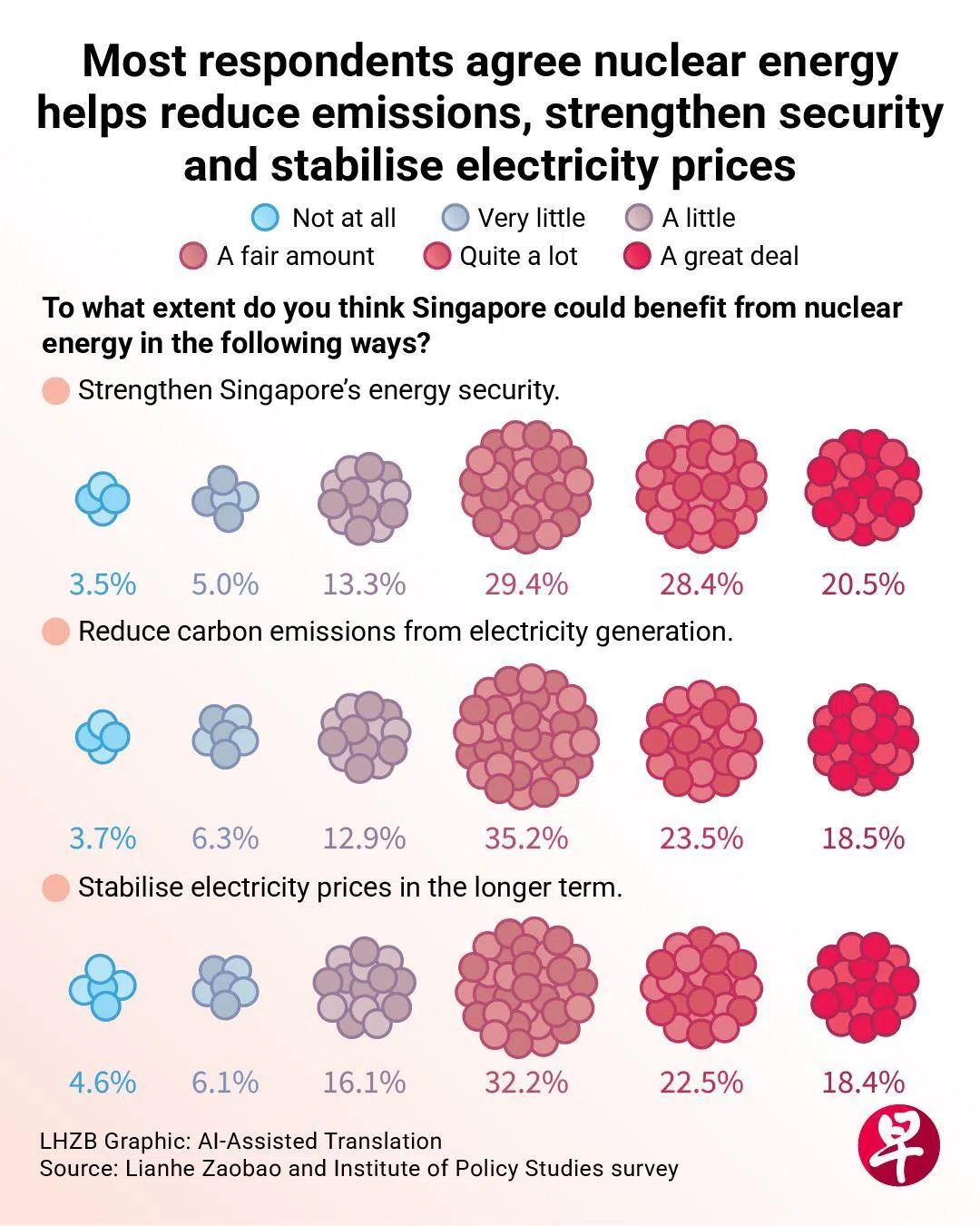
More than 70% of Singapore residents surveyed recognised the benefits of nuclear energy. Among them, 78.3% believed nuclear energy could help strengthen Singapore’s energy security, 77.2% believed it could reduce carbon emissions from electricity generation and 73.1% agreed it could help stabilise electricity prices in the longer term.
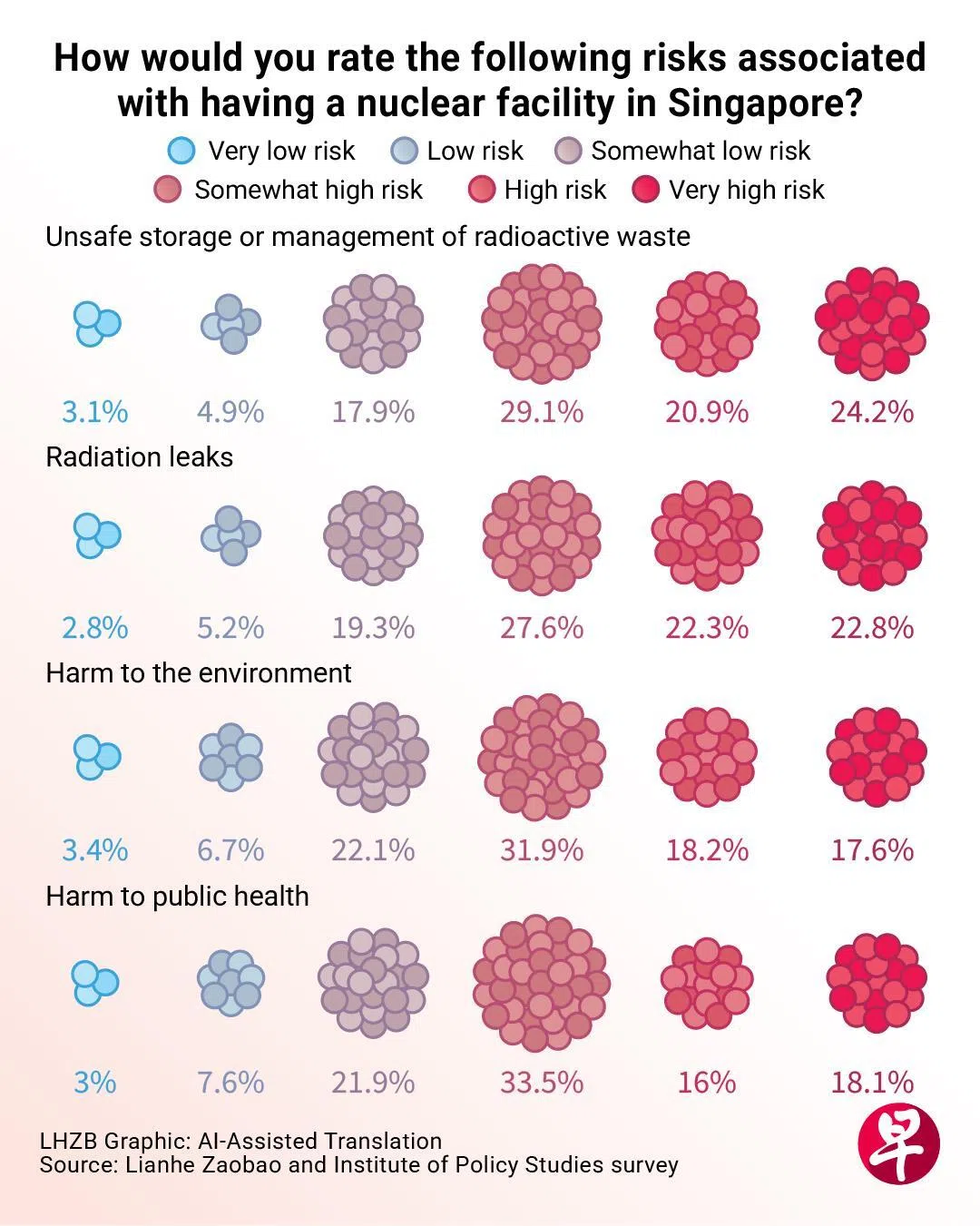
However, although nearly 70% (68.4%) of respondents were “fairly confident” or “very confident” in government agencies’ risk management, they remained concerned about the potential risks of nuclear facilities.
The greatest concern cited by respondents was unsafe storage or management of radioactive waste (74.2%), followed by radiation leaks (72.7%), environmental harm (67.7%) and detriment to public health (67.6%).
Offering an explanation for the gap in support between studying nuclear energy and actually deploying it, Dr Mathew Mathews, head of IPS Social Lab and principal research fellow at IPS, said supporting feasibility studies involves relatively little personal commitment on the public’s part. Building a nuclear facility, however, brings significantly more considerations into play.
“Actual deployment will require the public to be much more convinced and weigh considerations of safety and proximity,” Dr Mathews said. “The potential consequences also become much more immediate.”
He believed the poll results showed that “Singaporeans are cautious of this form of energy, but remain open-minded about it and don’t seem to be ruling it out as a viable option”.
Members of the public interviewed by LHZB on the street all wanted more information about nuclear energy to help them decide whether to support building a nuclear power plant in the future.
Graphic designer Rinyaphat Phothithaveekiat, 50, remains unsettled by the 2011 Fukushima nuclear accident in Japan. Safety concerns have left her undecided about whether to support the use of nuclear power.
Rinyaphat moved from Thailand to Singapore after marrying and has lived here for more than 20 years. She hopes to review the government’s research findings before making a decision, and called on the government to step up public education to help people understand nuclear technology.
Medical laboratory technologist Chik Heng Lan, 64, stressed that providing convincing data was key. If research ultimately showed that Singapore was suited to using nuclear energy, she would support building a nuclear power plant.
Citing Indonesia’s recent announcement that it would reduce natural gas exports to Singapore, Chik said, “If Singapore has a dispute with another country in the future and that country cuts off its natural gas supply, affecting our electricity supply, it is ultimately the people who suffer. So it would, of course, be best to be self-sufficient.”
