

Residents' understanding of nuclear energy and Singapore's nuclear energy strategy is limited, particularly among women. Far fewer women than men say they understand nuclear energy and small modular reactors, and are clear about Singapore's nuclear energy policy.
A nuclear energy poll of 1,145 people conducted jointly by Lianhe Zaobao (LHZB) and the Institute of Policy Studies found that about 36% of men felt they had some understanding of nuclear energy, compared with just 12.2% of women.
Although only a minority of men (16.6%) said they understood small modular reactors, this was still 10 percentage points higher than the 6.5% of women who said the same.
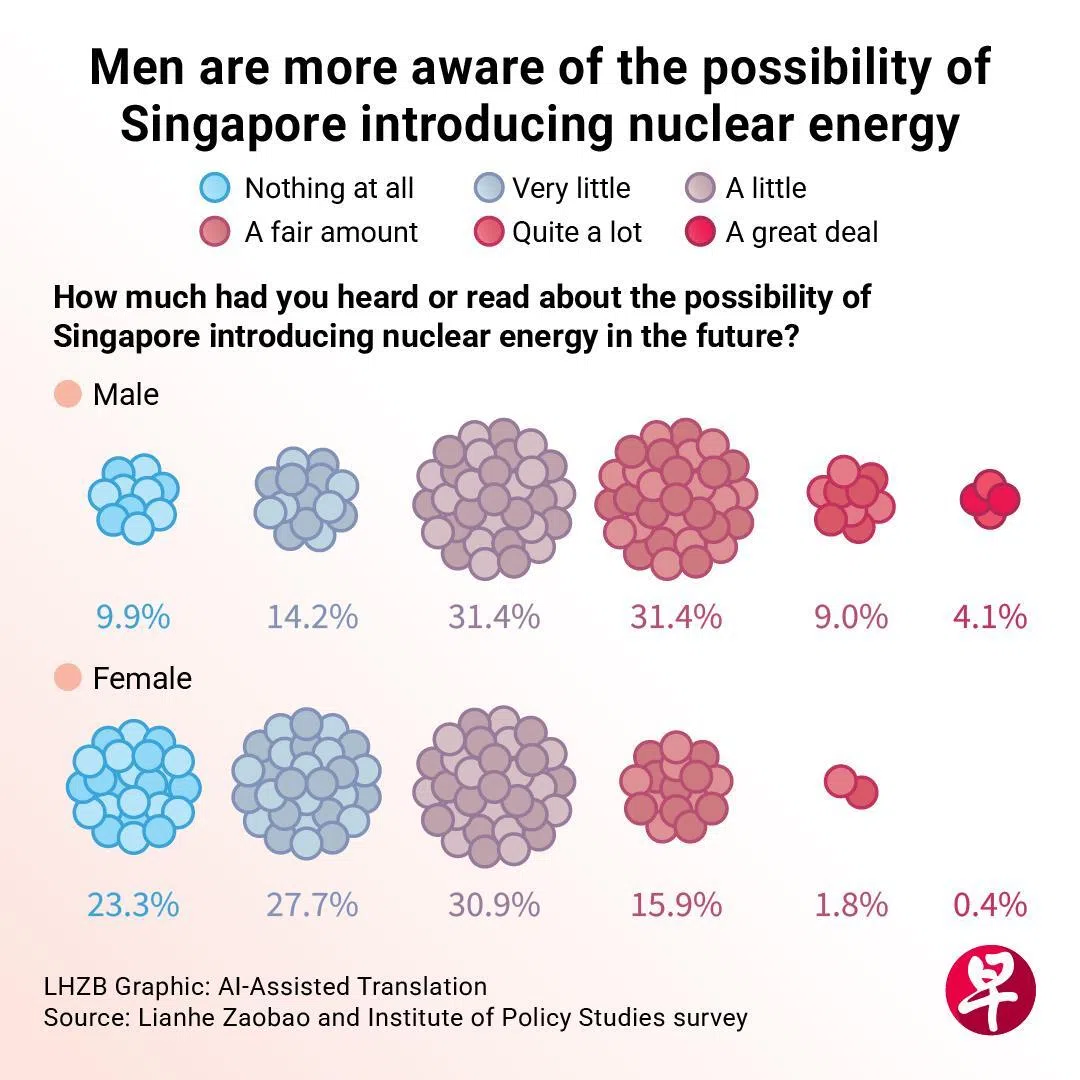
Men also paid more attention to Singapore's exploration of nuclear energy, with 44.5% of male respondents having heard or read a fair amount about it, compared with just 18.1% of women.
As many as 71% of male respondents correctly identified Singapore's current position on deploying nuclear energy: actively studying its feasibility but with no decision made yet. Only 49.9% of women were clear about this position, while as many as 35.8% were unsure. Just 13.3% of men were unsure.
Beyond gender differences, the poll also found that respondents aged over 36, as well as those with higher educational qualifications and socioeconomic status, were relatively clearer about Singapore's nuclear energy strategy, with fewer saying they were unsure.
More than 30% of middle-aged respondents aged 36 to 50, and those aged 51 and above, had heard or read a fair amount about Singapore's possible future deployment of nuclear energy. By comparison, just 26.4% of younger respondents aged 21 to 35 were aware of it.
The proportion of those who correctly identified Singapore's position on nuclear energy was 58.8% among middle-aged respondents and 66.3% among those over 51. Only 53.7% of younger respondents correctly identified the position, while as many as 30% were unsure.
The poll also found that respondents living in private housing and five-room HDB flats were more likely than those in one- to four-room HDB flats to correctly identify that Singapore was actively exploring nuclear energy. The proportions were 71.4% and 64.5% respectively.
Among university-educated respondents, 67.1% correctly identified Singapore's position on nuclear energy, while only 18.2% were unsure. Among those without a university education, 52.6% correctly identified the position and 32% were unsure.
