

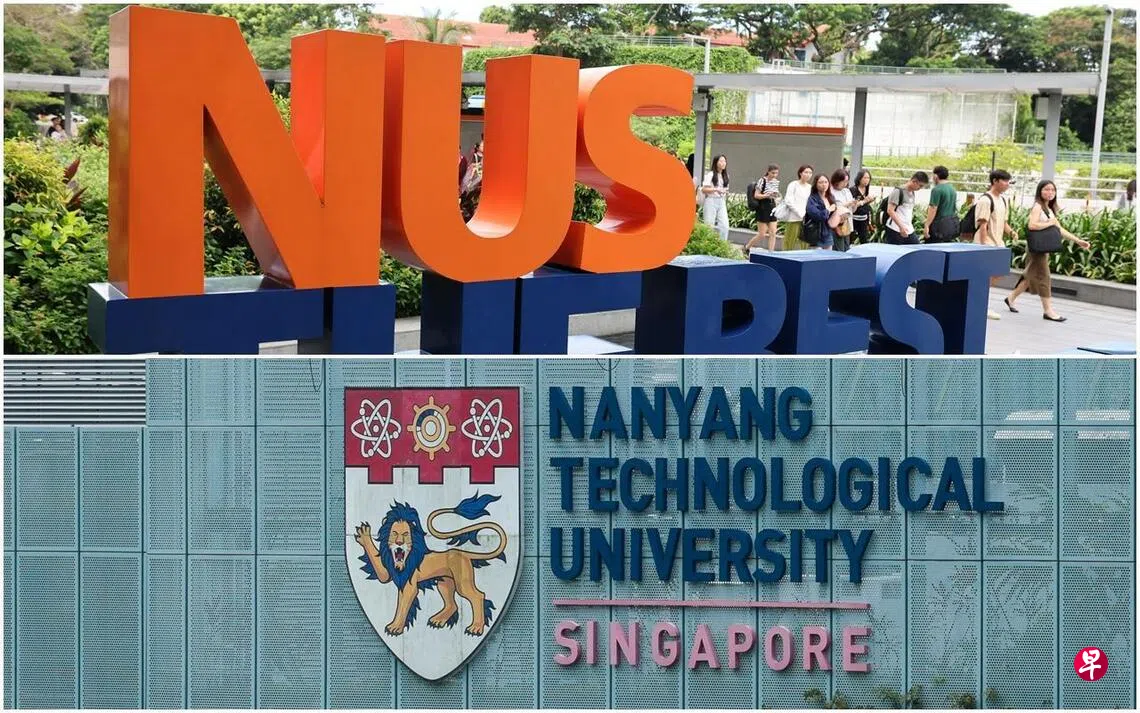
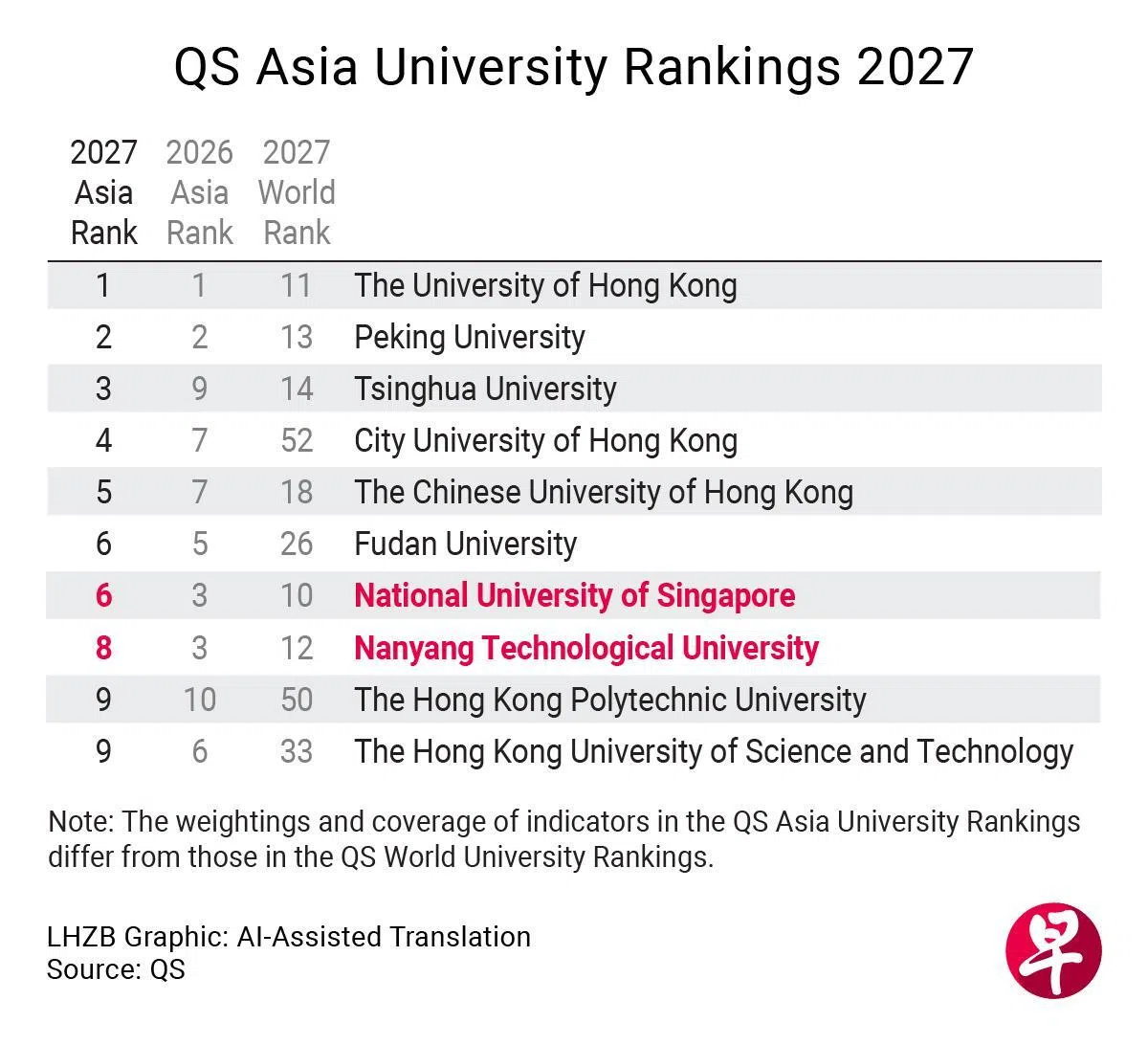
The National University of Singapore (NUS) and Nanyang Technological University (NTU) have both slipped in the latest Quacquarelli Symonds (QS) Asia University Rankings, falling from joint third last year to sixth and eighth respectively.
This is the first time since the 2011 rankings that no Singaporean university has made Asia’s top five.
International education consultancy QS released its 2027 Asia University Rankings on Tuesday (3 November). This edition covers 1,722 universities across 26 higher education systems, including 195 institutions making their debut.
While NUS and NTU slipped, the other three Singaporean universities on the list all rose in the rankings.
The Singapore University of Technology and Design (SUTD) entered Asia’s top 100 for the first time, climbing 81 places to 88th. Singapore Management University (SMU) rose 32 places to 90th, while the Singapore University of Social Sciences (SUSS) moved up from 627th to 562nd.
The University of Hong Kong retained the top spot, followed by Peking University in second place. Tsinghua University climbed from ninth to third, giving mainland China two universities in Asia’s top three for the first time since 2023.
City University of Hong Kong and the Chinese University of Hong Kong ranked fourth and fifth respectively. NUS tied with Fudan University in sixth place, while NTU ranked eighth.
QS senior vice-president Ben Sowter said: “The rapid rise of universities such as SUTD and SMU also shows that the strengths of Singapore’s higher education sector are broadening beyond its two flagship universities, NUS and NTU.
“As competition intensifies across Asia, Singapore’s ability to continue attracting global talent, fostering international collaboration and translating research excellence into reputation remains a key competitive advantage.”
Different indicators from world university rankings
The QS Asia University Rankings assess universities using 11 indicators tailored to the region, including academic reputation, employer reputation, faculty-to-student ratio, citations per paper and papers per faculty member.
The weighting and scope of these indicators differ from those used in the QS World University Rankings, resulting in differences in the rankings.
The report noted that all five Singaporean universities improved their rankings for academic reputation and employer reputation. Research impact also remained a strength, with three universities among Asia’s top 20 for citations per paper.
However, most Singaporean universities fell in the rankings for citations per paper and papers per faculty member. All five also slipped on the international research network indicator, with NUS the highest-ranked in eighth place.
The proportion of academic staff with PhDs was another relatively weak area for Singaporean universities. None of the local universities made the top 100 on this indicator, while NUS and NTU fell sharply to 247th and 293rd respectively.
Internationalisation remained a major strength for Singaporean universities. Four local universities ranked among the top 30 for the proportion of international faculty, including three in the top 20. Four also made the top 50 for the proportion of international students.
Sowter said: “The rankings show that, despite increasingly intense regional competition, universities that combine research excellence, international engagement and academic reputation can further consolidate their positions as Asia’s university landscape becomes more diverse and expands rapidly.”
Responding to queries from Lianhe Zaobao (LHZB), an NUS spokesperson said the university remained firmly at the top in Singapore and Southeast Asia in the latest rankings.
“Our strong performance across multiple indicators reflects our enduring strengths in academic excellence, employer recognition, international engagement and research impact. We are proud of our sustained excellence in an increasingly competitive higher education landscape.”
Responding to queries from LHZB, an NTU spokesperson said the university remained among Asia’s leading institutions, ranking 12th globally and third in Asia in the 2027 QS World University Rankings.
As different rankings use different assessment methodologies, positions may vary from year to year.
