

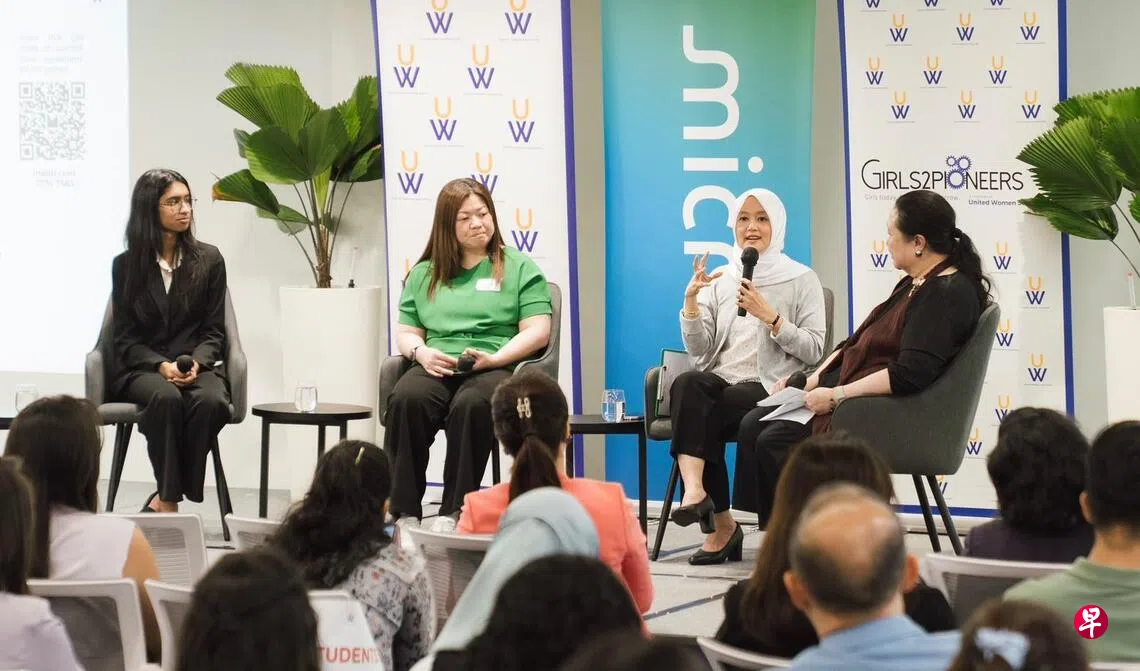
A new survey shows that more than 80% of young women use artificial intelligence (AI) at least weekly, yet only 6% feel “very confident” that they will thrive in an AI-driven environment.
The findings were revealed in Bridging the Gender Confidence Gap in AI, a report on gender differences in confidence in using AI, released by non-profit organisation United Women Singapore on Monday (2 November).
Commissioned by United Women Singapore, the survey was conducted by market research firm Milieu between May and June this year, with support from the Micron Foundation.
Cindy Pang, chief executive officer of Milieu Southeast Asia, told Lianhe Zaobao (LHZB) that the survey covered 800 Singapore citizens and permanent residents aged 16 to 29, comprising 640 women and 160 men. Nearly 60% of all respondents were students. Women outnumbered men because the survey focused on women, with men serving primarily as a comparison group.
Pang said respondents were selected from eligible members of Milieu’s pool of more than 56,000 regular survey participants in Singapore. Conducted through Milieu’s mobile app, the survey comprised 38 multiple-choice questions and one open-ended question.
The survey found that 84% of young women use AI at least weekly and that 81% regularly use AI chat tools. However, only 6% feel “very confident” that they will thrive in an AI-driven environment, compared with 16% of men.
The survey also found that while three in four women (75%) have a core foundational understanding of AI, only 5% rate their AI proficiency as “advanced”, compared with 12% of men. In terms of training, only 18% of women have participated in AI learning programmes, compared with 32% of men.
Pang said she was not surprised by the findings, as she rarely saw women around her attending AI training courses. However, the survey highlighted a link between women’s lower participation in training and their lack of confidence in using AI.
She said: “Women have some understanding of AI and are willing to use it, but because they have not received training, they feel they lack expertise and therefore lack confidence.”
Tan Ching Ne, chairperson of United Women Singapore, said: “I hope businesses will open their doors to working with us to help more women build confidence in using AI.”
Tan also noted that industries use AI in different ways. Therefore, more targeted training opportunities for women in different professions and fields could be provided if different industries each introduced AI training programmes for women are introduced.
Speaking at the launch that day, Rahayu Mahzam, Minister of State for Digital Development and Information and for Health, said: “UWS's findings are a timely reminder that as AI becomes a bigger part of our lives, we must pay attention not only to whether people have access to these technologies. We must also make sure that people feel able and confident to participate in the opportunities it creates.”
