

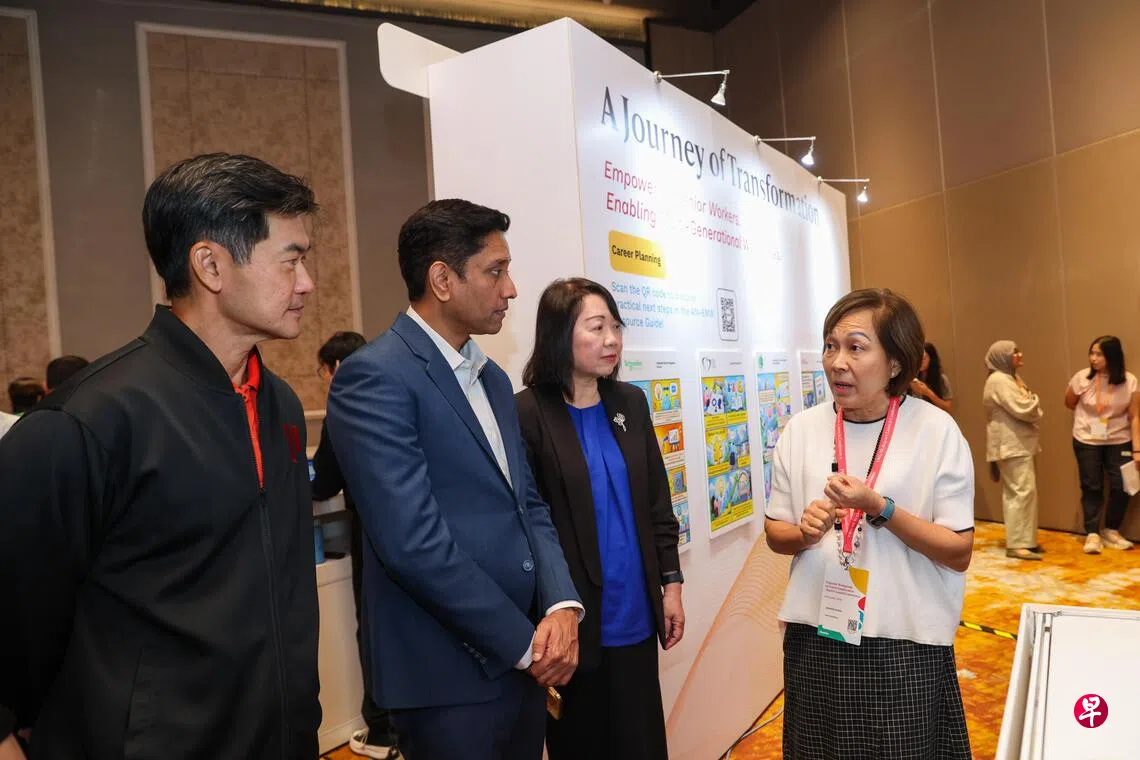
To better support older workers in their careers and meet their work needs, the Tsao Foundation launched a pilot late last year to train managers and staff to communicate effectively and explore career development options together. By the end of the pilot, the proportion of employees putting forward career development plans had surged from about 30% last year to 80%.
The Tsao Foundation’s Human Resources Director Jeannie Wong said in an interview that employees have different career aspirations. Older workers may want to move into more flexible roles for personal or family reasons, but often hold back for fear that making such requests could invite criticism or even lead to them being targeted by their employers. The organisation hopes to change employees’ mindsets so that it can make better use of older workers’ experience and expertise.
Wong said the seven-month pilot trained about 30 managers to communicate more effectively with employees aged 40 and above. The organisation also designed an artificial intelligence-powered digital tool that allows employees to enter their career goals and current roles. It then compares the skill sets required for each to identify possible pathways for upskilling.
The Tsao Foundation’s initiative, along with pilots by 29 other organisations, received funding last year from the Alliance for Action on Empowering Multi-Stage Careers for Mature Workers (AfA-EMW).
Tripartite workgroup releases report with six recommendations for a multigenerational workplace
AfA-EMW comes under the Tripartite Workgroup on Senior Employment, which was formally established in July last year. It aims to explore innovative solutions to support senior employment and has benefited more than 1,600 older workers to date. Drawing on the alliance’s achievements over the past year or so, the workgroup developed six recommendations to create more age-friendly, multigenerational workplaces. It released its report on Monday (26 October).
One recommendation is to support employers in offering more flexible workload arrangements through the Flexi-Load Programme, reducing early departures from the workforce. Another organisation, Kampong Kapor Community Services, welcomed the move. Its Corporate Services Director Martin Ho said, “Ultimately, it is about creating options to better meet the needs of our talents, rather than getting our talents to meet roles created traditionally.”
Ho acknowledged that manpower shortages were widespread across the social service sector. Hiring experienced full-time staff generally takes six to nine months, while new entrants need three to nine months of training. Older workers with relevant experience are therefore particularly valuable, but factors such as workload, the nature of the work or working hours often prevent them from staying on.
Citing social workers and counsellors as examples, Ho said that part-time and full-time staff traditionally have the same job scope. Both handle intake work, casework, and programme planning and delivery, with part-timers simply working fewer hours. Older workers, however, are often unable to remain “on call” to take on cases for various reasons, leaving them with little choice but to give up the job.
For this reason, the organisation piloted flexible workload arrangements, adjusting duties to meet employees’ needs. For example, some staff would only plan and deliver programmes, without having to take on individual cases. Ho said the organisation received more than 20 applications within just 20 days of posting an online recruitment advertisement for these roles.
According to the Ministry of Manpower’s Comprehensive Labour Force Survey conducted last year, labour force participation in Singapore falls sharply from the late 50s onwards. The main reasons for being outside the labour force were housework or caregiving responsibilities (52.6%) and old age, disability or poor health (16%).
