

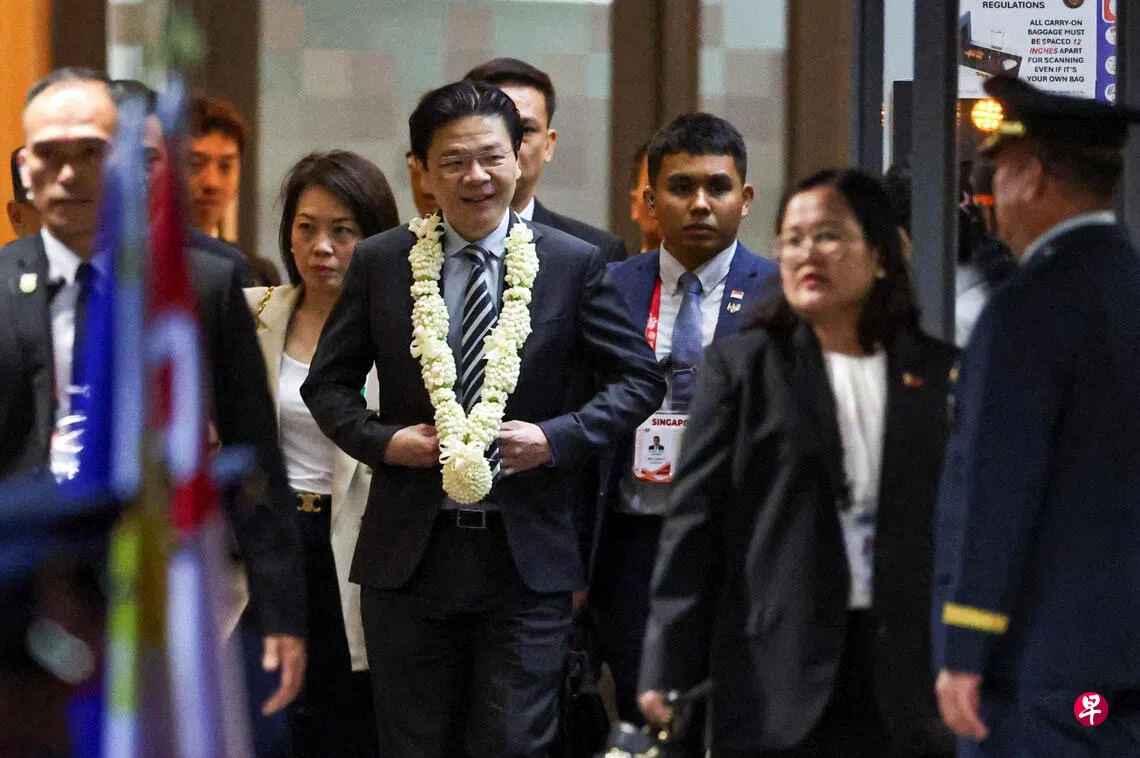
Amid geopolitical turmoil and challenges to international trade rules, ASEAN leaders, including Prime Minister Lawrence Wong, will gather in Manila to discuss strengthening energy security, deepening regional economic cooperation and working with external partners to tackle shared challenges.
PM Wong will make a three-day visit to Manila from Sunday (15 November) to attend the 49th ASEAN Summit and related meetings. This will also be the final summit under the Philippines’ ASEAN chairmanship this year.
The Prime Minister’s Office said in a statement on Saturday (14 November) that ASEAN leaders will reaffirm their commitment to ASEAN’s community building efforts and discuss ways to maintain an open and inclusive regional architecture. They will discuss opportunities in the digital and green economies, including strengthening the region’s energy security, accelerating its green energy transition and improving its ability to withstand external shocks.
The leaders will also discuss strengthening cooperation with external partners to promote regional peace, stability and prosperity.
ASEAN holds two summits a year, with the year-end summit also including a series of leaders’ meetings with external partners. Prime Minister Wong will attend ASEAN’s summits with key partners including Australia, China, India, Japan, the Republic of Korea, the US and the UN.
At these meetings, PM Wong’s interventions will focus on digital integration and energy security, exploring practical ways for ASEAN and its external partners to deepen collaboration.
Accompanying PM Wong on the visit will be his wife Loo Tze Lui and Minister for Foreign Affairs Dr Vivian Balakrishnan. Deputy Prime Minister and Minister for Energy, Trade and Industry (Trade) Gan Kim Yong will be acting Prime Minister during PM Wong’s absence.
Singapore to take over chairmanship next Tuesday; PM Wong to unveil theme
Singapore will take over the rotating ASEAN chairmanship from the Philippines at the summit’s closing ceremony next Tuesday (17 November). Prime Minister Wong will unveil Singapore’s chairmanship theme and speak about its chairmanship plans for the first time. Singapore will assume the rotating chairmanship on 1 January next year, which marks ASEAN’s 60th anniversary.
Over the past year, ASEAN has made progress on economic integration under the Philippines’ leadership, including advancing the ASEAN Digital Economy Framework Agreement and implementing the upgraded ASEAN Trade in Goods Agreement.
The Digital Economy Framework Agreement was formally signed on Saturday after nearly three years of negotiations. It aims to establish common rules in areas such as cross-border data flows, electronic transactions and digital payments, making it easier for businesses to expand across regional markets and for consumers to shop and pay across borders.
The upgraded Trade in Goods Agreement, signed last year, aims to ease the movement of goods between member states through measures such as reducing trade barriers and simplifying customs procedures. It was originally scheduled to take effect on 1 June next year, but ASEAN member states agreed in September this year to work towards implementing it by the end of this year.
In an interview with Lianhe Zaobao, Joanne Lin Weiling, coordinator of the ASEAN Studies Centre at the ISEAS – Yusof Ishak Institute, pointed out that economic cooperation generally offers tangible benefits to ASEAN members, making it easier to find common ground. By contrast, political and security issues involving sovereignty, territorial claims and major-power competition often expose differences in national positions, making progress harder.
She said: “ASEAN’s consensus-based decision-making further constrains progress when national interests diverge. This highlights the limits of ASEAN’s collective diplomacy, particularly on sensitive issues where developments are also shaped by actors beyond ASEAN’s control.”
Limited progress on South China Sea and Myanmar
During its chairmanship, the Philippines has actively pushed negotiations on the South China Sea Code of Conduct, seeking an agreement with China by year-end, but talks are only about 70% complete. Meanwhile, the situation in Myanmar remains deadlocked, with no clear breakthrough in ASEAN’s peace efforts.
Academics interviewed said these two unresolved issues highlight ASEAN’s difficulty in forging consensus when its members’ interests and positions diverge.
Philippine Foreign Secretary Theresa Lazaro said at a press conference on Saturday that negotiations on the South China Sea Code of Conduct were only 77% complete, urging all parties: “Let's give it more time.”
The Philippine Department of Foreign Affairs had previously said that key questions, including the code’s geographical scope and whether it will be legally binding, remain unresolved, and negotiations will extend into next year.
Chinese and Philippine vessels have been involved in repeated stand-offs and clashes in disputed waters in the South China Sea in recent years. Besides China and the Philippines, ASEAN members including Malaysia, Vietnam, Brunei and Indonesia also claim sovereignty over parts of these waters.
Lin said the frequency of negotiations should not be confused with substantive progress. ASEAN members themselves have different interests and positions on the South China Sea, while continuing incidents at sea have underscored the gap between diplomatic negotiations and developments on the ground.
She said that even if negotiations are not concluded at this summit, narrowing differences and reaching greater clarity on the code’s geographical scope and substantive provisions would constitute progress.
Dylan Loh, Associate Professor in the Public Policy and Global Affairs programme at Nanyang Technological University, pointed out that ongoing maritime stand-offs between China and the Philippines, as well as Beijing’s longstanding preference for non-binding language in the code, have made a breakthrough in negotiations difficult.
He said the parties should seek agreement on concrete risk-reduction measures, such as expanded hotlines and protocols for unplanned encounters between military and coast guard vessels at sea.
Myanmar seeks return of political representatives to ASEAN meetings
Myanmar is also testing ASEAN’s unity.
After Myanmar’s military staged a coup in 2021, ASEAN restricted the country’s political representation at summits, making substantive progress on implementing the Five-Point Consensus a condition for restoring it.
Progress on implementing the Five-Point Consensus has been limited over the past five years. Myanmar military leader Min Aung Hlaing became Myanmar’s president in April this year following an election. He has since visited five ASEAN member states, seeking greater diplomatic room for manoeuvre and the restoration of Myanmar’s political representation at summits.
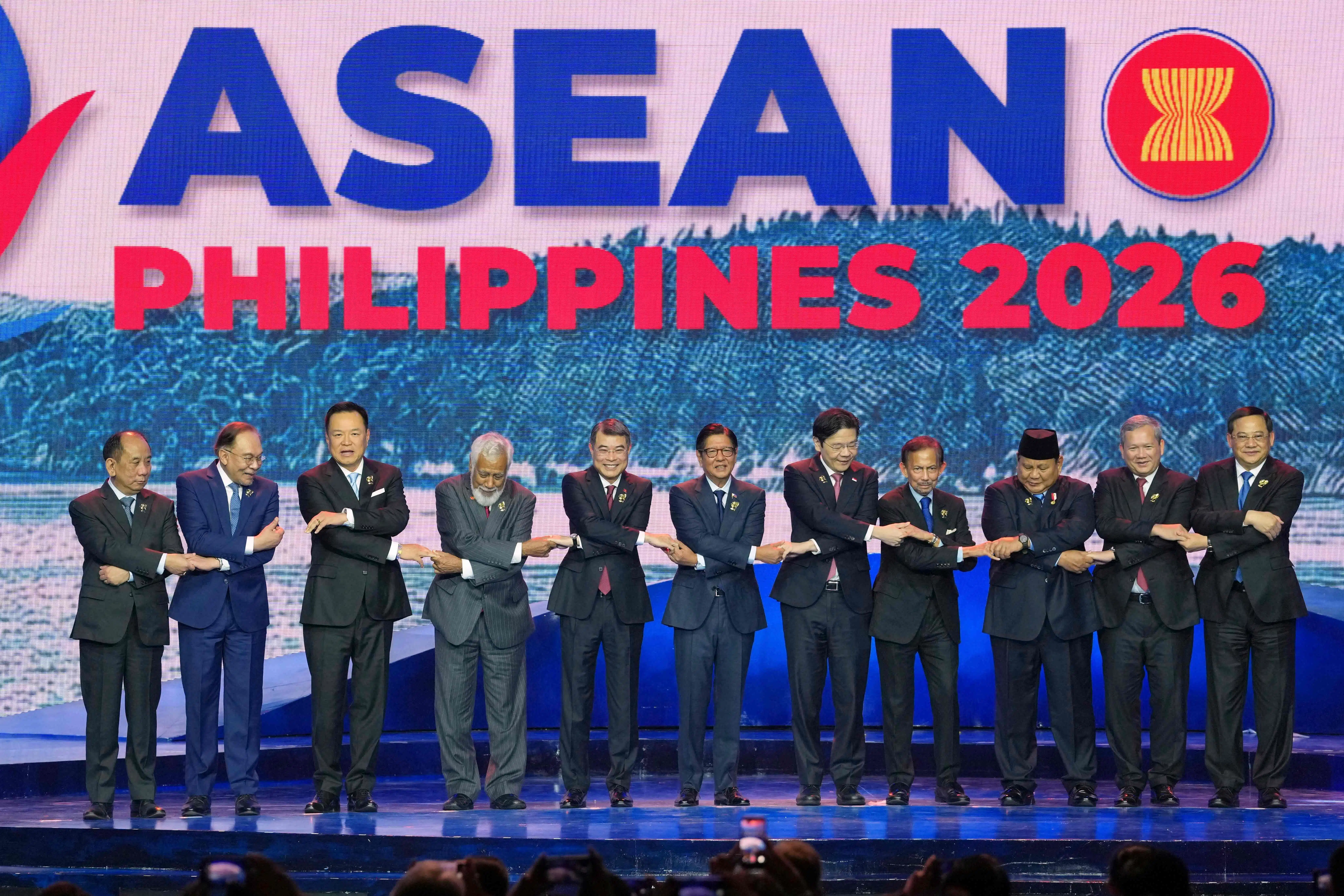
All 11 member states will be represented at this summit. Ten will send their leaders, while Myanmar will be represented by the director-general of its Foreign Affairs Ministry’s ASEAN Affairs Department.
Lin said ASEAN’s leverage over Myanmar remains limited, but its members’ collective position on restricting political-level representation at ASEAN meetings continues to be an important diplomatic tool.
She stressed that individual member states may engage Myanmar’s authorities, but such engagements should not undermine ASEAN’s collective position. “Ultimately, any decision to restore political-level representation should be based on concrete and verifiable improvements on the ground, rather than bilateral diplomatic engagement or the holding of elections alone.”
The Philippine Department of Foreign Affairs has confirmed that ASEAN leaders will review the implementation of the Five-Point Consensus at this summit.
