

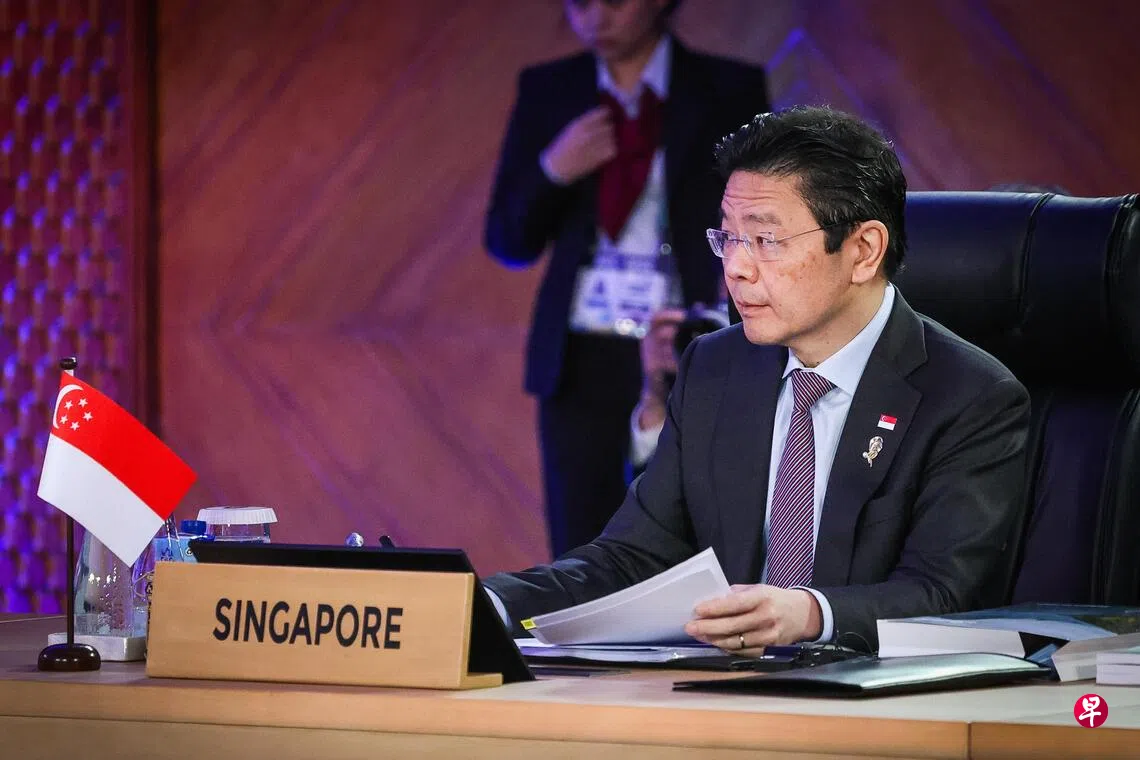
After concluding the ASEAN Summit and related meetings in Manila, the Philippines, Prime Minister Lawrence Wong will travel to China on Wednesday for a four-day visit. His first stop will be Shenzhen, where he will attend the Asia-Pacific Economic Cooperation (APEC) summit and meet Chinese President Xi Jinping. He will then head to Beijing to meet Chinese Premier Li Qiang.
The Prime Minister's Office said in a statement on Tuesday (17 November) that PM Wong will begin a two-day working visit to Shenzhen. On Wednesday (18 November) evening, he will attend a welcome dinner for leaders of APEC economies, followed the next day by the 33rd APEC Economic Leaders’ Meeting (AELM).
PM Wong will also have bilateral meetings with his counterparts on the sidelines of the AELM.
After the AELM, PM Wong will have a bilateral meeting with Chinese President Xi Jinping in Shenzhen before departing for Beijing, where he will have a bilateral meeting and lunch with Premier Li Qiang. PM Wong will also meet Member of the Political Bureau of the Chinese Communist Party (CCP) and Secretary of the CCP Beijing Municipal Committee, Yin Li.
This will be PM Wong's third visit to China since taking office in 2024. He made his first visit to China as prime minister in June last year, travelling to Beijing and Tianjin and meeting Xi, Li and Zhao Leji, chairman of the Standing Committee of the National People's Congress. In March this year, Wong visited China again to attend the Boao Forum for Asia Annual Conference in Hainan before travelling to Hong Kong.
APEC to focus on openness, innovation and cooperation amid geoeconomic fragmentation and trade tensions
Against a backdrop of growing global economic fragmentation, persistent trade tensions and new security challenges arising from technological change, China is hosting this year's APEC meetings under the theme “Building an Asia-Pacific Community to Prosper Together”, with openness, innovation and cooperation as its three priorities.
Leaders of the economies will discuss how to deepen regional economic integration, strengthen connectivity and advance innovation and digital transformation, fostering sustainable and inclusive growth in the Asia-Pacific through closer economic cooperation.
Singapore is focusing on two APEC initiatives this year: to strengthen regional supply chain connectivity and to reduce reliance on paper documents in cross-border trade.
The first is the Supply Chain Connectivity Framework Action Plan (SCFAP III). Singapore is working with APEC’s Policy Support Unit to lead a review of the implementation of the plan's third phase. This will help shape APEC's future work on more resilient, efficient and digitally enabled supply chains.
Preliminary findings show strong progress on trade digitalisation within the APEC region, though economies' electronic systems and standards still need to be better aligned to help businesses conduct cross-border trade more smoothly.
The second initiative is to establish the APEC Centre of Excellence for Paperless Trade (ACCEPT). PM Wong announced the initiative at last year's APEC summit in South Korea. The centre will be housed under the Singapore Business Federation and will encourage economies to reduce their use of paper trade documents and adopt electronic processes for cross-border trade, lowering business costs and improving efficiency.
Singapore is working with other APEC economies and industry to shape ACCEPT’s forward workplan, with activities expected to commence in 2027.
Accompanying PM Wong on his China visit will be his wife Loo Tze Lui; Minister for Foreign Affairs Dr Vivian Balakrishnan; Second Minister for Foreign Affairs and Home Affairs Sim Ann; Minister of State for Manpower and Energy, Trade and Industry Foo Cexiang; West Coast-Jurong West Group Representation Constituency MP Dr Hamid Razak; and officials from the Prime Minister's Office, the Ministry of Foreign Affairs, and the Ministry of Energy, Trade and Industry.
Deputy Prime Minister and Minister for Energy, Trade and Industry (Trade) Gan Kim Yong will be acting prime minister during PM Wong's absence.
