

China’s economic and technological strength continues to grow, and it has overtaken Singapore in some areas. But Prime Minister Lawrence Wong believes the two countries can still find new areas of cooperation that draw on their complementary strengths, including deeper cooperation in the digital economy and artificial intelligence, and expanding the scope of their government-to-government projects in Tianjin and Chongqing.
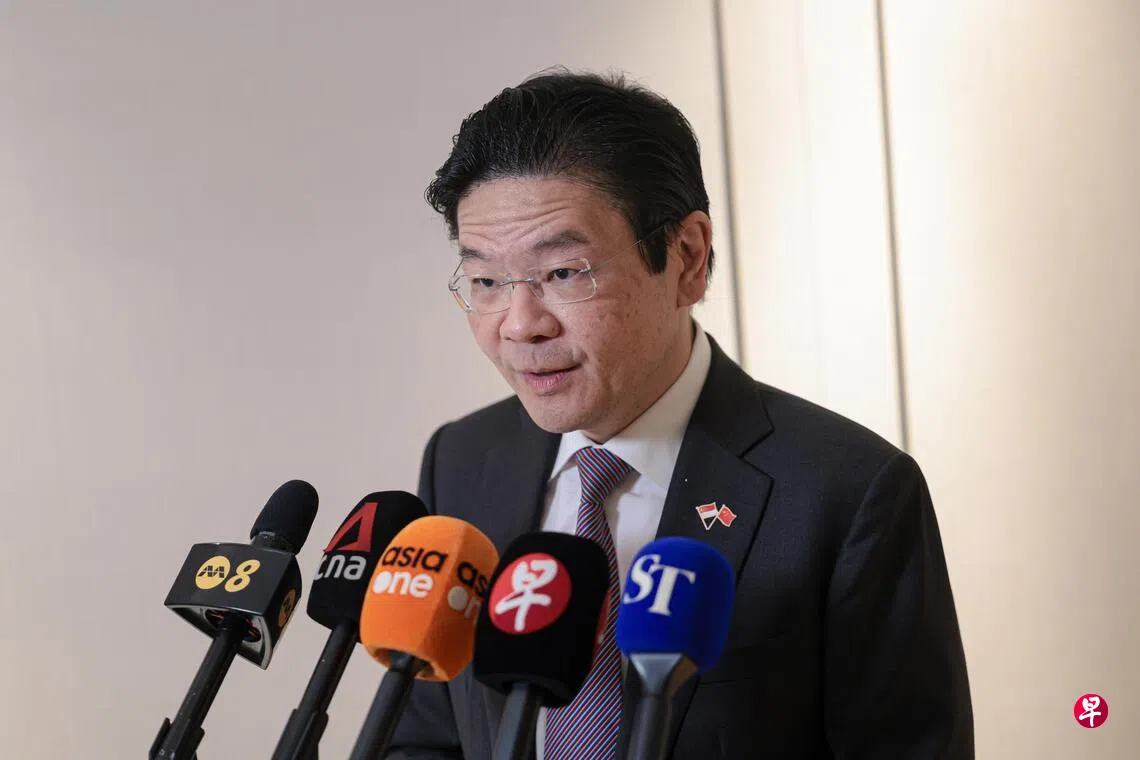
Wong concluded a four-day working visit to China on Saturday (21 November). Speaking to the accompanying Singapore media before wrapping up his visit, he said Singapore had consistently found ways to complement China’s strengths over the past few decades, in line with its development priorities and needs at different stages.
He said: “today's China is very different. It is rising and advancing rapidly, and in some areas, it is even well ahead of Singapore. It is a much bigger economy, with considerable size and scale. Yet, despite the differences, I think we can still find ways to be helpful, useful and complementary to one another.”
Wong said the digital economy and artificial intelligence (AI) were among the areas of cooperation he discussed with Chinese leaders during the visit. The two countries are also working to upgrade the China-Singapore Free Trade Agreement to further facilitate cooperation in these areas.
“The upgrade will have a digital economy component that will facilitate cross-border data flows. Both our countries are very much focused on AI applications — the practical use of AI in healthcare, autonomous vehicles and advanced manufacturing, for example.”
Wong identified autonomous vehicles as one area in which the two countries could expand cooperation. Chinese companies Pony.ai and WeRide are already running autonomous vehicle projects in Singapore. China has also designated next year as the China-ASEAN Year of AI Cooperation, offering opportunities not only to expand bilateral cooperation but also to extend it to Southeast Asia.
Beyond emerging technologies, the two countries could also broaden cooperation by building on existing government-to-government projects.
Citing the Sino-Singapore Tianjin Eco-City, Wong said the project had achieved good results. Cooperation could be expanded so that Singapore companies could seize development opportunities not only in Tianjin but also across the wider Beijing-Tianjin-Hebei region.
He said he had a good discussion with Beijing party secretary Yin Li during their meeting on Friday (20 November). It gave him a deeper understanding of Beijing’s development, including some of the high-tech areas being developed there, as well as progress in building the Xiong’an New Area.
Wong said these developments offered opportunities for Singapore and China to extend their cooperation beyond Tianjin to the wider Beijing-Tianjin-Hebei region.
Turning to the China-Singapore (Chongqing) Demonstration Initiative on Strategic Connectivity, Wong noted that cooperation had grown from the original Chongqing project into the New International Land-Sea Trade Corridor, which links western China with Southeast Asia. China now has other projects to improve regional connectivity, such as the Pinglu Canal, and the two sides could further explore how to create synergies between these projects, he said.
