

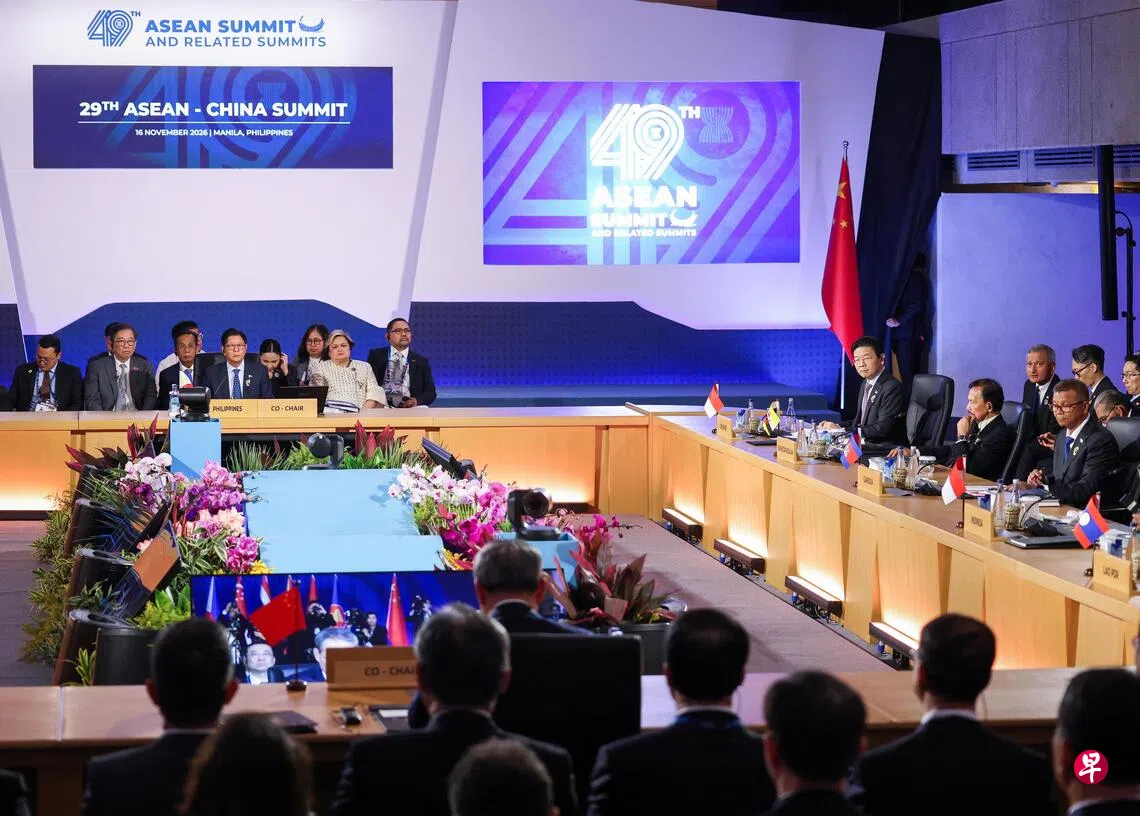
As geopolitical tensions sharpen and barriers to trade and investment rise, Prime Minister Lawrence Wong has called on ASEAN and China to work more closely together to deepen mutual trust and understanding, strengthen cooperation in trade, the digital economy and artificial intelligence, and keep the region peaceful and stable. He also urged both sides to conclude a code of conduct for the South China Sea in accordance with international law as soon as possible.
PM Wong said at the 29th ASEAN-China Summit in Manila, the Philippines, on Monday (16 November) that in this new international environment, the strong bonds between China and ASEAN show that there is another way forward, one that is based on cooperation and win-win partnership.
“We must work even more closely together to strengthen mutual understanding and trust, and find new opportunities for collaboration.”
On economic and trade cooperation, PM Wong said both sides should press ahead with building economic bridges and promoting openness and integration.
He said the ASEAN-China Free Trade Area 3.0 Upgrade will enter into force next month. Officials from both sides are also working on streamlining customs procedures and simplifying certification requirements. “These developments will give greater confidence to our businesses to invest and grow in our respective markets.”
ASEAN and China signed the ASEAN-China Air Transport Agreement in 2010, allowing airlines from both sides to operate flights between them. They subsequently expanded air traffic rights in stages, including allowing flights to carry passengers and cargo onwards to another destination after a stopover. Both sides are still discussing further liberalisation of air services to strengthen regional connectivity.
PM Wong said liberalising the agreement further would give cooperation an additional boost by improving air connectivity and facilitating greater flows of goods and people.
PM Wong also called on ASEAN and China to pursue practical cooperation in new areas, particularly by strengthening digital connectivity and deepening cooperation on the responsible development and adoption of artificial intelligence (AI).
He said China is one of the most digitally advanced countries in the world, and also ASEAN’s largest trading partner. Now that ASEAN has concluded a region-wide Digital Economy Framework Agreement (DEFA), there is potential for both sides to deepen digital connectivity.
PM Wong welcomed China’s proposal to designate 2027 as the Year of ASEAN-China AI Cooperation.
He said China is a leader in AI applications, while ASEAN countries have the potential and interest to harness AI to raise productivity and transform their economies.
Li Qiang: China and ASEAN should uphold tradition of friendship and mutual assistance
Chinese Premier Li Qiang told the summit that despite rising unilateralism and protectionism, as well as successive geopolitical conflicts, cooperation between China and ASEAN had advanced against the odds over the past five years, delivering encouraging results.
He said these hard-won achievements offered valuable lessons and insights. Both sides could draw on them to uphold their tradition of friendship and mutual assistance, seize opportunities arising from technological advances, and work together to strengthen their capacity for innovation and develop new areas of economic growth.
He said: “China and ASEAN countries have a long history of friendly exchanges. This tradition has not faded amid international turbulence. Rather, it has grown stronger and more resilient as all sides have repeatedly supported one another in facing challenges together.”
He also said China and ASEAN had long supported economic globalisation and regional integration. “Although trade and economic restrictions have increased sharply around the world, we remain firmly committed to upholding multilateralism, promoting free trade and expanding the benefits of cooperation.”
When the Philippines assumed the rotating ASEAN chairmanship early this year, it sought to conclude negotiations with China on a code of conduct for the South China Sea by the end of the year. That target, however, will not be met.
Philippine Foreign Secretary Theresa Lazaro told a press conference on Sunday (15 November) that both sides had reached preliminary agreement on about 80% of the draft’s paragraphs. However, key issues, including whether the code would be legally binding and which waters it would cover, remained unresolved. Negotiations will continue during Singapore’s ASEAN chairmanship next year.
Chinese and Philippine vessels have been involved in repeated confrontations in disputed waters in the South China Sea over the past year.
Philippine President Ferdinand Romualdez Marcos Jr. said at the opening of the ASEAN-China Summit that all parties’ shared commitment to international law and the peaceful settlement of disputes must be reflected in their actions, including self-restraint, mutual respect and practical cooperation.
“Even amid regional and global uncertainties, ASEAN and China continue to find common ground and pursue tangible cooperation.”
PM Wong described China as a valued and active partner through its consistent support for ASEAN-led mechanisms, including the East Asia Summit, ASEAN Regional Forum and the ASEAN Defence Ministers’ Meeting-Plus. “These interactions have helped to build trust and understanding.”
He said ASEAN looked forward to the expeditious conclusion with China of an effective and substantive code of conduct for the South China Sea, in accordance with international law, especially the 1982 United Nations Convention on the Law of the Sea, that safeguards the rights and interests of all parties that use the South China Sea.
