

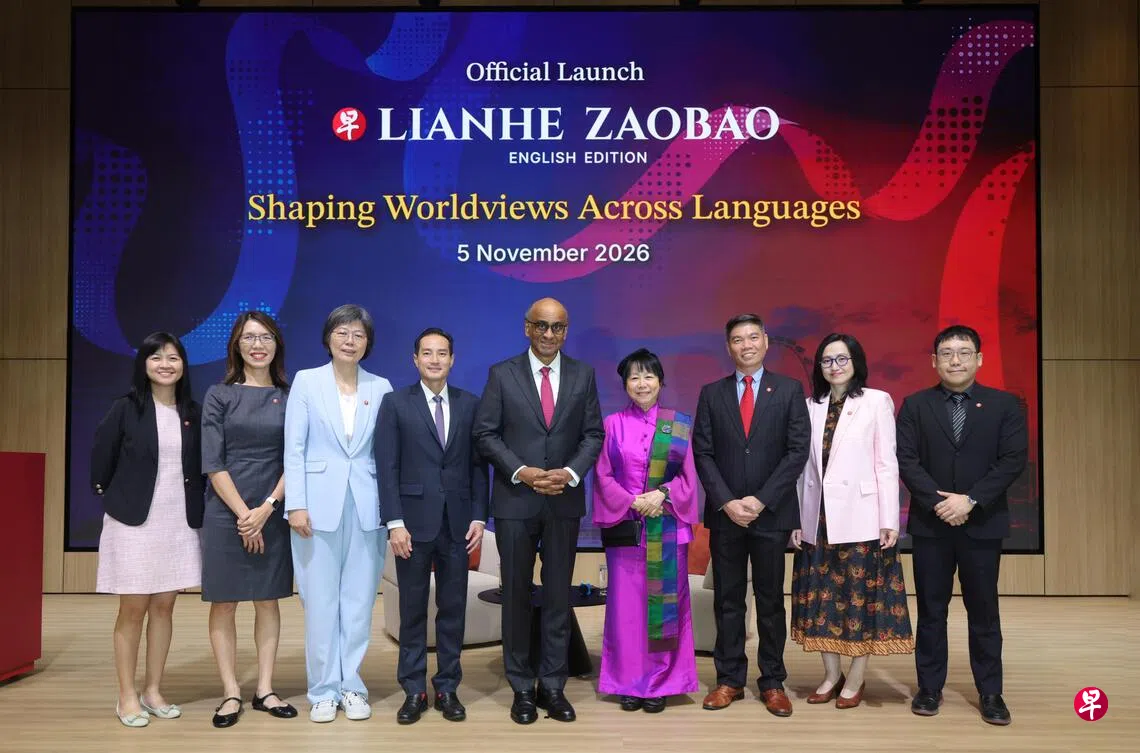
China is becoming more important to the world, yet understanding of it is much weaker than before. President Tharman Shanmugaratnam said Singapore media outlets such as Lianhe Zaobao could offer an inside-out perspective through credible reporting and analysis, helping to provide a bridge in thinking between different perspectives.
President Tharman was the guest of honour at the launch of the Lianhe Zaobao English website on Thursday (5 November). In a fireside chat afterwards with its editor, Chow Yian Ping, he discussed the role Lianhe Zaobao could play in fostering cross-cultural understanding.
He noted that China is becoming more important to the world in many spheres, but scholarship on China has declined. People-to-people exchanges and official contacts between China and the West, particularly the US, have also decreased. Understanding of China is therefore weaker than before, which is troubling.
“So the need for a credible, trusted perspective of developments in China is now greater than ever. And in a humble way, I think the media in Singapore can play a role in bridging the differences in perspectives,” he said.
President Tharman said he read widely about China and found that international media reporting on the country tended to elevate systemic and cultural differences, sometimes even civilisational, ideological and governance differences.
He noted that differences between societies and systems must be respected. But to truly understand a society and how to interact with one another, it was also necessary to recognise similarities, including shared governance and policy challenges. More importantly, people in different societies had similar struggles and aspirations.
“If you read views in China at every level of society, including literature, including even literature written by ordinary gig workers, you know that the concerns are very similar to many other societies.”
He said understanding of not just China, but also Southeast Asia and India, was relatively superficial. The task of high-quality media was to delve into a society and the flow of thinking at all its levels, to offer an “inside-out perspective” of reality rather than just an outside-in perspective.
“I think Lianhe Zaobao was very well placed to do that. Both because of the language, but it’s not just the language; it’s a certain perspective of the wholeness of society that you bring and have to continue to bring.”
Singapore perspective means ‘providing trusted information and building bridges of understanding’
The President said Singapore’s characteristics as a small country with a relatively short history, and a society that was not monocultural, placed its media in a good position to be bridge-builders.
However, he stressed that a “Singapore perspective” did not mean projecting Singapore’s or Singaporeans’ views and preferences, much less viewing the world through a parochial Singapore lens.
“It is to provide a credible and trusted source of information and analysis that will hopefully, in a modest way, provide a bridge in thinking and understanding in a world that’s becoming more divided.”
On the role of mother-tongue media in fostering social cohesion in Singapore, President Tharman noted that those educated in Chinese and those educated in English had slightly different emphases in how they viewed issues.
He said Chinese-language media placed greater emphasis on the continuity of culture and values passed down from one generation to another, as well as on culture across society as a whole. These concerns were not absent from English-language media, but when reading Chinese-language media, one sensed that they came “more from the soul”, rather than being just a rational disposition.
Earlier this year, the screening of the Chinese Teochew-language film Dear You sparked a lively debate about dialects in Singapore. Citing this example, President Tharman said Lianhe Zaobao had approached the issue from a different angle, which resonated deeply with him.
“And I appreciated reading it because it came more from the soul. It had that instinctive way of thinking about the generation of grandparents and our parents.”
He said Singapore needed these different sets of eyes on its own society. “They are not actually different identities; they reflect different parts of the Singapore identity.”
He stressed that Lianhe Zaobao English should not merely connect different communities, but also cultivate flexibility and openness of mind within each community, helping the Singapore identity to evolve.
He said this also applied to Chinese Singaporeans, especially the younger generation who communicated mainly in English, allowing them to benefit from a different pair of eyes on social and international issues.
