

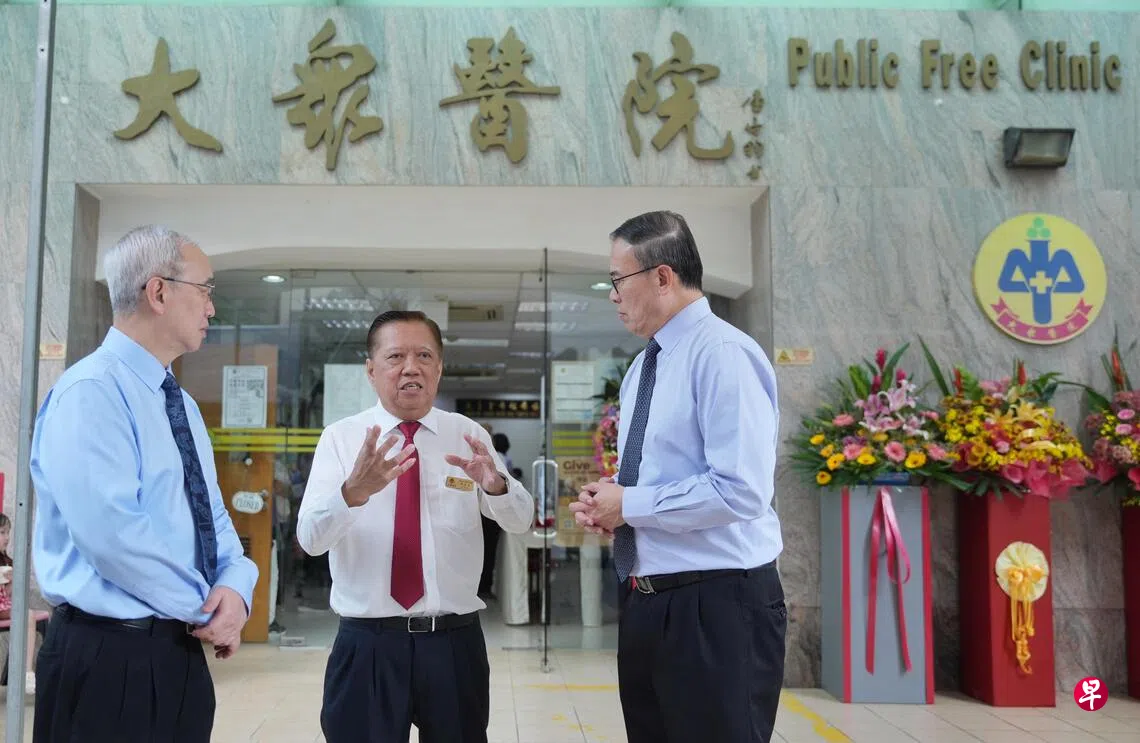
Public Free Clinic Society, which provides affordable traditional Chinese medicine (TCM) services, plans to hold six talks on TCM Food Therapy & Herbal Recipes next year to help the public understand how dietary adjustments can address health issues such as stress and poor sleep.
Seow Ser Fatt, President of Public Free Clinic Society, told Lianhe Zaobao at its 52nd anniversary celebrations on Sunday (22 November) that the six Mandarin talks would begin in late February next year. Conducted by TCM physicians, they will be held every two to three weeks at the auditorium of its headquarters in Geylang Lorong 9. Each session will last about three hours, comprising two hours of theory and a one-hour demonstration on preparing Chinese herbal teas.
Seow said: “There are many Chinese medicinal halls in Singapore, and Chinese herbal drinks are also readily available. We hope this series of talks will help more people, especially younger working adults, learn more about maintaining their health through TCM.”
He said the talks would introduce the benefits of ingredients such as tea leaves, chrysanthemum, goji berries and American ginseng according to TCM theory. They will also explain how to choose suitable teas to help improve sleep, relieve work-related stress and ease digestive discomfort.
Founded in 1974 as a small clinic in Boon Keng Road, Public Free Clinic Society now operates five clinics, including its headquarters, and has a home medical team serving patients with mobility difficulties.
The registration fee is generally $2, while acupuncture costs about $5. Patients facing financial difficulties can also receive free treatment.
Seow said its clinics see more than 500 patients a day on average, over 70% of whom are elderly. The society therefore hopes the talks will introduce more young people to TCM approaches to maintaining health. Details are expected to be announced on its website before the end of the year.
Many members of the public interviewed expressed interest in attending the talks. Private-hire driver Lim Poh Seng, 52, has a busy work schedule and sometimes sleeps poorly. He hopes to learn more about ways to improve his health through TCM.
He also suggested making the talks as lively and engaging as possible, “otherwise it will be harder to hold young people’s attention”.
Civil servant Tan Shao Hui, 27, said he had always been interested in TCM and wanted to try the Chinese herbal teas he saw on sale at medicinal halls.
“The talks can help me choose teas with benefits suited to my needs. I hope the first two hours of each session will include some interactive elements, such as displays of different medicinal herbs.”
Another civil servant, Bryan Lee Ker Xiang, 31, is also looking forward to the programme. He said: “TCM focuses on treating the root cause of ailments rather than suppressing the symptoms.”
Separately, Public Free Clinic Society’s headquarters has become the sixth institution in Singapore to receive TCM clinic accreditation. According to the Academy of Chinese Medicine, Singapore website, the headquarters received accreditation on 27 October, valid for three years.
Singapore formally launched last month the TCM Accreditation Programme. TCM providers and practitioners who voluntarily participate and gain accreditation could be allowed to offer a broader range of clinical services in future. They will also have more opportunities to work with the Ministry of Health in areas such as the diagnosis and treatment of chronic diseases.
Seow said Public Free Clinic Society patients who need blood tests or X-rays currently still have to make separate appointments at Western medicine clinics.
“With accreditation, we are more confident about developing two-way collaboration with Western medical institutions. Our physicians could refer patients directly for tests at Western medicine clinics, which could in turn send the results directly to us, saving patients time.”
The five institutions previously accredited were Kwong Wai Shiu Hospital in Serangoon, NTU Chinese Medicine Clinic, Singapore Chung Hwa Medical Institution (Headquarters), Singapore Thong Chai Medical Institution (Headquarters) and Kang Sheng TCM in Novena.
