


A recent recruitment advertisement drew considerable attention online in Singapore. Xiang Xiang Hunan Cuisine was offering monthly salaries of up to S$4,000 for restaurant hosts (also known as “welcomists”). Waiters and management trainees could also earn up to S$3,600 a month.
These figures caught the eye because they are close to the overall median starting salary of S$4,500 for university graduates in Singapore in 2025.
On the related topic of service, a reader’s letter published in The Straits Times’ opinion pages on 15 November described the the writer’s experience of visiting four retailers in search of a travel bag, only to find that staff either failed to greet him or ignored him altogether, watching him enter without asking whether he needed help. He ended up spending less than a minute in each shop and bought nothing.
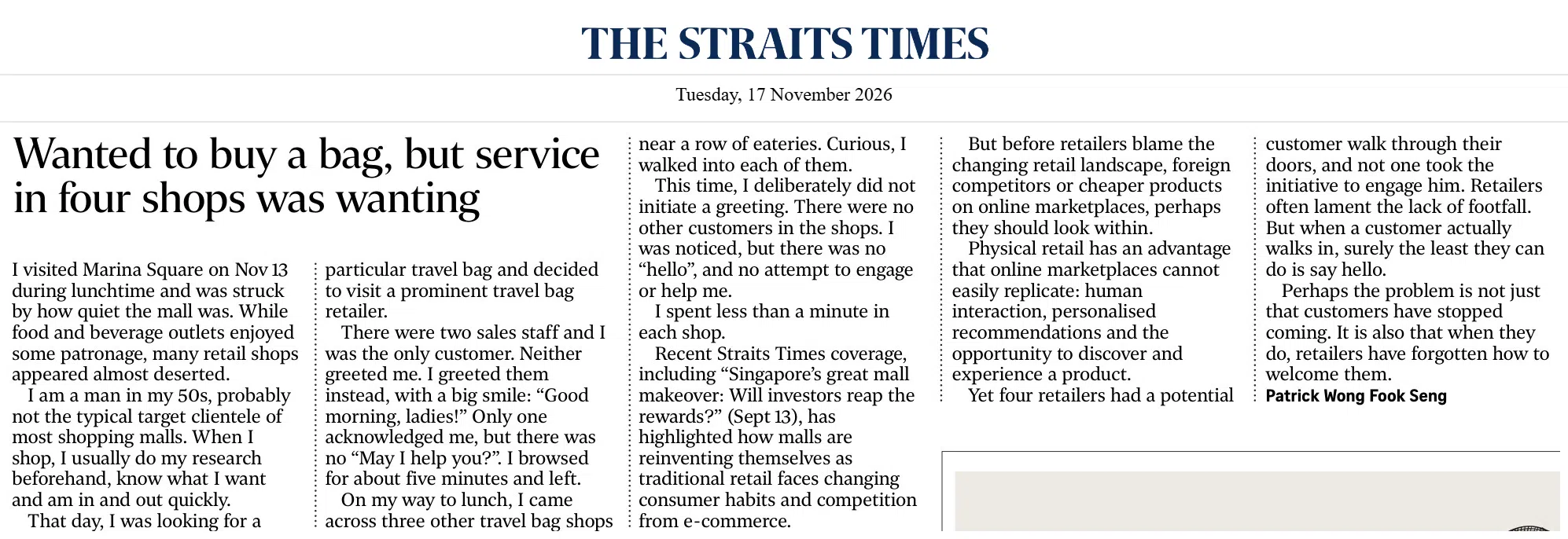
Service quality clearly affects sales, particularly in retail and food and beverage. So how should we value the work of employees who serve customers on the front line?
Service is more than a friendly smile
For most people, good service might mean a warm smile, a polite greeting and the ability to handle all manner of customer queries and problems calmly, providing the help that they need.
These may seem like basic requirements that service staff should already meet, but they involve considerable interpersonal skills.
Take the restaurant hosts Xiang Xiang Hunan Cuisine is recruiting. Their job is not simply to put on a bright smile and say “Welcome”. They also have to check reservations, arrange for seating and respond to customer enquiries. Most importantly, at least in my view, a host must be able to handle all sorts of unexpected situations during busy periods.
The same applies to retail staff. After greeting customers as they enter, staff must judge whether they would prefer to browse on their own or need someone to introduce the products. They must be neither so aloof that customers feel neglected nor so enthusiastic that they feel pestered.

Doing this work well requires communication skills, powers of observation, sound judgement and adaptability. When faced with rude or even aggressive customers, staff must also keep their emotions in check and remain professional under pressure.
Why are soft skills not always reflected in the pay?
These abilities are usually classified as soft skills. Unlike hard skills such as professional knowledge and technical proficiency, they are difficult to quantify. They are therefore often treated as personality traits or basic social skills, overlooking the fact that they are also workplace competencies.
Whether businesses are willing to pay for these service skills is another question.
Good service is not just about being friendly. More importantly, it means knowing how to respond to someone’s needs at the right time and in the right way. Not everyone is born with that judgement; it also takes experience and training. The question is whether businesses provide enough training to help employees develop these abilities. Do their pay structures also recognise employees’ service quality?
Singapore’s Progressive Wage Model for the retail sector not only sets a wage floor but also requires employers to provide relevant training and establish a wage ladder based on employees’ skills and productivity. This at least recognises that service skills are worth investing in, can be improved through training and can progressively translate into career advancement and higher pay.
At the same time, quality service cannot depend solely on employees’ personal enthusiasm. Businesses must provide fair pay and benefits, training and working conditions, while customers should show service staff basic respect. We are certainly entitled to expect good service, but service staff are ordinary people too. They get tired, and factors outside work can affect their mood. Expecting them to remain professional does not mean disregarding their dignity as workers.

Good service deserves to be taken seriously
Singapore society has long placed a premium on academic and professional qualifications. The knowledge and skills required of doctors, lawyers and engineers are naturally valued accordingly. By contrast, service-sector jobs are often seen as having low entry requirements and requiring few technical skills, or even as little more than a temporary way for young people to earn a living.
This perception may also shape our expectations of service staff. We want them to be friendly, patient and good communicators, able to handle all sorts of problems, yet we may not realise that meeting these expectations itself requires ability and training.
But if society continues to take service staff’s efforts for granted, and businesses remain unwilling to invest in their skills and recognise the value of their labour, all our hopes for quality service are unlikely to amount to much.
