

Resorts World Sentosa (RWS) will commit S$5 million over the next two years to expand its artificial intelligence (AI) projects and work with US technology giant Microsoft to develop an “AI brain”, seeking solutions that can be extended from tourism to sectors such as logistics and healthcare.
Senior Minister of State for Digital Development and Information and Health Tan Kiat How officiated at the launch of RWS’s SYMBIOSIS AI Living Lab on Wednesday (25 November). In his speech, he said the ambition of SYMBIOSIS was to move beyond isolated AI applications and develop integrated and scalable solutions that work in real-world environments.
“What we learn at RWS could be replicated in hospitals, airports, business parks, and many other locations, helping more enterprises adopt AI with greater ease and confidence.”
Tan noted that deploying robots often requires extensive customisation. Different robots, buildings, and enterprise systems may not communicate easily with one another. The industry should therefore identify common problems that can be solved collectively, rather than leaving each enterprise to find its own way. “We don’t want every enterprise trying to solve the same problem, duplicating efforts and using resources inefficiently.”
He said the key was to develop common platforms and standards that could be adopted across the enterprise ecosystem, which was also the main aim of the partnership between RWS and Microsoft. The “AI brain” they will develop is a shared digital platform integrating various AI applications, enterprise systems and technology solutions.
Besides coordinating robots, the platform will enable RWS to use data and AI to deliver personalised guest experiences, streamline workflows and improve operational efficiency. Microsoft will contribute engineering expertise, with the aim of developing reusable architectures and workflows that could ultimately benefit other sectors, such as healthcare and logistics.
Government agencies back initiative as Microsoft pledges over US$1 million
The two-year SYMBIOSIS AI Living Lab initiative is supported by the Infocomm Media Development Authority (IMDA) and the Singapore Tourism Board (STB). RWS plans to commit S$5 million to expand its projects in the first two years. Microsoft has pledged up to US$1.5 million (about S$1.94 million) over the course of the initiative, providing expertise, AI upskilling courses, and cloud and AI technologies to help develop and implement the solutions.
In her speech, RWS chief executive Lee Shi Ruh thanked IMDA for helping to align technology with business needs, and STB for supporting staff training. She noted that RWS has more than 8,000 employees and welcomed 17 million visitors last year. Its diverse businesses, including hotels, restaurants, convention and exhibition facilities, a theme park, a water park and an oceanarium, make it an ideal testing ground for technology.
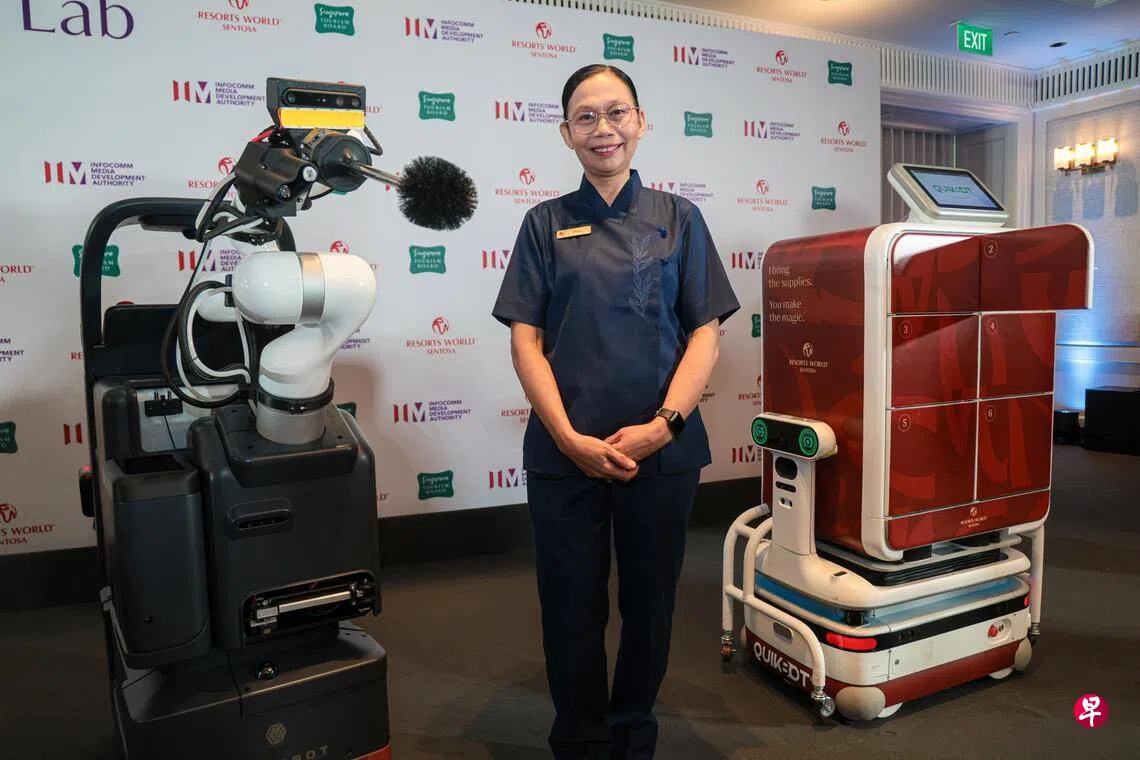
RWS is currently trialling driverless refrigerated vehicles to transport pastries at its Pierre Hermé patisserie, outdoor delivery robots to transport food at Adventure Cove Waterpark, and indoor delivery robots at its Equarius Hotel to move room supplies from back-of-house storage areas to guest room floors.
Equarius Hotel assistant housekeeping supervisor Maria Luz Atones Tham, 57, said delivery robots now automatically bring room supplies such as dental kits to each floor at night. “With our floors already stocked when we start work in the morning, we have more time to prepare and inspect rooms, attend to guests’ requests and focus on the little details that matter to our guests.”
She said the team would also soon trial cleaning robots in the toilets. She hopes the new technology will make daily work easier while maintaining high standards of cleanliness and service.
