

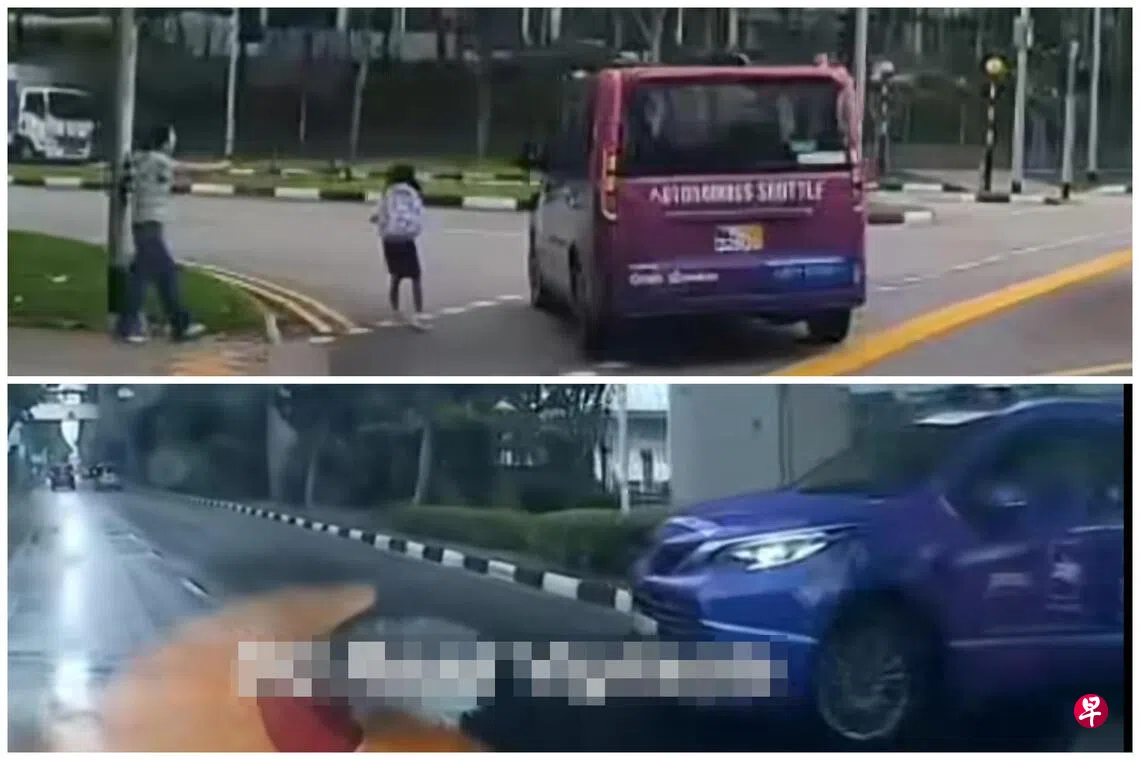
Amid concerns over the safety of self-driving vehicles, the Land Transport Authority (LTA) said it is reviewing recent incidents with the operators involved to establish what happened and identify areas for improvement. LTA has also worked with the Traffic Police to develop procedures for responding to and managing incidents involving autonomous vehicles.
Lianhe Zaobao reported on Tuesday (10 November) that two self-driving vehicles were involved in separate near misses with a pedestrian and a car in Punggol last Thursday (5 November). In recent days, members of the public have also shared videos of near collisions with self-driving vehicles and apparent traffic violations by such vehicles. Some have also questioned who would bear responsibility if a self-driving vehicle caused an accident.
In response to queries from Lianhe Zaobao, an LTA spokesperson confirmed that the authority was aware of the videos circulating online. It is reviewing the incidents with the autonomous vehicle operators involved to establish what happened and identify any necessary improvements.
The spokesperson said safety has remained the authority’s top priority as self-driving vehicles begin operating on roads. All self-driving vehicles currently on the roads are governed by the regulatory sandbox framework established under the Road Traffic (Autonomous Motor Vehicles) Rules 2017. They must comply with all traffic rules, as well as LTA’s safety and operational requirements.
Incident response procedures developed with Traffic Police
LTA has worked with the Traffic Police to develop protocols for responding to and managing incidents involving autonomous vehicles. All authorised autonomous vehicle operators must maintain liability insurance covering third-party death, bodily injury and property damage caused by or arising from the use of autonomous vehicles, including claims involving passengers.
If operators fail to meet these requirements, the authority may take regulatory action, including directing them to implement corrective measures, or suspending or revoking their authorisation to operate on public roads.
The spokesperson explained that the ongoing pilot in Punggol allows operators to test and progressively refine their technology in local traffic conditions to meet traffic rules and safety requirements.
“This also highlights the importance of testing, which allows self-driving vehicles to become familiar with local road conditions with safety operators on board. We will continue working with autonomous vehicle operators to address issues identified during the pilot and ensure that autonomous vehicle operations meet the required safety standards.”
Quarterly deployment reports from next month
The spokesperson also said that, from next month, the authority will publish quarterly reports on autonomous vehicle deployment, including the size of the fleet in service, passenger experience and safety performance. This will give the public access to actual data to assess the performance of self-driving technology more objectively.
There are currently 25 passenger-carrying self-driving vehicles on local roads, while a small number of commercial self-driving vehicles are also undergoing testing.
