


Do lines such as “It won’t give you heartburn” and “Rules must not be broken” sound familiar? These catchphrases from AI-generated short dramas have caught on among older viewers in Singapore, some of whom have stayed up late to keep watching. One organisation warns that an obsession with these dramas may mask social isolation.
Generative artificial intelligence (GenAI) is sweeping through film and television production. As AI-generated short dramas gain public attention, more seniors are watching them. On Singapore’s streets and public transport, older people can sometimes be seen looking down at their screens, engrossed in these shows.
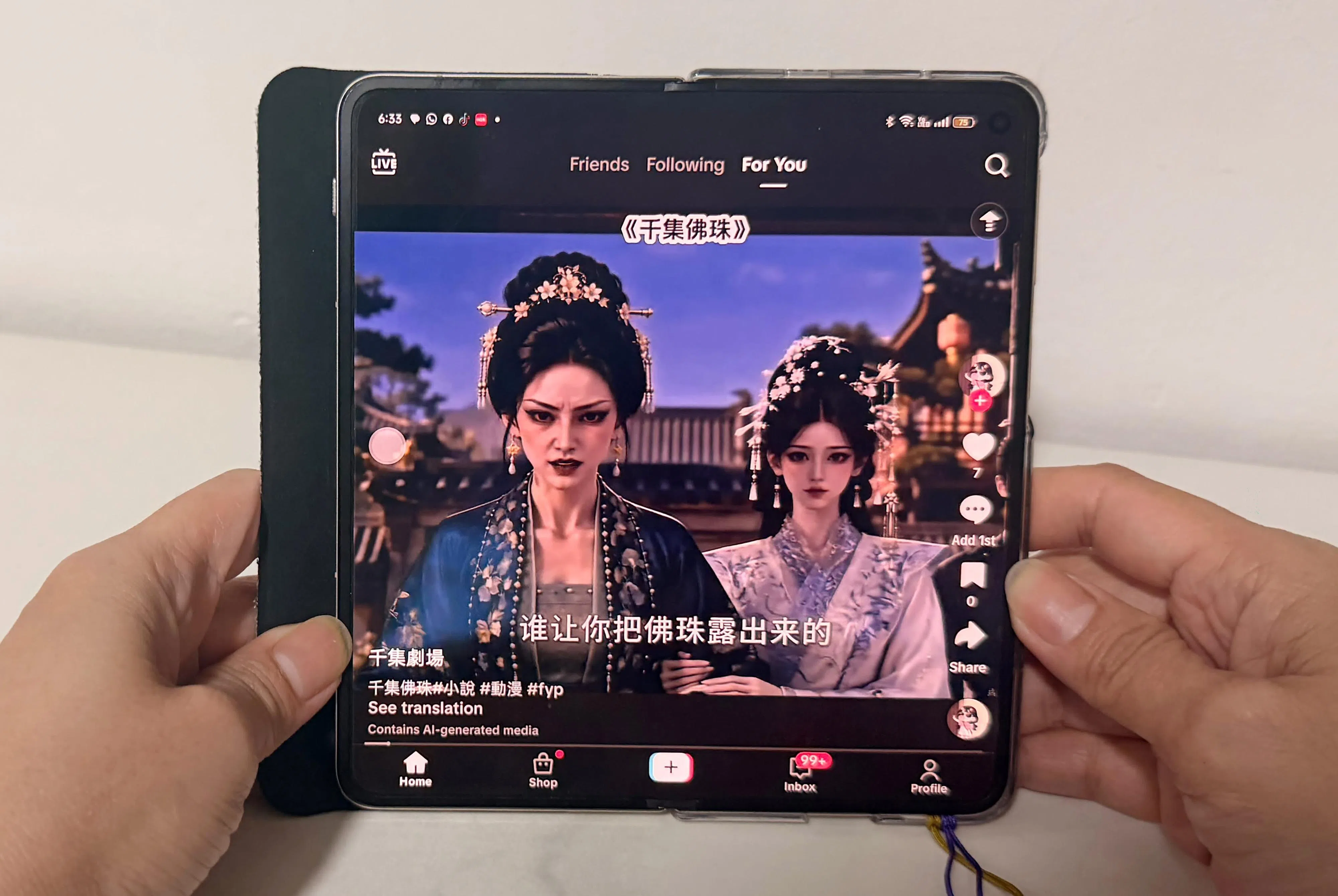
Asked by Shin Min Daily News why they found the dramas so absorbing, several seniors gave answers such as “new episodes come out very quickly”, “once you start, you can’t stop” and “you can finish them in no time”.
Housewife Chen Liming, 59, picks up her phone whenever she has free time to watch AI-generated short dramas about conflicts between mothers-in-law and daughters-in-law, or palace intrigue. “I used to watch more, staying up instead of sleeping. The next day, I wouldn’t feel very alert, and my eyes would feel a little tired.”
She has since learnt to exercise restraint, trying to limit her viewing to no more than three hours a day.
Mr Huang, a 65-year-old retiree who also enjoys AI-generated short dramas, said: “Short dramas are much more convenient. You can start watching as soon as one appears in your feed. And those apocalyptic storylines are so over the top that they would be difficult to film in real life. They draw you in and keep you watching.”
Many seniors also said that most AI-generated short dramas on the short-drama platform Hongguo were free to watch, making them an inexpensive form of entertainment.
Li Rongfu, head of community care development at the Tzu Chi Foundation (Singapore), told Shin Min Daily News that while seniors at its centre had not shown clear signs of addiction to AI-generated short dramas, the organisation was concerned about potential digital risks. “We have observed that many seniors rely heavily on digital tools for information, but they are often unable to assess whether sources are credible or the information is genuine.”
To address this, Tzu Chi is conducting a joint study with the National University of Singapore on how seniors can make good use of the internet and AI to obtain health information.
Karen Wee, executive director of Lions Befrienders, said more than half of the seniors in its care owned smartphones. Of these, nearly half spent one to two hours watching short videos, including AI-generated dramas.
She said: “Some seniors are not simply hooked on the content. Rather, they lack people to socialise with and confide in, so their phones become a substitute for companionship, helping them cope with loneliness when no one is around. Beyond AI-generated short dramas, we should be paying greater attention to psychological issues and social isolation.”
For the full report, see the 28 November 2026 edition of Shin Min Daily News.
