

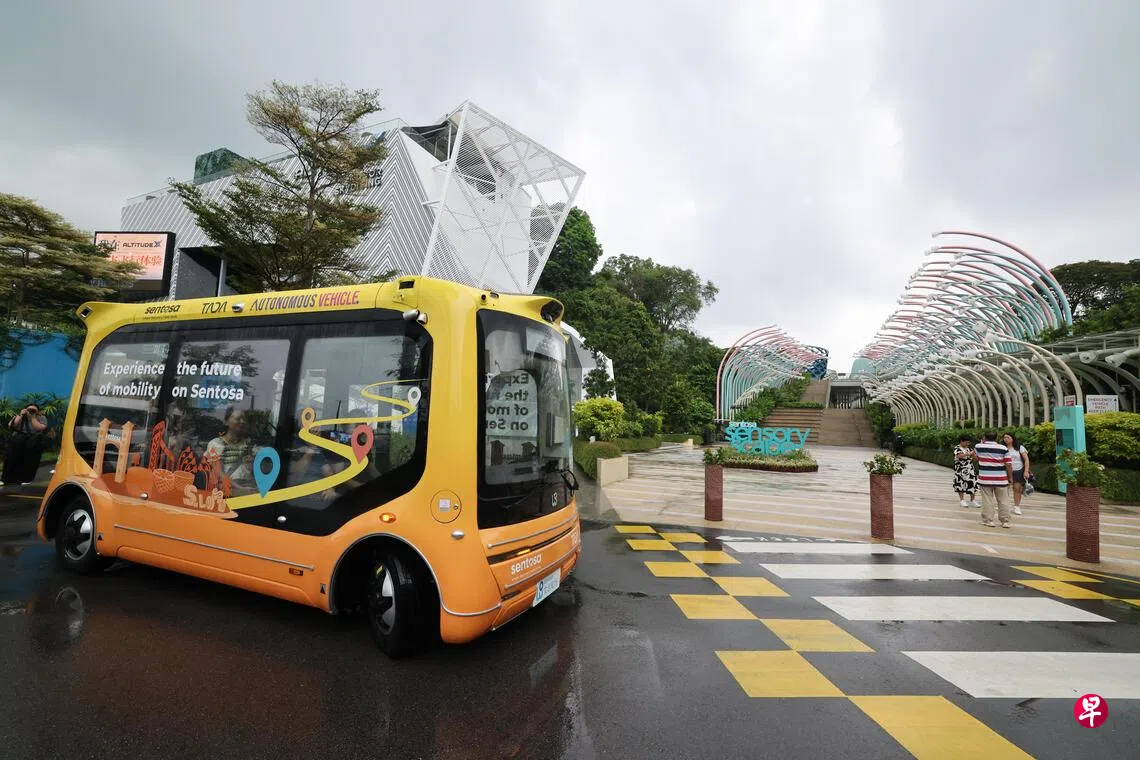
Sentosa will launch a trial of an on-demand autonomous shuttle service early next year. Visitors arriving on the island will be able to book an eight-seater driverless vehicle directly to attractions and dining venues at Siloso and Palawan beaches, instead of transferring to a beach shuttle that stops at every stop.
Sentosa Development Corporation announced on Thursday (29 October) that it was partnering TADA Mobility to launch the trial in western Sentosa early next year, and invited the media for a test ride. During the trial, visitors can book free rides through the TADA private-hire car platform daily from 1pm to 7pm.
This pilot scheme aims to provide more convenient and accessible transport options, making it easier for visitors to explore the island. The autonomous vehicles will follow preset routes, skipping some pick-up and drop-off points according to passengers’ bookings, to reach destinations more directly and quickly, without the need for transfers. Through the trial, the authorities will examine how to reduce waiting times, improve the reliability of ride arrangements and shorten journeys between transport hubs, hotels and attractions.
The trial will use two eight-seater autonomous minibuses developed by WeRide. A Sentosa Development Corporation spokesperson said rides could be shared depending on the number of numbers, with up to two groups travelling together per trip.
Phased roll-out across 27 pick-up and drop-off points
The trial service will run alongside the island’s existing shuttle services and roll out in phases, covering 27 pick-up and drop-off points in total.
The first phase, expected to begin early next year, will mainly connect 21 pick-up and drop-off points across Siloso, Imbiah and Beach Station, including hotels, beaches and attractions. The second phase will extend eastwards to cover the whole island, including Sentosa Cove and Tanjong Beach. Its launch date has yet to be set.
The autonomous vehicles’ routes will cover roads along Siloso and Palawan beaches as well as other roads on the island. Roads along the two beaches are currently closed to private cars and private-hire cars, and are reserved for authorised vehicles such as delivery vehicles and the Beach Tram.
Getting to the island’s hotels and attractions currently requires navigating a patchwork of private transport and transfers. To reach Shangri-La Rasa Sentosa by public transport, for example, guests must take the Sentosa Express, transfer to a beach shuttle and then walk after alighting. Alternatively, they can take the hotel’s dedicated shuttle bus from VivoCity, which runs every 15 minutes.
Mr Allen Khoo, general manager of Shangri-La Rasa Sentosa, said in an interview that autonomous vehicles could greatly improve transport connectivity on the island, making it easier for guests to visit the group’s restaurants, beach clubs and all the island’s attractions. This would be a major advantage for partner businesses and hotel operators.
He explained how guests would enjoy greater flexibility and convenience, particularly for families, where they no longer need to plan their day around fixed bus schedules or rush to catch a ride. “Because you're on holiday, it should be more relaxed and not restricted by time.”
Each autonomous vehicle to have a safety operator
Each autonomous vehicle will have a safety operator trained by public bus operator Tower Transit, as well as remote monitoring capabilities to provide timely assistance when needed. Tower Transit told Lianhe Zaobao (LHZB) on Thursday that it had been operating Sentosa’s bus services for a year and was familiar with road conditions on the island. Safety operators are currently undergoing a month-long training programme covering vehicle operation, emergency response and defensive driving.
Before the autonomous vehicles begin carrying passengers under the trial, Sentosa Development Corporation and TADA will test the routes, booking process, pick-up and drop-off arrangements, and safety procedures. Both parties will work with the Land Transport Authority to ensure strict compliance with safety and operating protocols during the trial, with rigorous inspections to ensure the vehicles are safe for road use.
Thien Kwee Eng, chief executive officer of Sentosa Development Corporation, said in response to questions from LHZB that the corporation would assess demand and usage during the trial. The public would be notified in advance of any plans to charge for the service.
She told the media that the second phase of the trial would depend on regulatory approval from the Land Transport Authority, with plans to expand gradually across the island. “The purpose of the trial is to collect feedback from our guests, so that we are able to better refine the service, and also look at how we can better integrate it within our Intra Island network of transportation options to give flexibility and convenience to our guests.”
Sentosa is exploring an upgrade that would provide audio commentary in the autonomous vehicles in future, introducing visitors to nearby attractions and distinctive experiences.
