

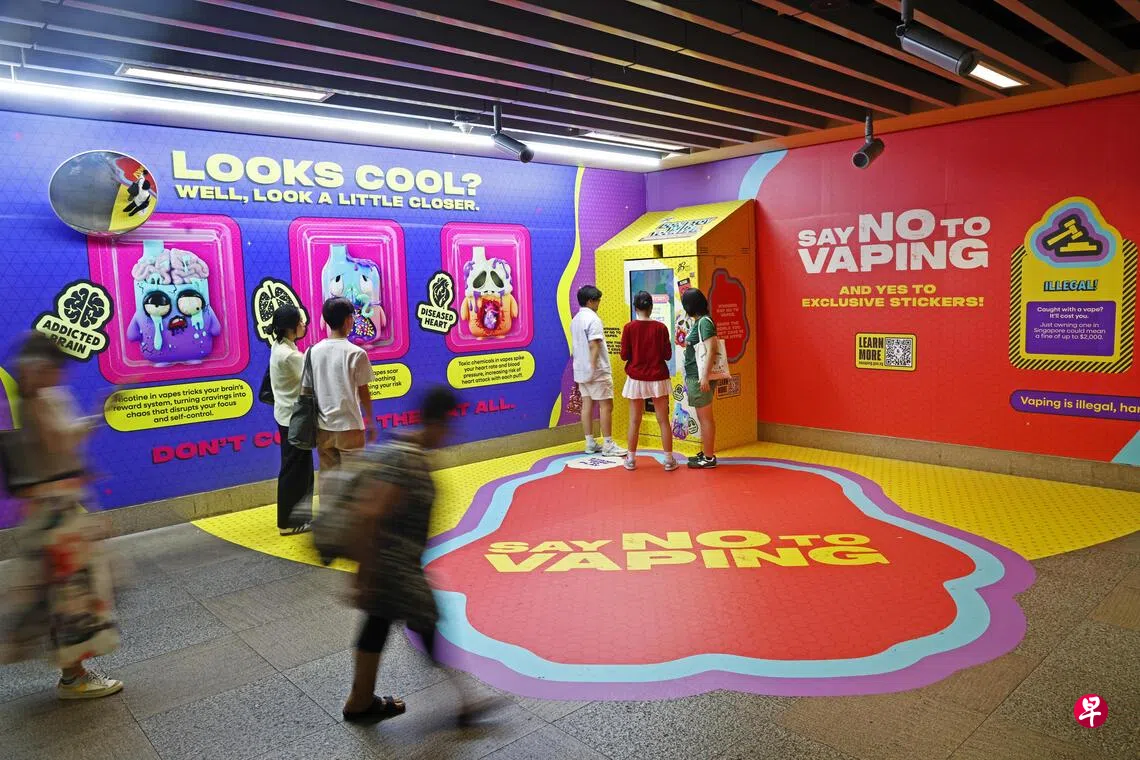
The number of young drug abusers on the Youth Enhanced Supervision Scheme surged from 36 the year before last to 130, with nearly 60% abusing the medical anaesthetic etomidate. Social workers are calling on parents, schools and others to build an inclusive community support network to help young offenders get back on track.
Since April 2018, the Ministry of Social and Family Development (MSF) has appointed several integrated service providers to run diversionary programmes to rehabilitate young people under 21 who have committed minor offences but have not been charged. These include the six-month Youth Enhanced Supervision Scheme (YES), which focuses on rehabilitating young drug abusers.
According to the Supporting Youth Rehabilitation Trends Report, released on 29 September, participation in YES reached 130 in 2025, up sharply from an annual average of just over 30 over the preceding three years.
Wong Yu Jin, deputy director of Partner and Capability Development at MSF’s Rehabilitative Service, told Lianhe Zaobao (LHZB) that the increase was mainly due to the referral of about 75 young first- or second-time etomidate abusers to YES by the Health Sciences Authority (HSA) after September last year.
Wong said: “The large majority were first-time offenders. First-time offenders receive psychoeducation to help them understand the harms of etomidate abuse, and how to maintain an etomidate-free lifestyle.”
Etomidate was classified as a Class C controlled drug in Singapore in September last year. Vape cartridges laced with etomidate are commonly known as “zombie vapes”, as users may wander about in a zombie-like state. The substance is not only addictive but can also cause serious side effects.
Wong said youths arrested for a second time for etomidate abuse receive more structured rehabilitation under YES, including case management, psychoeducation, family sessions and school-based support. HSA may also require these youths to undergo random urine testing. Those who fail to comply with programme requirements and continue abusing drugs may also face prosecution.
SHINE Children and Youth Services is one of the agencies participating in YES. SHINE’s assistant director, Zhuang Xinyan, said the centre first assesses the specific problems a young person faces before tailoring an intervention plan. For example, those who abuse etomidate because of peer influence are taught to recognise and resist such influence, while being encouraged to interact more with their families. Those who turn to etomidate because they cannot cope with negative emotions after arguments with family members are taught how to regulate their emotions.
Zhuang said young people may start using etomidate after being introduced to it by friends or romantic partners, to escape reality or cope with negative emotions, or because they think being intoxicated makes them look cooler.
Parents and schools play an important role in helping young people stop using addictive substances. However, Zhuang cautioned that adolescents are at a stage of exploring, experimenting and forming their own views. If adults respond condescendingly to their questions or opinions, they may become reluctant to share openly.
Zhuang said: “We encourage parents and other trusted adults to maintain open, respectful dialogue while providing clear guidance and boundaries.”
Guidance Programme participation reached 352 last year, up by 166
The Guidance Programme, another diversionary programme, is for young people aged 10 to 18 who have committed minor offences such as theft, trespassing and harmful sexual behaviour.
The report showed that 352 young people participated in the Guidance Programme in 2025, an increase of 166 from the previous year. Most were referred for theft.
Aaron Scott Donovan, a senior social worker in the Youth Department at Fei Yue Community Services, said in an interview that these youths often did not intend to harm others. Rather, they were seeking acceptance from peers or trying to cope with difficult emotions, without fully considering the consequences.
The Guidance Programme also provides therapy to foster healthy attitudes towards sexuality. Donovan, who supervises the project, said harmful sexual behaviour among youths often arises from a combination of factors, including trauma, inadequate supervision, problematic peer influences, difficulties regulating emotions and exposure to sexually explicit material. Unmet developmental needs may also play a part. Without sexuality education and appropriate guidance, young people can easily develop misconceptions about sex, consent and interpersonal boundaries that lead them to offend.
Data showed that both YES and the Guidance Programme had completion rates above 80% over the past five years, reaching 84.6% and 91.2% respectively last year. Both programmes also recorded declines in their two-year reoffending rates, an encouraging sign of their effectiveness.
Among young people who completed YES in 2023, 6.1% reoffended within two years, a decline of 5.2 percentage points from the previous cohort. For those who completed the Guidance Programme in 2023, the two-year reoffending rate was 4.5%, compared with 7% for the previous cohort.
