

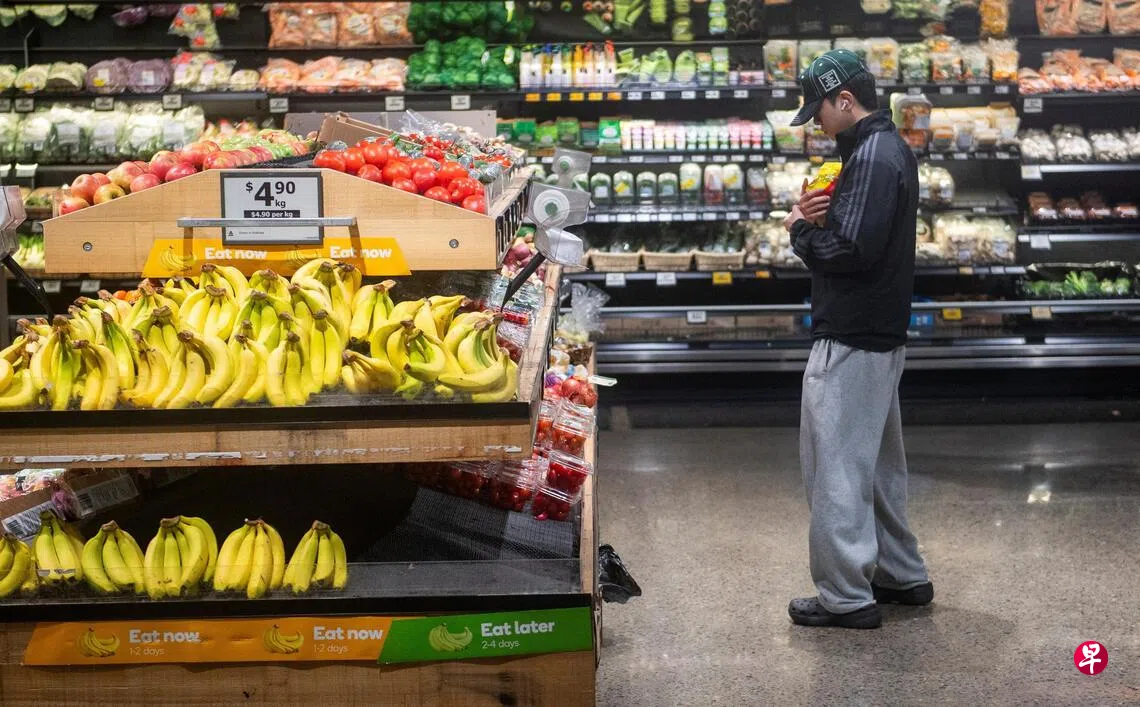
Singapore and Australia are expanding cooperation on essential supplies. Academics interviewed said the two countries were drawing on their complementary strengths and longstanding mutual trust to translate the broader commitment under the enhanced Comprehensive Strategic Partnership to strengthen supply chain resilience into a practical mechanism for keeping essential goods and energy flowing, with concrete benefits for both countries.
Prime Minister Lawrence Wong and Australian Prime Minister Anthony Albanese co-chaired the 11th Singapore-Australia Leaders’ Meeting in Canberra on Tuesday (23 November). The two countries signed a memorandum of understanding during the meeting to expand cooperation on trade in essential supplies.
Nick Bisley, a professor of international relations at La Trobe University in Australia, told Lianhe Zaobao that the latest deepening of Singapore-Australia cooperation was part of a very concerted effort by the Albanese government to focus heavily on Southeast Asia in its foreign policy.
The Albanese government launched Australia’s Southeast Asia Economic Strategy to 2040 in 2023, setting out a long-term plan to expand trade and investment between Australia and Southeast Asia.
Bisley said: “Southeast Asia is critically important to Australia. It is our front door, back door and window to the world.”
Bisley said Australia was trade-dependent, with many of its policy settings established over a long period for a world of open markets, stability and globalisation. Now, with geopolitics interfering with markets, Australia had to make adjustments, become more resilient and diversify its sources of supply.
He said Singapore was an absolutely critical partner for Australia in this regard. Australia’s fuel supply was dependent on imports, while Singapore played an important role in refining and distributing petroleum across the region.
The two countries also complement each other in food supplies: Australia has the resources, while Singapore relies on imports to meet its needs.
“These are two countries that work very well together. They have compatible government systems. They are very familiar with working with each other and have a good foundation to build on.”
Building on a protocol agreed in July this year, the memorandum of understanding signed by Singapore and Australia expands cooperation on trade in essential supplies beyond petroleum products and liquefied natural gas to cover more categories, including food, medicines, agricultural supplies and semiconductors.
Analysis: Bilateral cooperation can strengthen resilience but cannot prevent global supply shocks
Sarah Teo, an assistant professor at the S. Rajaratnam School of International Studies at Nanyang Technological University, said in an interview that diversification was key to Singapore’s security of supply. The essential supplies arrangement with Australia therefore gave Singapore another layer of resilience.
But she stressed that no bilateral arrangement could completely insulate Singapore from a major global disruption to supplies. Singapore should not assume that any single partner could guarantee supplies during a crisis. Instead, it needed enough reliable sources so that if one was disrupted, the impact would remain manageable.
“This should be seen as part of a broader diversification strategy rather than a guarantee of supply.”
Beyond essential supplies, the two countries are also advancing cooperation in artificial intelligence (AI), green innovation and carbon sequestration. Teo said that, at the functional level, these were areas where Singapore and Australia had complementary interests and capabilities. Collectively, these initiatives also served the broader strategic goal of resilience.
“This means building stronger ties with trusted partners, creating greater interdependence, and giving both countries more options in an uncertain geopolitical environment.”
Singapore-Australia AI cooperation could expand across Southeast Asia: Academic
According to their joint statement on AI, the two countries will strengthen cooperation on AI testing, evaluation and trustworthiness verification, share experiences in talent training, and promote links between governments, businesses and research institutions. They will also jointly participate in AI governance and standard-setting, and work together to address cyber and AI security risks.
Bisley noted that Australia’s land and solar energy resources gave it the conditions to develop large data centres. The government saw investment opportunities in AI and had shown an appetite for regulation, but the electorate was uneasy about the technology’s potential social consequences.
He said AI governance needed genuine international cooperation, and there had not been much so far. Singapore-Australia cooperation could be an early step towards building something that extended across ASEAN or broader Southeast Asia.
Bisley also said both countries were globally engaged and, in many respects, globally dependent and vulnerable to developments in AI. “Taking common steps is interesting and important. It builds on a long period of trust and cooperation between governments that know how to work together.”
