

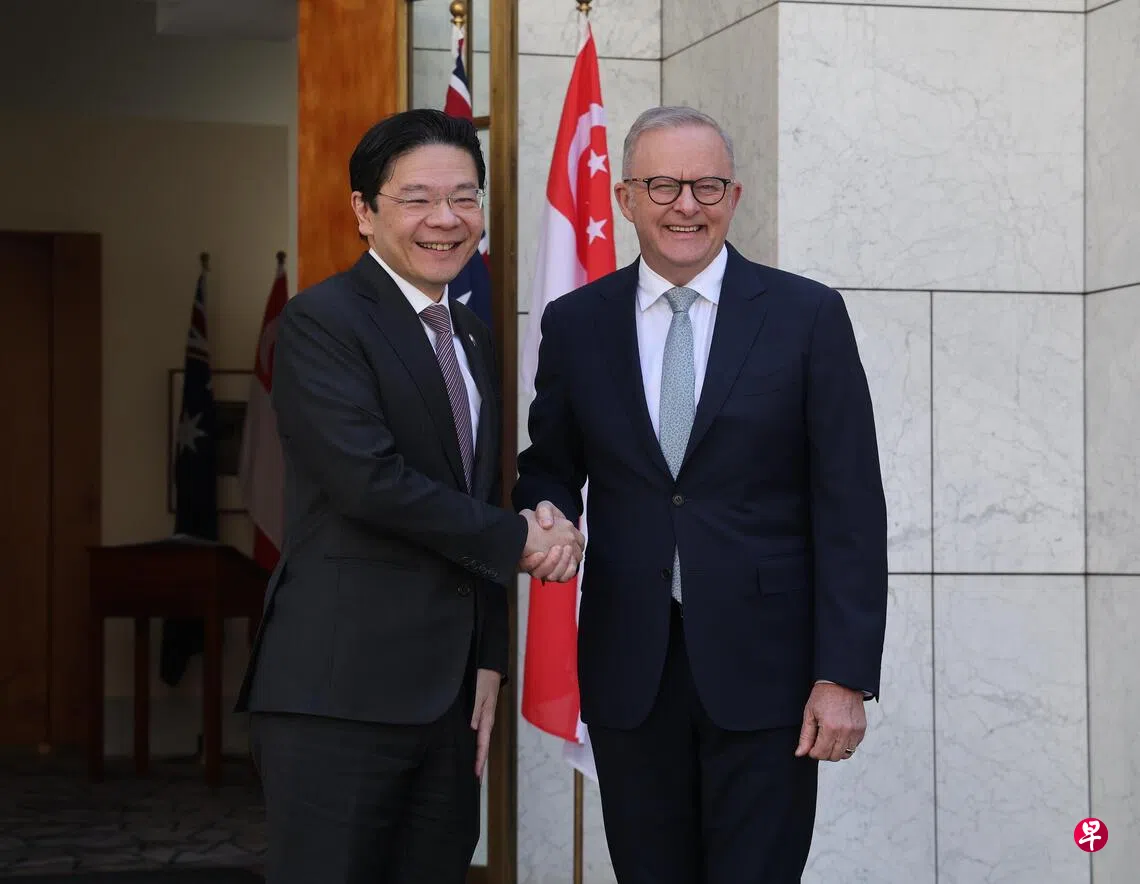
Amid disruptions to global trade and supply chains, Singapore and Australia are expanding their cooperation on trade in essential supplies beyond petroleum oils and liquefied natural gas to include food, pharmaceuticals and semiconductors, among other items. The aim is to keep essential supplies flowing between the two countries even during a crisis.
Prime Minister Lawrence Wong, who is on an official visit to Australia, co-chaired the 11th Singapore-Australia Annual Leaders’ Meeting with Australian Prime Minister Anthony Albanese in Canberra on Tuesday (24 November). They then witnessed the exchange of a memorandum of understanding (MOU) on essential supplies.
Under the MOU, the two countries will expand their cooperation on trade in essential supplies to cover agricultural chemicals and inputs such as crop protection products and fertilisers; construction materials; food; fuel and fuel additives; pharmaceuticals and medical products; renewable energy technologies; semiconductors; telecommunications equipment; traffic signaling equipment; and water treatment chemicals.
The MOU was signed by Minister for Sustainability and the Environment and Minister-in-charge of Trade Relations Grace Fu and Australian Foreign Minister Penny Wong. It supplements the Protocol on Economic Resilience and Essential Supplies signed by Singapore and Australia in July this year.
Under the Protocol, the two countries commit to endeavour not to adopt or maintain export restrictions on agreed essential items, currently covering petroleum oils such as diesel and liquefied natural gas. The Protocol also establishes means for advance notification and consultation, as well as the review and withdrawal of measures. It will enter into force upon the completion of domestic procedures on both sides.
Australia is an important source of Singapore’s food and energy imports, while petroleum products refined in Singapore are also among Australia’s key imports from the city-state. The two countries have further advanced cooperation on essential supplies this year to reduce the impact of global supply chain disruptions on both sides.
Earlier this year, the conflict in the Middle East disrupted global energy markets and supply chains. Speaking at a joint press conference, PM Wong said these are practical arrangements that will make a real difference when the next disruption comes.
“They reflect the trust we have built, and our shared commitment to keeping trade open and supply chains resilient, even in difficult times.”
Beyond trade, Singapore and Australia also cooperate extensively in areas including investment, defence and security, the green and digital economy, technological innovation and people-to-people exchanges.
The two countries established a Comprehensive Strategic Partnership in 2015 and launched an upgraded partnership last year. They plan to advance 80 initiatives over the next 10 years, including signing 20 new agreements and MOUs and establishing 11 new dialogue mechanisms.
PM Wong said bilateral ties were in excellent shape, and he was glad the two countries were already making good progress and translating their plans into concrete results.
Singapore and Australia sign cross-border carbon storage agreement, opening new pathway to cut industrial emissions
Besides strengthening economic resilience, Singapore and Australia will work together to seize new opportunities for growth in areas such as artificial intelligence (AI) and the green and digital economy.
The two countries signed the world’s first Green Economy Agreement in 2022. PM Wong said they would launch the Getting to Zero Co-Innovation Programme to support enterprises in both countries to develop and commercialise low-emissions products and services.
Singapore and Australia also signed the Agreement on Transboundary Movement of Carbon Dioxide Streams for the Purposes of Offshore Geological Sequestration on Tuesday. It establishes a framework for Singapore to transport captured carbon dioxide to Australia for storage in geological formations beneath the seabed in future.
Carbon capture and storage involves capturing carbon dioxide generated by industrial activities and transporting it to suitable locations for long-term storage, preventing its release into the atmosphere. For industries where it is difficult to abate emissions through existing technologies, this offers another pathway to reduce carbon emissions and helps Singapore achieve its goal of net-zero emissions by 2050.
Singapore’s Ministry of Energy, Trade and Industry said the new agreement formalises the transfer of carbon dioxide accounting responsibility for its cross-border movement, and lays the groundwork on how carbon dioxide would be measured, reported and accounted for by each country.
PM Wong said artificial intelligence (AI) would be an important driver of economic transformation. Singapore and Australia both have capabilities in this field and can draw on their complementary strengths to jointly develop and deploy AI for the benefit of businesses and workers.
He said the two countries could also strengthen cooperation on the evaluation, reliability testing, interoperability and governance of AI systems. They could explore practical approaches for implementation in both countries, with the potential to extend them to other ASEAN countries in future.
Singapore and Australia deepen regional cooperation, encourage Australian firms to expand into Southeast Asia
Singapore and Australia will also work together to strengthen regional cooperation and integration. PM Wong said both countries wanted a stable and prosperous region. Australia is ASEAN’s oldest Dialogue Partner and an integral part of the region’s security and prosperity.
Singapore will assume the ASEAN chairmanship next year. PM Wong thanked Albanese for his strong support of Singapore’s chairmanship and welcomed Australia’s commitment to deepening its engagement with Southeast Asia.
“We hope that more Australian companies will use Singapore as a launchpad to invest in the region. We will also work together to support the development of the region, including through our joint Third Country Training Programme.”
