

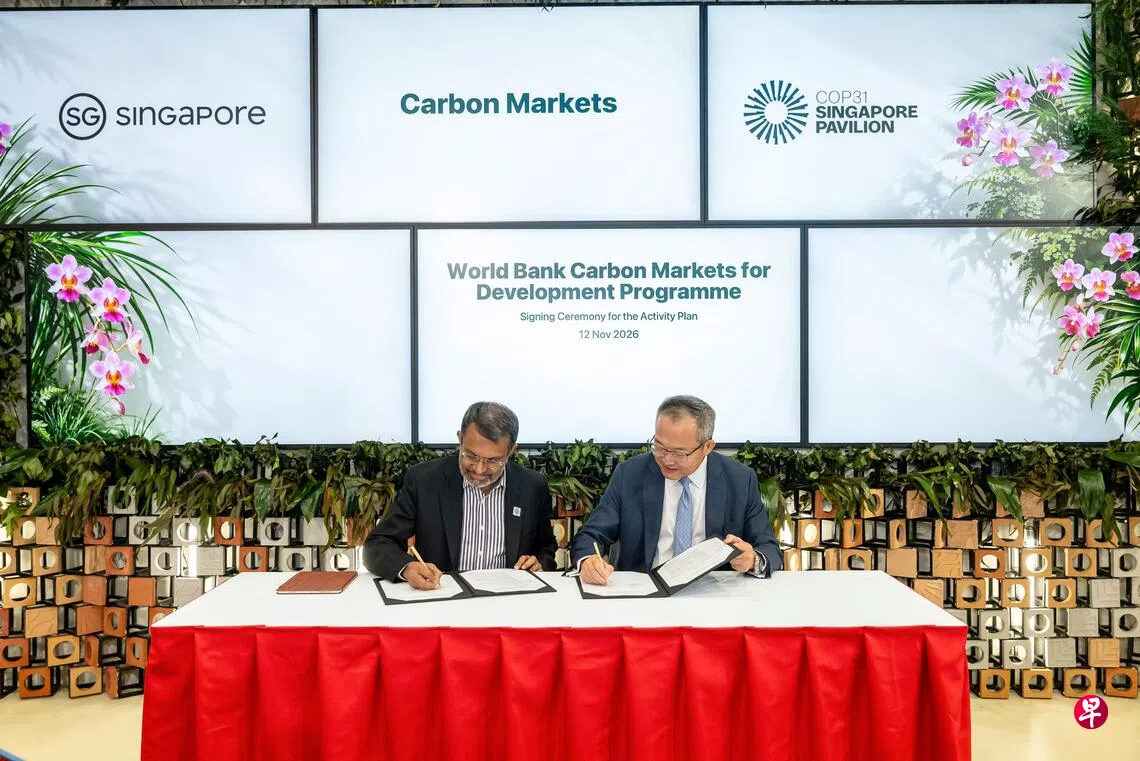
Singapore will work with the World Bank over the next three years to help developing countries strengthen carbon market mechanisms, address financing difficulties faced by small emissions reduction projects and train specialists. This will enable these countries to participate more effectively in carbon credit trading and attract funding to reduce emissions.
Singapore’s Ambassador for Climate Action Ravi Menon and Guangzhe Chen, the World Bank Group’s vice president for planet, signed the detailed 2027–2029 Activity Plan for the Singapore Carbon Markets Programme at the Singapore Pavilion on Thursday (12 November), during the 31st UN Climate Change Conference (COP31) in Antalya, Türkiye. Singapore and the World Bank jointly launched the programme in May this year.
Menon noted that much of the world’s mitigation potential lies in developing nations. Carbon markets lower the cost of global decarbonisation, by directing capital to where a tonne can be cut most affordably. They also generate revenue and improve livelihoods in countries with limited fiscal resources. However, many developing countries lack well-developed trading systems, project financing and specialist expertise, preventing them from realising the full potential of carbon markets.
Under the Activity Plan, the two sides will first help countries strengthen the infrastructure needed for carbon trading, including establishing carbon credit registries and promoting digital technology for more accurate measurement, reporting and verification of emissions reductions. The two sides are developing a Carbon Registry Toolkit covering legal foundations, governance and technical standards. The Activity Plan will also extend digital measurement, reporting and verification (dMRV) to emerging emissions reduction project classes, including regenerative agriculture, blue carbon and community-based clean energy.
Second, to address the lack of start-up funding and high transaction costs faced by small emissions reduction projects, the two sides will explore combining small projects into larger portfolios. This would spread transaction costs, attract more investors and make it easier for buyers to purchase carbon credits collectively.
For example, Singapore and the World Bank have helped establish the Bhutan Climate Fund under the programme. It targets US$25 million (about S$32 million) to support the development of a pipeline of about 4.6 million tonnes of carbon credits.
Third, the two sides will help developing countries strengthen their carbon market policies and institutions, and work with Nanyang Technological University to provide policymakers with training and opportunities for peer learning.
Menon said: “The true measure of a carbon market is not the credits it trades or the dollar amounts of financing that go into it. It is the tons of emissions that it cuts and the livelihoods it lifts.”
Meanwhile, the Coalition to Grow Carbon Markets, which Singapore helped launch, issued a policy guide on the same day outlining eight measures to channel more funding into climate action. These include aggregating buyer demand to lower transaction costs and clarifying the rules for corporate use of carbon credits.
The coalition also issued the Antalya Declaration, stressing the importance of effective measures to encourage private-sector investment in international carbon markets.
Minister for Sustainability and the Environment and Minister-in-charge of Trade Relations Grace Fu will visit Türkiye from Friday (13 November) until the following Saturday (21 November). She will first visit Istanbul and Mersin before travelling to Antalya to attend the UN Climate Change Conference.
