

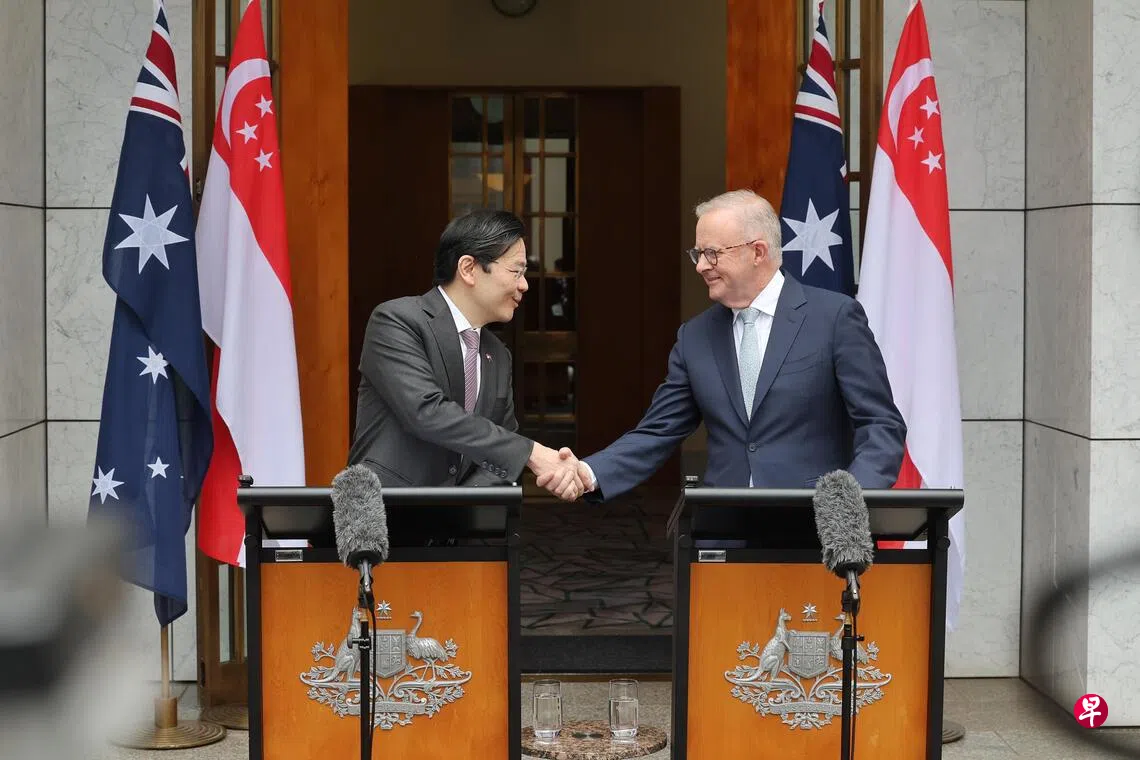
The latest cooperation agreements between Singapore and Australia will not only facilitate bilateral business ties, but could also serve as a “lighthouse”, helping show the way for deeper integration of Southeast Asia and deeper integration between ASEAN and Australia.
Prime Minister Lawrence Wong spoke about what bilateral cooperation means for the two countries’ peoples and the region at a joint press conference in Canberra on Tuesday (24 November), after co-chairing the 11th Singapore-Australia Annual Leaders’ Meeting with Australian Prime Minister Anthony Albanese.
The cooperation outcomes announced that day covered areas including supplies of essential goods, artificial intelligence (AI), and cross-border carbon capture and storage. Wong said these agreements might not seem immediately relevant to Singaporeans on a day-to-day basis, but would bring the two countries closer together and open up more opportunities.
“These are all agreements that eventually will mean ease of doing business for Singaporeans, more opportunities for our companies, more jobs for Singaporeans. We think that will, in the end, create more opportunities for both Singaporeans and Australians.”
Albanese said the relationship was very strong, but there were new opportunities as well. Both countries had very strong education systems and business communities, he said, and could further explore whether regulatory barriers or inconsistencies were impeding trade and economic engagement.
Singapore will assume the rotating ASEAN chairmanship next year and work to further deepen the bloc’s ties with external partners. Australia was ASEAN’s first dialogue partner and is an important partner with which Singapore hopes to deepen regional cooperation.
Wong said Singapore and Australia shared a similar perspective on openness, free trade and a rules-based global system. Their bilateral cooperation could also serve as a “lighthouse” for other parts of Southeast Asia, helping show the way for deeper integration of Southeast Asia and deeper integration between ASEAN and Australia.
“Whether it’s on energy, whether it’s on supply chains, whether it’s on AI cooperation, we hope we can show the way between Australia and Singapore first, and eventually have these solutions and cooperation scaled throughout the region.”
Southeast Asia must retain autonomy amid US-China rivalry
Over the past week, Wong and Albanese attended the ASEAN Summit and the Asia-Pacific Economic Cooperation (APEC) Economic Leaders’ Meeting. Both also met separately with US President Donald J. Trump and Chinese President Xi Jinping on the sidelines of the meetings.
Amid China-US strategic competition in the Asia-Pacific, Wong said Singapore was friends with both the US and China and would continue to engage both superpowers. Like other countries in the region, Singapore did not want to be forced to choose sides.
Importantly, Southeast Asia must preserve its strategic autonomy, with the space to manoeuvre and choose its own future.
He said this required Southeast Asia to continue engaging the US and China while strengthening ties with other major partners around the world. During its rotating ASEAN chairmanship next year, Singapore would seek to deepen the bloc’s ties with partners including Canada, the EU and the Gulf Cooperation Council.
Wong said ASEAN’s partnership with Australia was critical in this context, and both sides wanted to deepen cooperation. “I do believe in our chairmanship year, there will be potential for us to bring Australia and ASEAN even more closely together.”
Albanese, for his part, said the US was Australia’s most important ally, while China was its most significant trading partner. He said Australia and Singapore, as like-minded countries, could play important roles by working together to make sure that no country was dominant and that sovereignty was respected around the world.
He said the two countries should also work together to support the multilateral system, including the UN, APEC and ASEAN.
Albanese also said Australia’s relationship with ASEAN’s 11 member states was critical to its economic future, as well as important to its national security and engagement in the region. “The fact that our relationship is so strong is, I think, a big plus for Australia.”
