

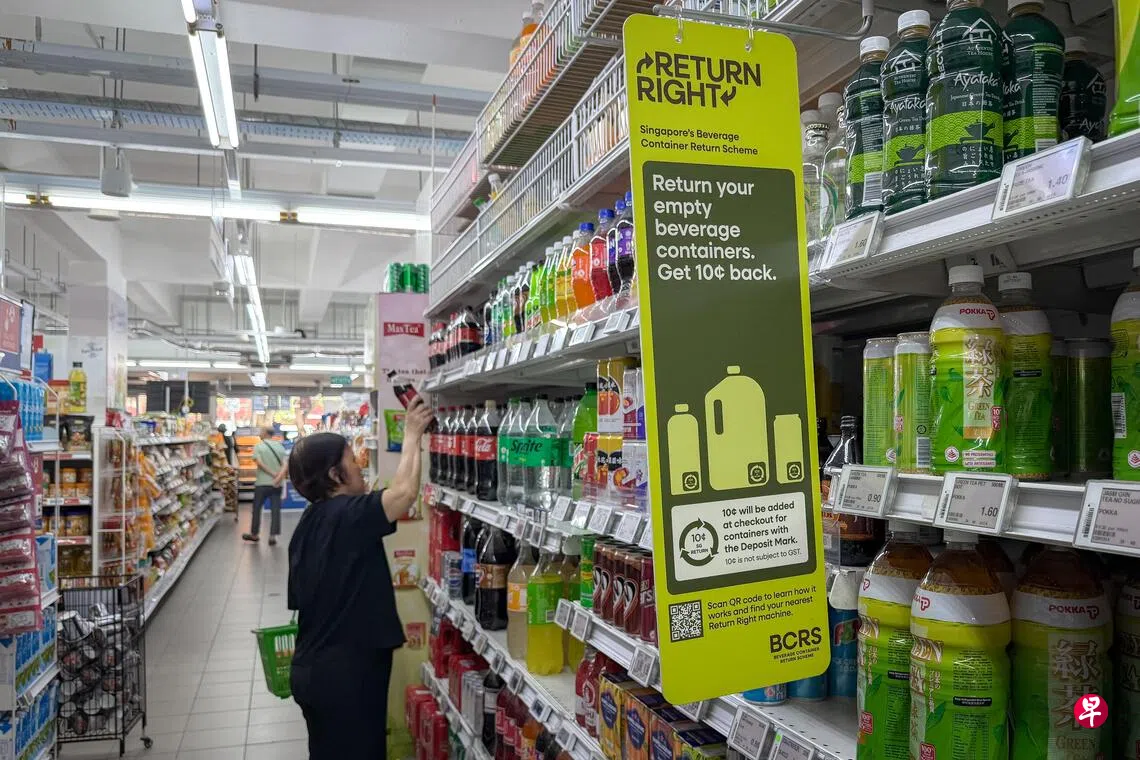
To tackle the growing challenge of packaging waste more comprehensively, the Singapore Environment Council has proposed building on the Beverage Container Return Scheme (BCRS) to bring all types of packaging waste across all industries within the recycling regulatory framework. It also suggested exploring how to charge packaging producers and importers fees based on their environmental impact.
On Wednesday (25 November), the council released a report, Beyond BCRS: A Roadmap for Comprehensive Packaging Responsibility (《超越BCRS:全面包装责任路线图》), exploring how to expand the Extended Producer Responsibility (EPR) framework to help Singapore achieve the goals of its Zero Waste Masterplan.
The council noted that while the Beverage Container Return Scheme, launched in April this year, marked an important milestone, the vast majority of packaging remains outside its scope.
The report envisages a regulatory framework covering all packaging materials, including plastic, paper, cardboard, glass and metal. Besides improving material recycling rates, the expanded scheme would discourage excessive packaging and promote the use of packaging materials with a lower environmental impact.
Proposed eco-modulated fees to encourage businesses to reduce excessive packaging
The council set out four main recommendations: covering more packaging materials, establishing multiple complementary channels for collecting packaging waste, introducing “eco-modulated fees”, and strengthening public-private partnerships.
The introduction of the Beverage Container Return Scheme marks the first expansion of Singapore’s EPR framework since it began regulating the recycling of electronic products in 2021.
The council recommends expanding the range of packaging materials and industries covered by the EPR framework, while tailoring collection channels to the characteristics and recycling requirements of different materials to reduce contamination and improve recovery rates.
Similar eco-modulated fee mechanisms are already in place in some European countries and the US. Unlike the deposit-refund model used by the Beverage Container Return Scheme, this mechanism charges packaging producers and importers a fee.
Under this mechanism, producers that place large volumes of packaging on the market, or use less sustainable materials, may have to pay higher fees. This is intended to encourage businesses to reduce unnecessary packaging and improve their designs, while providing additional resources for the collection and recycling of packaging materials.
The report suggests that in the short term — one to three years — technical experts, industry representatives and policymakers could jointly develop a framework, gathering data through Mandatory Packaging Reporting and life cycle assessments. In the medium term — three to five years — a uniform fee could first be applied to all packaging materials, with a gradual transition to a full eco-modulated fee system once higher-quality packaging data becomes available.
Research and pilot projects over the next three years
The council recommends a phased approach to the related research and pilot projects over the next three years.
The research would include gathering data to help develop an eco-modulated fee framework, exploring potential packaging alternatives, and assessing the operational viability and cost-effectiveness of public-private partnership models.
Pilot projects could test collection methods, sorting arrangements, transport logistics and recycling pathways for different packaging materials to build practical experience.
Singapore Environment Council executive director Zheng Guosong said: “Our report highlights the opportunity to explore a more comprehensive approach that encourages businesses to reduce unnecessary packaging, improve packaging design and take greater responsibility for the materials they place on the market.”
Dr Janil Puthucheary, Senior Minister of State for Education and Sustainability and the Environment, was the guest of honour at the report’s launch. In his speech, he said careful consideration was needed when deciding whether and how to extend EPR to other types of packaging waste.
“We are a small, dense city-state, and what is workable here depends on our infrastructure and how our businesses operate. We need to understand the costs and practical implications across the value chain, so that any future system delivers real results without placing an unnecessary burden on stakeholders.”
