

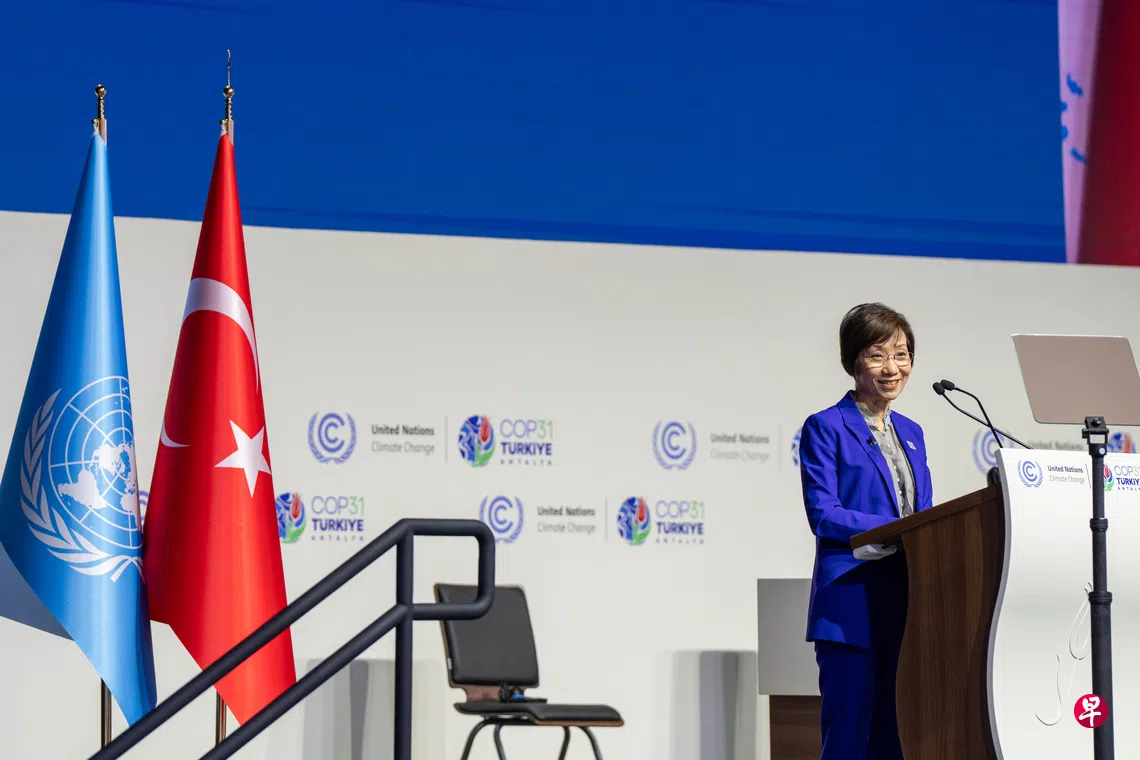
Singapore has launched a new programme to provide technical assistance, climate finance, grants and advisory services tailored to developing countries’ needs, helping them cope with the impact of climate change. Singapore will also donate US$500,000 (about S$640,000) to help Pacific countries strengthen their resilience to climate risks.
Minister for Sustainability and the Environment Grace Fu announced the Singapore Green Cooperation Programme (SGCP) while delivering Singapore’s national statement at the 31st UN Climate Change Conference (COP31) on Tuesday (17 November).
The new programme comes under the Singapore Cooperation Programme, launched in 1992. It builds on the Sustainability Action Package introduced in 2023, bringing together existing assistance programmes and broadening the scope of support.
New programme focuses on three areas of climate cooperation
The National Climate Change Secretariat said in a statement that Singapore hopes the SGCP will augment traditional technical assistance with a broader suite of solutions that better meet partner countries’ needs.
The new programme will focus on three areas of climate cooperation: helping partner countries develop policies and build capacity to develop carbon markets; strengthening their climate resilience by improving planning and response capabilities in areas such as water resources, infrastructure and agriculture; and supporting them in developing and implementing climate policies and mapping out transition pathways.
Beyond technical assistance, Singapore will also provide support in climate finance, advisory services, pilot projects and research collaboration, according to partner countries’ needs.
In research collaboration, for example, Singapore can help countries in the region develop more reliable and cost-effective methods for carbon measurement at scale through its Research, Innovation and Enterprise (RIE) plans. This would enhance the credibility and quality of nature-based carbon projects in Southeast Asia.
Small island developing states often bear the brunt of climate change, with Pacific island countries particularly hard hit. Rising sea levels and extreme weather threaten local livelihoods and prospects for sustainable development.
Singapore will therefore make a one-off contribution of US$500,000 to the Pacific Resilience Facility (PRF) under the SGCP. The donation will support small-scale community projects in the Pacific, helping local communities strengthen their capacity to cope with climate change and natural disasters.
The PRF is the first Pacific-owned and led regional financial institution, established under the architecture of the Pacific Islands Forum. The forum has 18 members, including Australia, Papua New Guinea, Tuvalu and Fiji.
The National Climate Change Secretariat’s statement said the SGCP reflects Singapore’s firm belief in South-South cooperation — cooperation among developing countries — and its commitment to practical, mutually beneficial climate action. The authorities will release more details of the programme in due course.
The national statement on climate change outlined Singapore’s efforts to reduce emissions and tackle climate change, including developing alternative energy sources, strengthening coastal defences, drawing up heat resilience plans, bolstering food security and promoting regional cooperation.
Fu noted that climate change continues to outpace the world’s collective response. Extreme weather is placing growing pressure on communities, livelihoods and critical infrastructure. This year’s European heatwaves and floods in Asia reinforce the urgency of climate action — not only to reduce emissions and limit further warming, but also to strengthen the resilience of communities and critical systems against escalating climate risks.
“The next phase of global climate cooperation must place greater emphasis on implementation. It will require us to focus less on declarations alone, and more on the practical work of delivery. It will require patience, pragmatism and partnership. It will require us to preserve multilateral cooperation, even when consensus is difficult.”
