

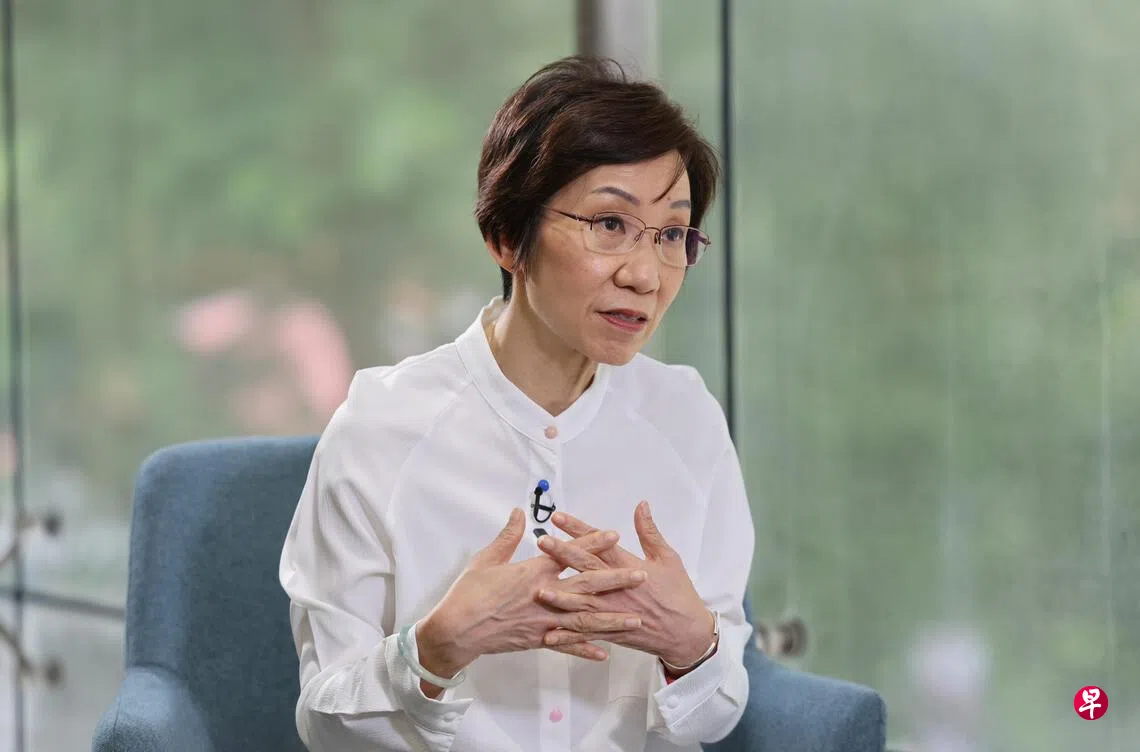
The United Nations Framework Convention on Climate Change (UNFCCC) has nearly 200 parties, and Singapore can advance its positions effectively only by taking part in person. Singapore will also use this year’s climate change conference to learn from other countries about alternative energy.
Minister for Sustainability and the Environment Grace Fu will lead Singapore’s delegation to the 31st UN Climate Change Conference (COP31) in the middle of this month, her sixth time doing so as a minister.
At previous conferences, Fu was invited to co-facilitate ministerial consultations on Article 6 of the Paris Agreement with ministers from other countries, advancing negotiations on international carbon market mechanisms.
When asked why Singapore actively participates in the global climate summit, she said in an interview last Thursday (5 November): “We want to bring forward our national position at the UNFCCC, to explain our pathways. So it's important for us to be in the room.”
At the 30th UN COP in Belém, Brazil, last year, parties formally adopted 59 indicators to track progress on climate adaptation, but have yet to agree on how to put them into practice.
Citing this example, Fu said how these indicators are put into practice will have a significant impact on Singapore, which will ultimately have to adopt and implement them. Singapore therefore wants to be involved in the process of finalising the indicators.
Climate finance in focus, with opportunity to showcase Singapore’s contributions
Climate finance is expected to remain a key topic at this year’s conference.
Beyond taking part in negotiations, Fu said Singapore also hopes to show that some countries are making voluntary contributions to climate finance. Examples include Singapore’s Financing Asia’s Transition Partnership (FAST-P) and its efforts to develop carbon markets.
Singapore’s greenhouse gas emissions are expected to peak at about 64.43 million tonnes in 2028. Its emissions reduction target is to bring this down gradually to 62.51 million tonnes in 2030, with a net emissions target of 60 million tonnes after offsets through international carbon credits.
Singapore has signed carbon credit implementation agreements with 12 countries. Those with Bhutan, Ghana, Peru, Rwanda, Thailand and Mongolia are operational, allowing developers to apply for authorisation for eligible projects and paving the way for cross-border trading. Fu expects trading in the first carbon credits to begin in 2027.
Singapore is also actively developing alternative energy to reduce carbon emissions, and the climate conference offers an opportunity to exchange ideas with other countries.
Fu said Singapore is exploring options such as biomethane and geothermal energy. It is just starting out in many of these areas, while other countries are far ahead, so it hopes to use the opportunity to gather more information and learn from them.
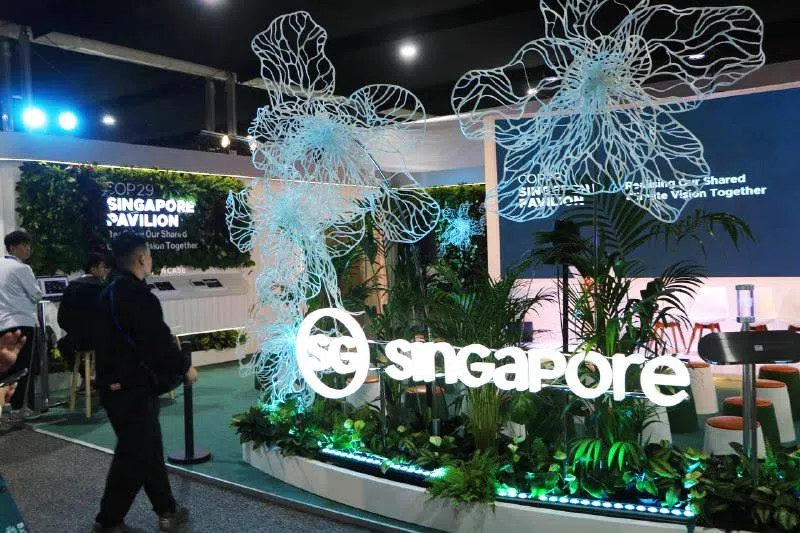
Singapore Pavilion builds connections to advance climate action
Singapore has set up a Singapore Pavilion every year since the 27th climate change conference as a key platform for advancing cooperation.
Fu described the Singapore Pavilion as a “physical symbol” of Singapore’s role in building connections.
It links policy with implementation and solutions with finance, while bringing together partners across countries and sectors, including governments, business representatives, researchers and policymakers.
