

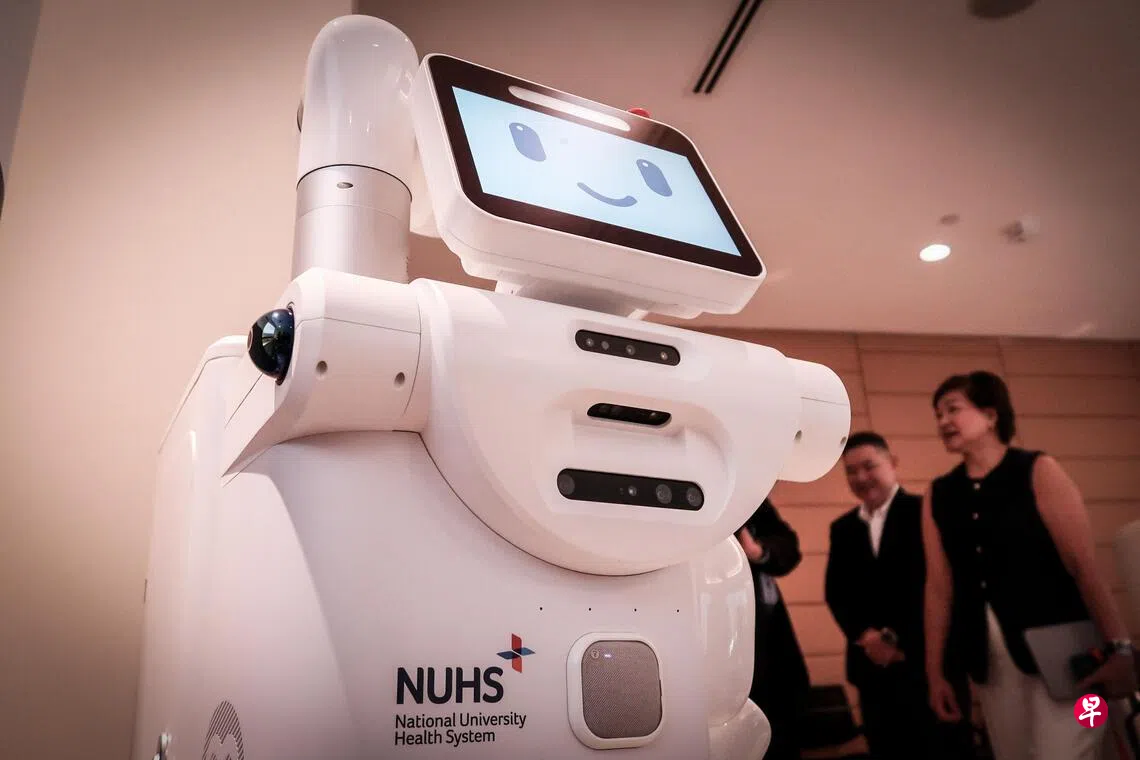
The sight of nurses constantly rushing about is often a visitor’s first impression of a hospital ward. That could change in four or five years.
The National University Health System (NUHS) plans to build a healthcare system using sixth-generation mobile communications technology (6G), with robots taking over more nursing tasks.
On Tuesday (3 November), NUHS signed a memorandum of understanding with Singtel and Swedish telecommunications technology company Ericsson to jointly develop a 6G healthcare system.
One joint project aims to develop a fleet of service robots by around 2030 to take over many of the physical tasks nurses now perform in wards.
These include delivering medication and laboratory reports and measuring vital signs such as blood pressure and heart rate, freeing nurses to spend more time providing personalised care.
NUHS is one of Singapore’s three public healthcare clusters. It comprises more than ten healthcare institutions, including National University Hospital, and primarily serves residents in the west. The other two public healthcare clusters are SingHealth and the National Healthcare Group.
Under the collaboration framework, NUHS will provide clinical, academic and research leadership, Ericsson will contribute expertise in mobile network technologies, network architecture and future 6G research, and Singtel will contribute expertise in advanced network deployment and services.
6G offers tenfold speed boost and seamless AI connectivity
Experts expect next-generation 6G networks to enter service globally around 2030, offering speeds about ten times those of 5G and latency of only about a tenth.
This means 6G could enable seamless integration between artificial intelligence (AI), robots and various control systems, significantly improving real-time information transmission and service capabilities.
To advance future healthcare applications of 6G networks, the three parties also established the National University XG AI Centre (NXAC) on the day of the signing.
According to the partners, NXAC will be the world’s first 6G AI centre dedicated to healthcare. The name “XG” reflects the Centre’s longer-term ambition to span successive generations of network technology, from 5G today towards 6G and beyond.
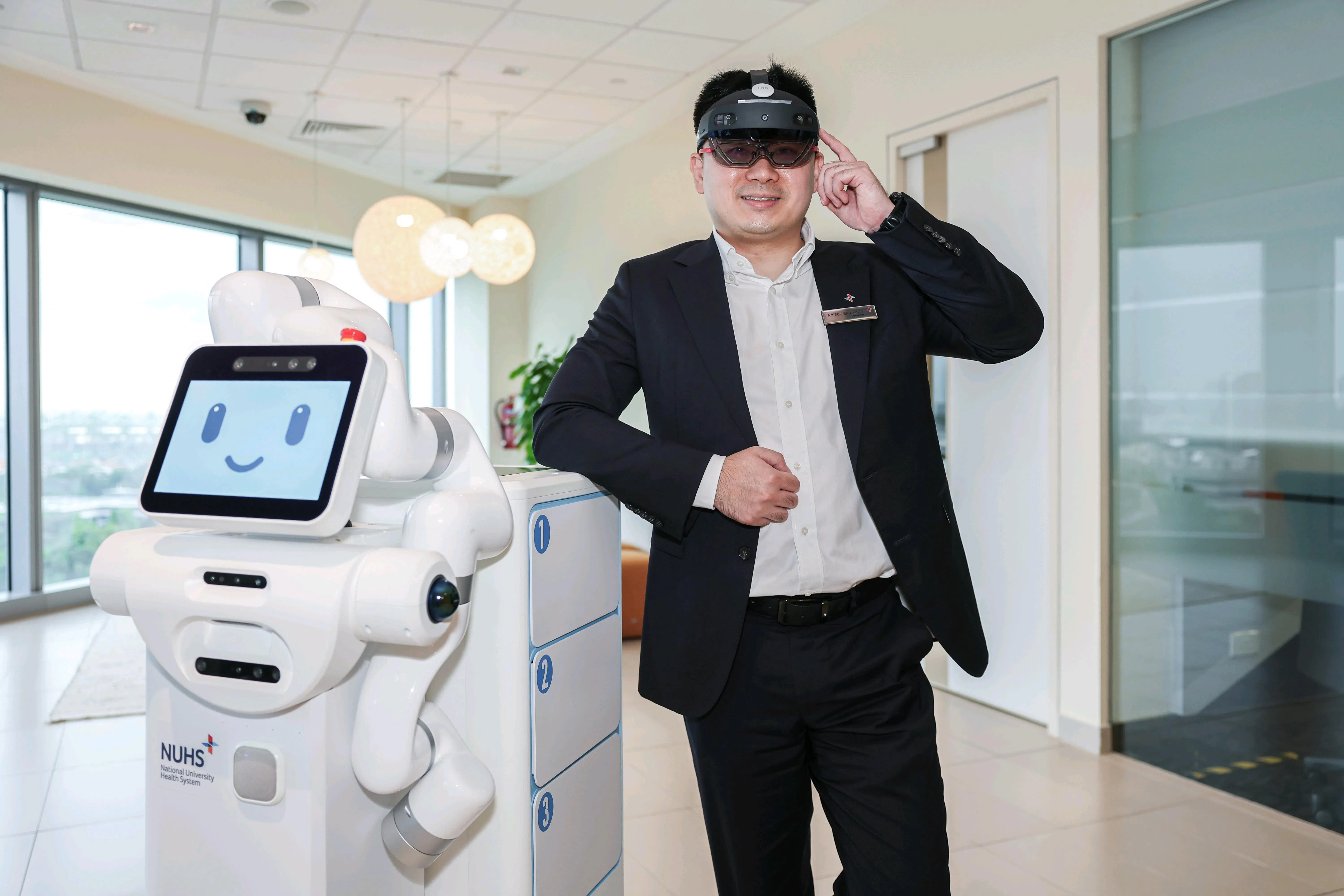
Adjunct associate professor Gao Yujia, centre director of NXAC, who is just 39, said the new centre provides a platform for industry experts and healthcare professionals to jointly develop and validate healthcare applications using next-generation network infrastructure and AI.
A research and development team of about 20 people is expected to be assembled by next year.
In an interview with Lianhe Zaobao (LHZB), Gao said the centre is developing service robots powered by AI and 5G networks to deliver medication, measure vital signs, converse with patients and answer general queries. In the future, 6G networks will allow these services to run more smoothly.
As for the fact that robots will be taking over some nursing duties, he stressed: “Using robots will not reduce our need for nurses. Only the nature of their work will change.”
He explained that repetitive tasks currently take up much of nurses’ time. With the help of robots, nurses will have more time to provide face-to-face care, including asking patients more detailed questions about their condition and offering advice.
NXAC will also develop ways to connect medical devices and wearables to support day-to-day hospital operations and extend care beyond hospitals to settings such as patients’ homes and nursing facilities. The centre will also develop new technologies in areas such as surgical support.
Daniel Ode, head of Ericsson Singapore, Brunei and Philippines and Global Customer Unit Singtel, said: “Next-generation healthcare applications such as robotic surgery, holomedicine, and remote monitoring demand deterministic network performance that cannot be compromised, as well as secure and reliable network support.
“By elevating clinical care standards and augmenting frontline clinical teams, we are further reinforcing Singapore's global leadership as the benchmark for the AI-native hospital.”
Ng Tian Chong, chief executive officer of Singtel Singapore, said: “As Singapore prepares for a rapidly ageing population and increasingly complex healthcare needs, we have an opportunity to fundamentally rethink how care is delivered with technology.”
