

Global climate action has slowed because of factors such as geopolitical tensions and inflation, affecting Singapore’s decarbonisation progress. To that end, Singapore will review decarbonisation plans across all sectors and take stock of overall progress towards the Singapore Green Plan.
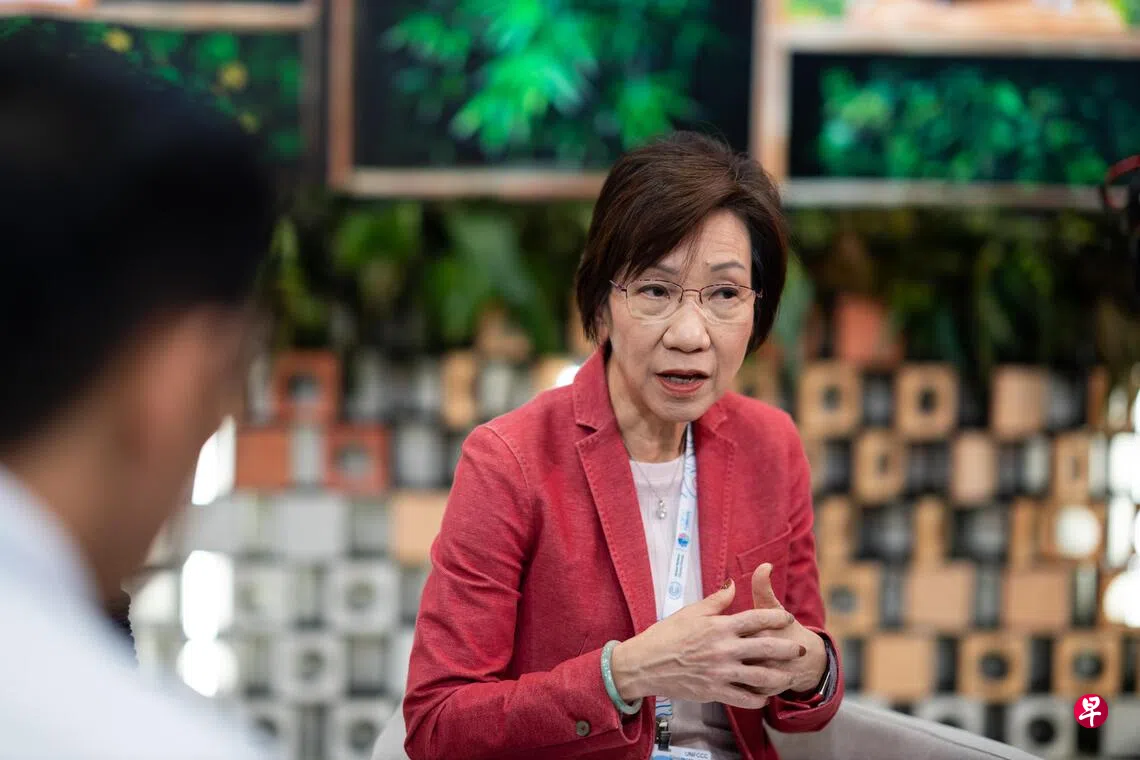
Negotiations at the 31st UN Climate Change Conference (COP31) are entering their final stretch. Minister for Sustainability and the Environment Grace Fu spoke to local and overseas media on Friday (20 November) about the challenges that changes in the international landscape pose for Singapore’s emissions reduction efforts.
This is the sixth time Fu has led Singapore’s delegation to the annual international conference.
She said that while Singapore hoped countries could reach a consensus at the conference, the reality was that global climate action had slowed. Singapore depends heavily on international partnerships and can move only as fast as the rest of the world, particularly in decarbonising its energy sources.
“I think it's about time for us to take stock, and we will take guidance from what we see as the international movement on global climate action, and then to basically look at some of our plans and ask ourselves whether the plans require adjustments.”
Launched in 2021, the Singapore Green Plan 2030 sets clear targets for the energy transition, urban greening, sustainable living, the green economy and building a resilient future.
On the carbon tax, for example, Prime Minister Lawrence Wong said in his Budget statement earlier this year that if global climate action continued to lose momentum, Singapore might set its carbon tax towards the lower end of the S$50 to S$80 per tonne range by 2030.
To achieve its target of net-zero emissions by 2050, Singapore has embarked on bilateral carbon market cooperation with about 30 countries since 2022. During this year’s climate conference, Singapore approved its first carbon credit project in Rwanda. The project promotes ceramic water filters to reduce carbon emissions from residents burning charcoal to boil water.
Talks with international counterparts on closer carbon market cooperation and standardising processes
Fu said she had met counterparts from the EU, Norway, Republic of Korea, Lao PDR, Philippines, Rwanda and Peru over the past week to explore further cooperation in developing Article Six markets. These are major buyers and host countries with which Singapore works well.
She said there was scope for buyers and host countries to work more closely together. As carbon markets expand, differing processes and administrative requirements sometimes increase the time and resources needed for compliance. “it's time for us to look at how we can reduce compliance costs, reduce administrative burden, and to enable faster onboarding of some of the host countries.”
She explained that, to ensure carbon credits are not double-counted, buyers and host countries each have their own assessment criteria and requirements. Whenever Singapore works with another country, both sides must go through the process of aligning their requirements. They could therefore explore harmonising these processes and establishing a common template. She stressed that this was not a standardisation of laws, but a standardisation of processes.
