

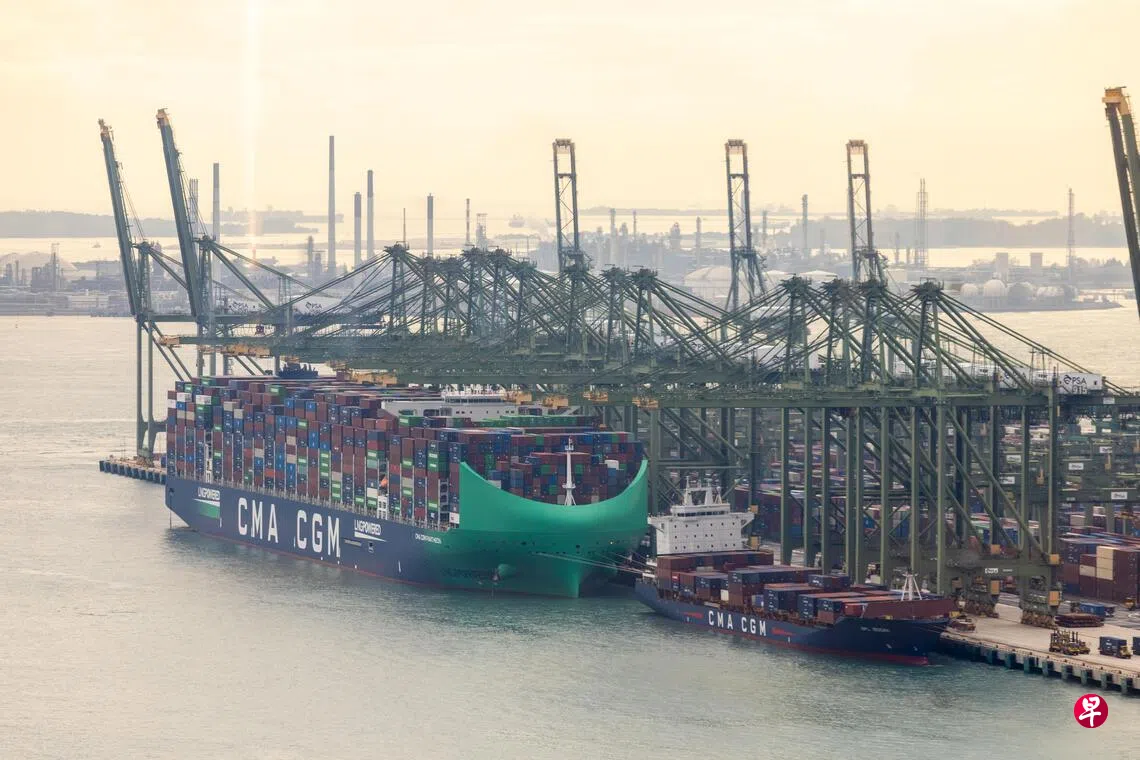
Singapore’s maritime sector is seeing early results from efforts to broaden its fuel options. Ships are increasingly taking on cleaner fuels, with alternative fuels recording annual increases in both bunker sales and market share.
Methanol, liquefied natural gas (LNG) and biofuels can all replace conventional fuel oil. They produce lower carbon and sulphur emissions when burnt, making them cleaner marine fuels. For example, burning fossil LNG releases about 20% less greenhouse gas than heavy fuel oil (HFO), a conventional marine fuel. Bio-LNG produces even lower emissions.
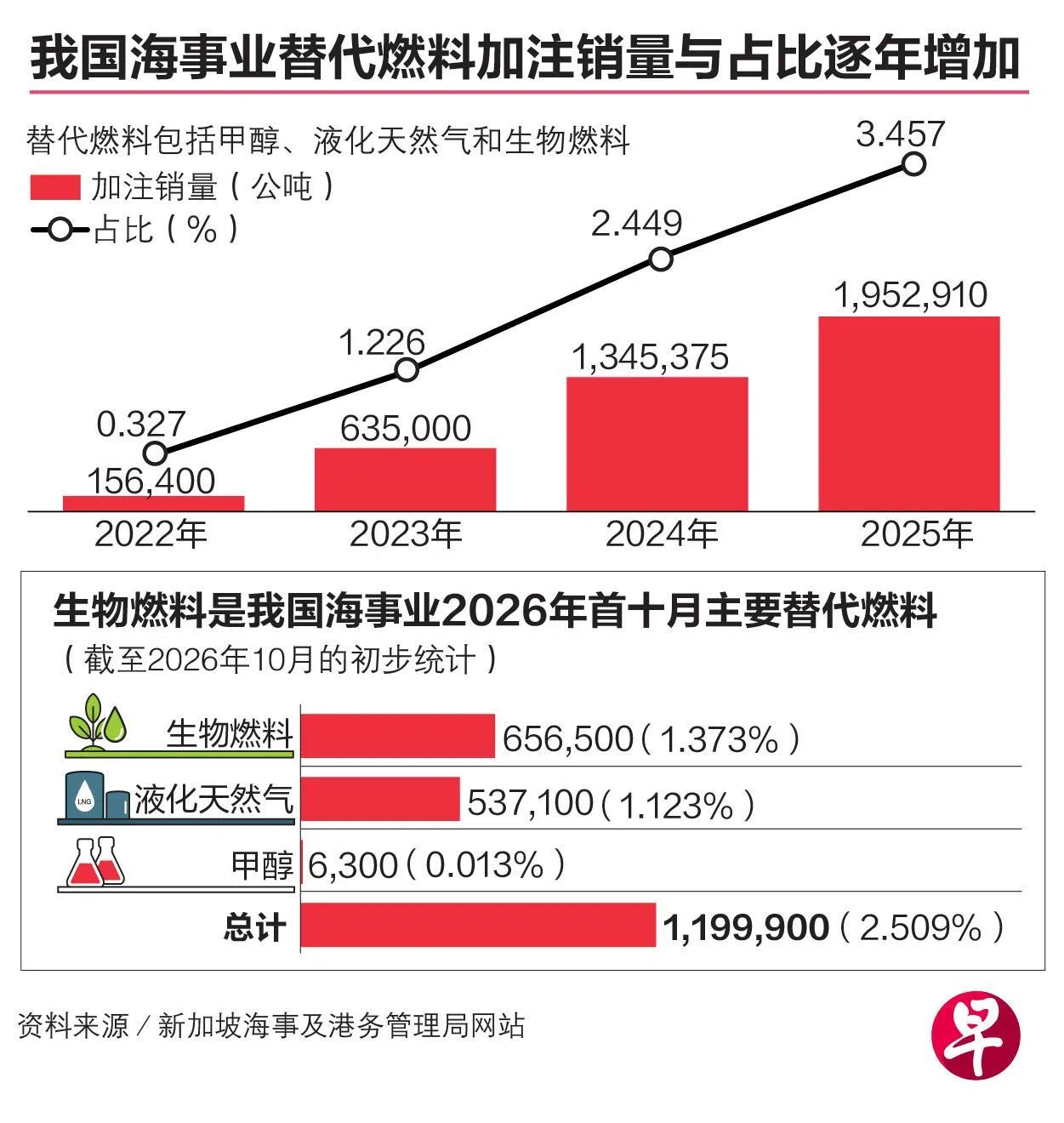
Data on the Maritime and Port Authority of Singapore website show that alternative fuel bunker sales in Singapore reached 1,952,910 tonnes last year, accounting for 3.457% of total bunker sales. Both figures have been rising since 2022.
After Singapore released its Maritime Singapore Decarbonisation Blueprint in 2022, alternative fuel bunker sales increased more than threefold from 156,430 tonnes that year to 635,000 tonnes in 2023, before doubling to 1,345,375 tonnes in 2024. These accounted for 0.327%, 1.226% and 2.449% of total bunker sales in the respective years.
Preliminary figures show that sales of these cleaner bunker fuels totalled 1,199,900 tonnes in the first ten months of this year, or 2.509% of total bunker sales over the same period.
Under the Maritime Singapore Decarbonisation Blueprint, Singapore will step up decarbonisation efforts in seven areas, including port terminals; domestic harbour craft; the Singapore Registry of Ships; future marine fuels, bunkering standards and infrastructure; and efforts at the International Maritime Organization and other international platforms to support global maritime decarbonisation.
In recent years, the Maritime and Port Authority of Singapore has introduced a series of decarbonisation measures. These include installing a solar power system at Marina South Pier; requiring all new harbour craft operating in Singapore’s port waters to be fully electric from 2030 or use net-zero-emission fuels; expanding alternative fuel supply capabilities; and exploring new fuels such as ethanol.
International Maritime Organization discusses implementation of net-zero framework
As a member of the International Maritime Organization (IMO), Singapore is also actively involved in discussions to develop the Net Zero Framework.
Under a proposal put forward by the organisation last year, the framework would establish a four-tier pricing mechanism, classifying ships as ultra-low-, low-, high- or ultra-high-emission vessels and imposing charges or providing rewards accordingly.
Ships in the ultra-low-emission category, which run entirely on zero- or near-zero-emission fuels, would receive financial rewards. Low-emission ships would earn “Surplus Units”, similar to carbon credits, which could be banked for up to two years, traded or transferred.
Ships exceeding emissions limits would be divided into two further tiers. Those below a specified threshold could buy “Remedial Units” to offset excess emissions. Those above it would have to use compliance units banked in previous years, buy Surplus Units from low-emission ships or purchase Remedial Units at a higher price.
The proposed IMO Net-Zero Fund would handle transactions in Remedial Units. Proceeds from their sale would be used to reward ultra-low-emission ships, support decarbonisation in developing countries, and develop the organisation’s capacity-building efforts and strategies, among other purposes.
However, disagreements among member states prevented the draft from being adopted as scheduled at an extraordinary session of the IMO’s Marine Environment Protection Committee last year. Negotiations were deferred until the end of this year for further consideration. The current meeting opens on Monday (30 November), with issues including reward and penalty mechanisms and standards, target deadlines and the fund’s governance system still to be discussed.
About 60% of Singapore-registered ships expected to be affected by net-zero framework
Prof Ng Szu Hui, who leads maritime decarbonisation research at the Centre of Maritime Studies at the National University of Singapore (NUS), said in an interview that the IMO Net Zero Framework’s main value lies in establishing a uniform global standard for greenhouse gas fuel intensity. Ng is also a professor in the Department of Industrial Systems Engineering and Management at NUS’s College of Design and Engineering.
“While hurdles remain before a deal can be finalized, the breadth of compromise proposals being put forward is an encouraging sign that governments and industry stakeholders are actively working to find a workable path forward for global shipping.”
The proposed framework would apply to ocean-going ships with a gross tonnage exceeding 5,000 tonnes. Ng noted that the Singapore Registry of Ships is the world’s fourth-largest ship registry and caters primarily to international commercial shipping. Measured by gross tonnage, about 62% of Singapore-registered ships exceed 5,000 tonnes.
This means that a Net Zero Framework adopted by the IMO could directly affect Singapore-registered ships.
Ng said in her analysis that bunker sales data alone do not clearly reflect the maritime sector’s progress in decarbonisation. However, alternative fuel sales trends, together with the Singapore government’s trials of different bunker fuels, broadly indicate steady progress in Singapore’s multi-fuel bunkering capability.
She believes that if the framework is implemented, Singapore could capitalise on this strength to become a preferred bunkering hub for international ships, helping them take on lower-carbon fuels and earn rewards or Surplus Units.
