


Persistently high global greenhouse gas emissions, combined with a very strong El Niño, have pushed Singapore’s monthly mean temperatures to successive record highs since August. The Meteorological Service Singapore forecasts that monthly mean temperatures in November and December could also remain above the long-term average, potentially making this the hottest year on record.
Data from the Meteorological Service Singapore shows that from January to October this year, every month except February recorded a mean temperature above the 1991–2020 long-term average.
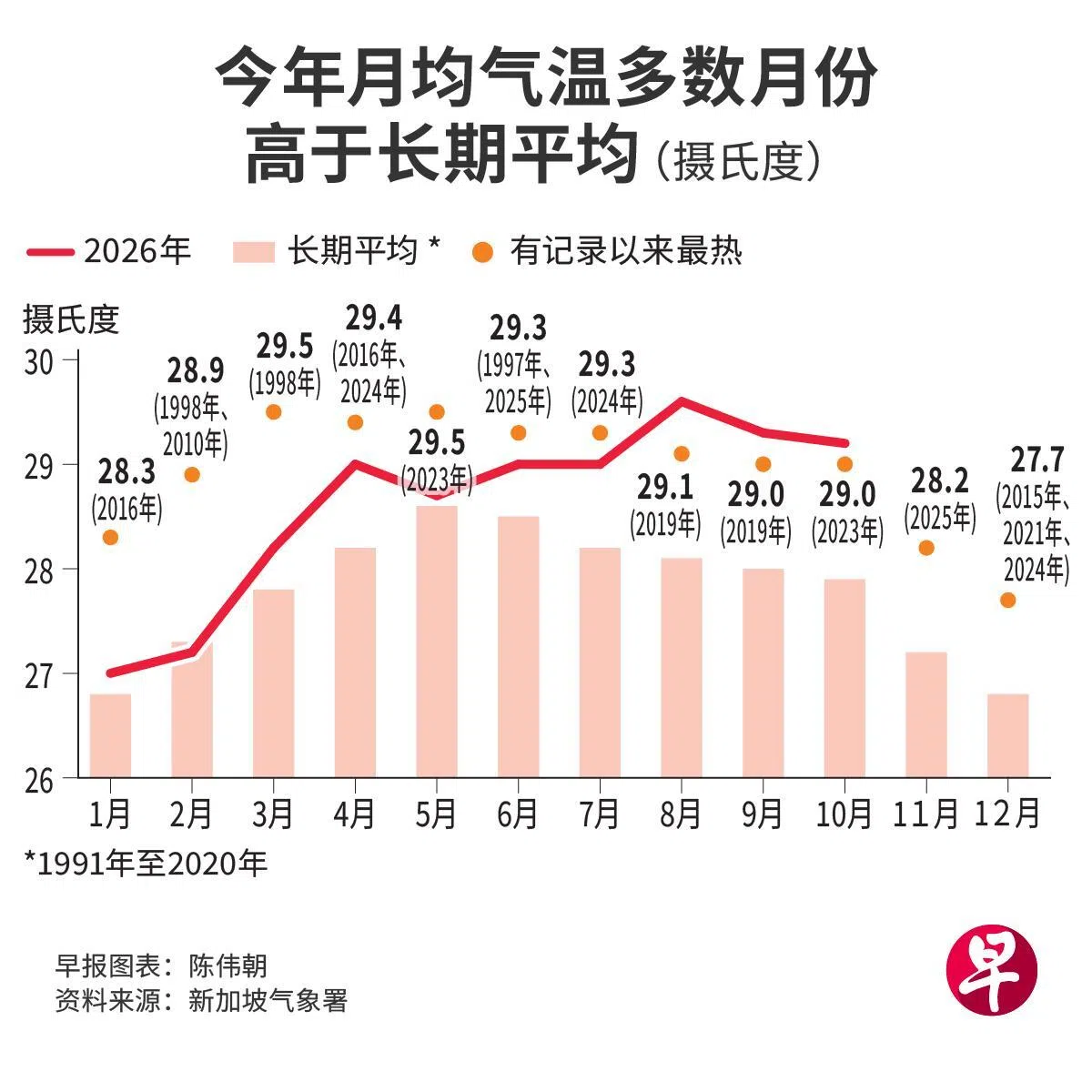
Since August, Singapore’s monthly mean temperatures have repeatedly set records for the respective months. The mean temperature in August was 29.6 degrees Celsius, exceeding the previous record for the month of 29.1 degrees Celsius. September and October recorded mean temperatures of 29.3 degrees Celsius and 29.2 degrees Celsius respectively, both surpassing the previous record of 29 degrees Celsius for each month.
In response to queries from Lianhe Zaobao, the Meteorological Service Singapore said monthly mean temperatures in November and December were also expected to exceed the long-term average. This year’s annual mean temperature is therefore very likely to match or surpass the records set in 2016, 2019 and 2024, making it the hottest year on record.
Alongside the long-term warming trend, El Niño and a positive Indian Ocean Dipole that emerged in the middle of the year, Singapore also experienced several episodes of extremely high temperatures during this year’s south-west monsoon.
In an interview, Nanyang Technological University Professor of Environmental Health, Steve Yim, explained that these factors combined to push Singapore’s daytime maximum and night-time minimum temperatures significantly above historical averages. The temperature for the full year will depend on the intensity and frequency of rainfall in late November and December.
National University of Singapore, Department of Physics, Adjunct Associate Professor in Atmospheric Science Dr. Koh Tieh Yong predicted that 2026 was highly likely to become Singapore’s hottest year on record.
He said El Niño had led to below-average rainfall in the second half of the year. Reduced cloud cover meant more direct sunlight reached the ground, keeping temperatures elevated.
El Niño is a naturally occurring warming phenomenon caused by rising sea surface temperatures in the central and eastern tropical Pacific Ocean. The El Niño that emerged this year is highly likely to persist until May next year. A positive Indian Ocean Dipole refers to a difference in sea surface temperatures between the western and eastern Indian Ocean, which affects the climate and environment of surrounding regions through interactions between the ocean and atmosphere.
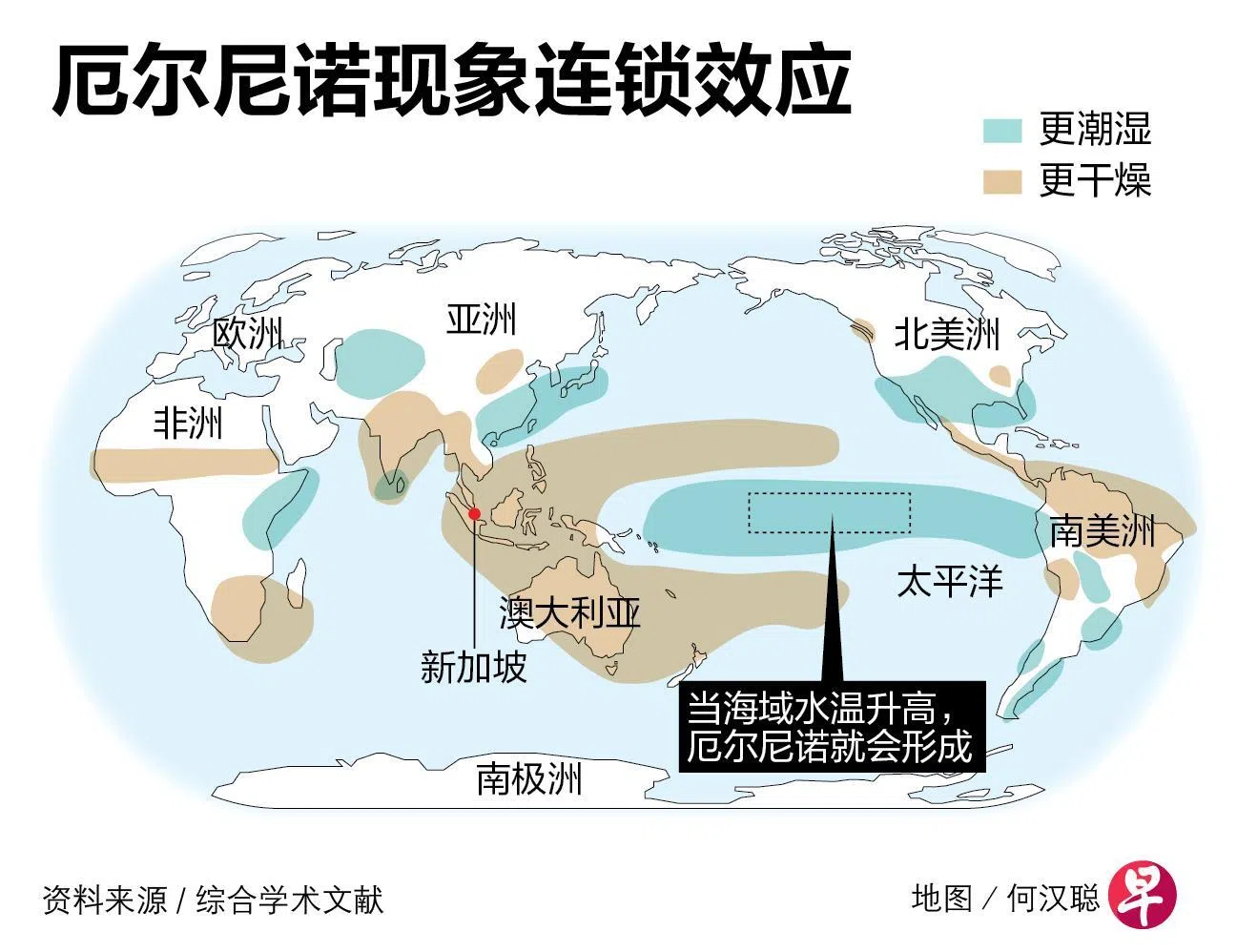
According to a 12 November assessment by the US National Oceanic and Atmospheric Administration, there is a 60% chance that El Niño will intensify to its strongest level since 1950 during the periods from October to December this year and from November to January next year.
Yim said El Niño’s warming effect on Singapore’s temperatures was usually most pronounced as it reached peak strength and began to weaken, and often persisted into the early part of the following year. “There is an ongoing need for heat health awareness.”
Global temperatures could be second-highest or highest on record
Singapore’s climate conditions are in line with global trends. A November report by the EU’s climate monitoring agency, the Copernicus Climate Change Service, said 2026 was expected to be the world’s second-hottest year on record, with a 20% chance of matching or surpassing 2024 as the hottest.
The report said the global mean temperature in 2026 would almost certainly be more than 1.5 degrees Celsius above pre-industrial levels. The average temperature rise over the four years from 2023 to 2026 was also expected to exceed 1.5 degrees Celsius.
Greenhouse gas emissions, which continue to rise unabated, are the main driver of ongoing global warming. According to the UN Environment Programme’s Emissions Gap Report 2026 (《2026年排放差距报告》), greenhouse gas emissions in 2025 were estimated at 58.4 billion tonnes, 100 million tonnes less than in 2024.
However, the report noted that greenhouse gas emissions for 2025 were still being tallied, with a wide uncertainty range of about 5.5 billion tonnes in either direction.
High temperatures not only affect human health but also have a direct economic impact. An October report by global index provider MSCI estimated that, under current environmental conditions, declines in labour productivity linked to extreme heat translated into economic losses of about US$3.9 trillion (S$5 trillion), or about 2% of global gross domestic product.
Data provided by MSCI to Lianhe Zaobao shows that Singapore incurs annual economic losses of between US$46 billion and US$49 billion (S$59.4 billion to S$63.2 billion) from the impact of extreme heat on labour productivity. By 2101, these losses could rise to about US$51 billion to US$76 billion (S$65.8 billion to S$98.1 billion), depending on climate conditions.
