Energy consumption per square metre at Singapore’s public healthcare institutions fell by 7.9% last year compared with the average baseline from five to seven years earlier, while water consumption per person fell by 22.5%. Waste disposed of per person also dropped sharply, by 29.4% over three years.
Coordinating Minister for Social Policies and Minister for Health Ong Ye Kung shared the figures in a speech at Clean and Green Singapore Day on Saturday (21 November). He said: “Even though workload and patient numbers are rising rapidly, we continue to drive decarbonisation and recycling across all our healthcare institutions.”
Referring to the Singapore Green Plan 2030, launched in 2021, he acknowledged that Singapore is a small country and that whatever measures it takes on sustainability are unlikely to have a material impact on global climate change. However, if Singapore implements the plan effectively, it can offer lessons for other countries. “I believe this is what makes our efforts worthwhile.”
The government has designated this year the “Year of Climate Adaptation” and is working with Singaporeans to develop the country’s first National Adaptation Plan, which is expected to be unveiled next year. Ong stressed that the government, businesses, communities and individuals all have a part to play in the plan.
This year’s Clean and Green Singapore Day was jointly organised by the National Environment Agency, National Parks Board and North West Community Development Council, and held at Kampung Admiralty and Woodlands Galaxy Community Club. Several exhibitions were also held at Kampung Admiralty, including the “Keep Singapore Clean 2026” (《保持新加坡清洁2026》) roadshow and the interactive exhibition “Adapting Together for a Liveable Home” (《携手适应气候共创宜居家园》).
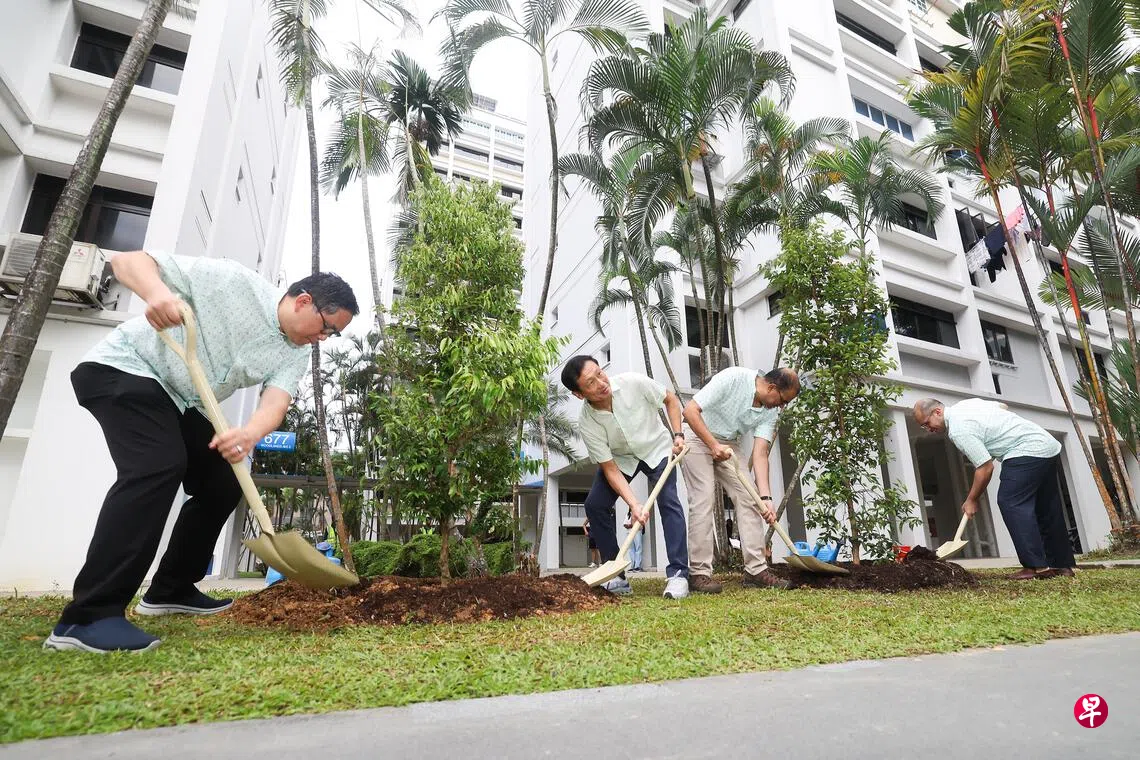
As part of the OneMillionTrees movement, Ong also took part in a tree-planting activity near Woodlands Galaxy Community Club that day. Others present included Senior Minister of State for Education and Sustainability and the Environment Dr Janil Puthucheary, Senior Parliamentary Secretary for Culture, Community and Youth and Sustainability and the Environment Goh Hanyan, Senior Parliamentary Secretary for National Development and Education Dr Syed Harun Alhabsyi, and Mayor of North West District Alex Yam. They planted a total of six trees from two native species, Syzygium zeylanicum and Gardenia tubifera.
Decathlon and local social enterprise design carrier bag for BCRS
Recycling bottles and cans is one way to go green. To promote Singapore’s Beverage Container Return Scheme (BCRS), a pilot initiative encouraging people to return their bottles and cans was introduced at the Clean and Green Singapore Day event.
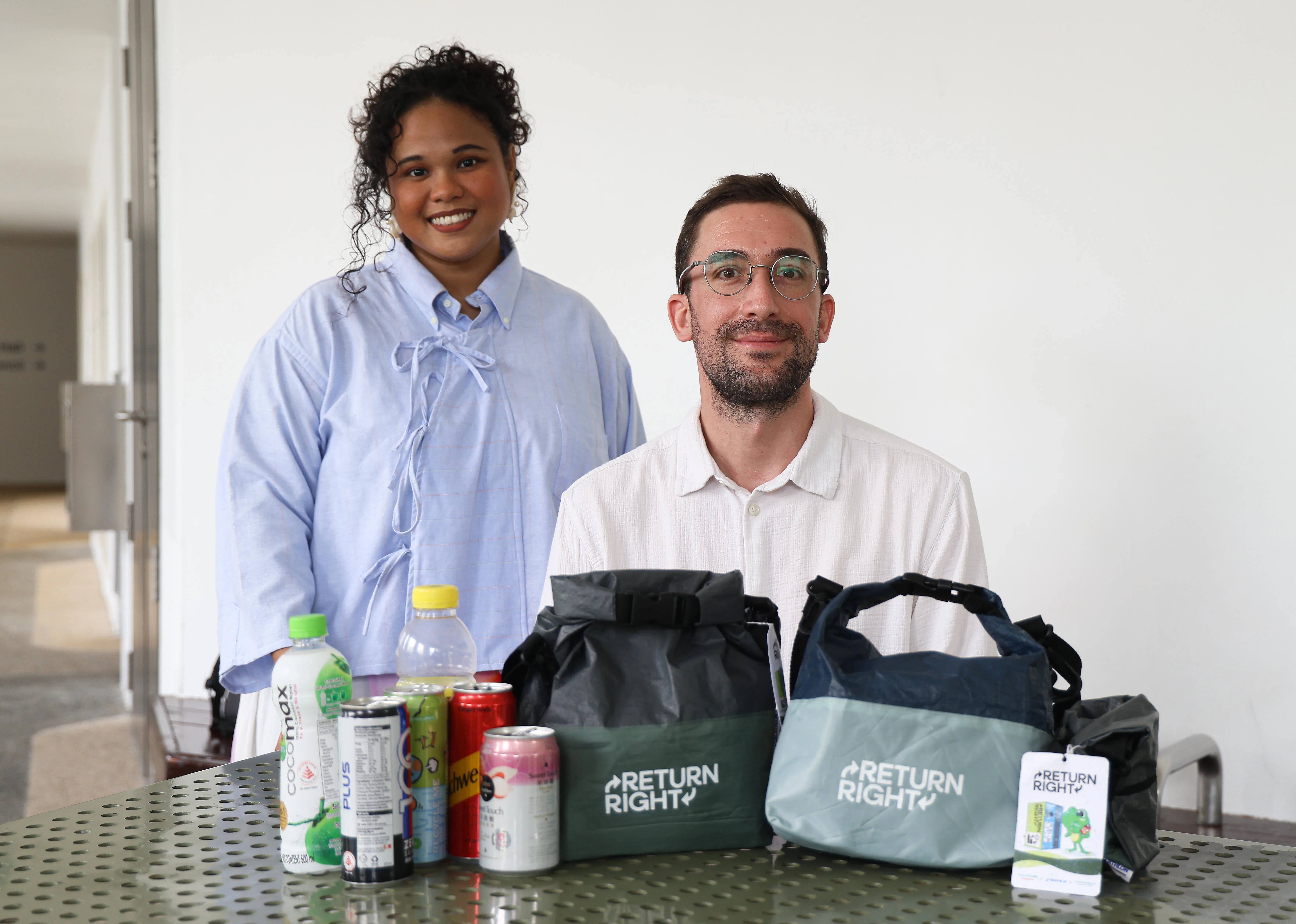
An international sports brand and a local social enterprise have jointly developed a compact, foldable recycling bag that makes it easier for consumers to carry empty beverage bottles and cans to reverse vending machines.
Made from upcycled waterproof sporting materials, the bag can hold about six cans. Elastic straps inside keep the containers upright, while a roll-top closure prevents residual liquids from leaking out.
With support from the National Environment Agency’s 3P Partnership Fund, social enterprise Commenhers contributed its upcycling expertise and network of community makers to turn unusable tents and groundsheets from sports brand Decathlon into carrier bags, creating opportunities for community engagement.
Joris Eyral, Decathlon Singapore’s circular economy transformation lead, told the media that the bag is currently at the prototype stage, with internal feedback being gathered. It is expected to go on sale next year.
Commenhers chief executive Nuryanee Anisah Mohamed Noor said in an interview that processing and repurposing the discarded materials was painstaking and difficult, as some were dirty or badly damaged. People might ask why a bag needed to be designed specifically for empty bottles and cans, she said. Its main purpose is to serve as a reminder, encouraging people to collect empty beverage containers and return them at reverse vending machines to do their part for the environment.