

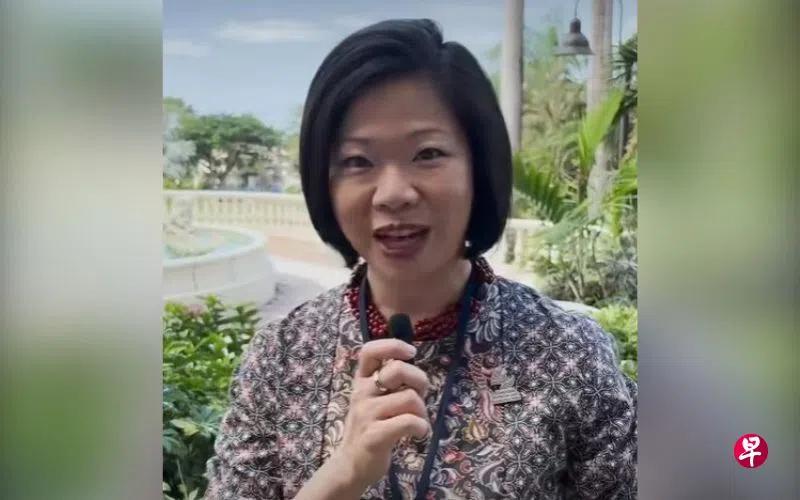
Small states may have limited land and resources, but “size need not determine our destiny”. Many small island states are also “Big Ocean States” with abundant marine resources and economic potential.
Second Minister for Foreign Affairs and Home Affairs Sim Ann urged countries to deepen cooperation and turn their development potential into tangible opportunities through innovative financing, training and institutional capacity building.
Speaking at the Commonwealth Ministerial Meeting on Small States in Antigua and Barbuda on Monday (2 November), Sim said small states were more vulnerable to external shocks such as climate change, technological disruption and geopolitical conflicts in an increasingly turbulent world. This made it all the more important for them to work together to strengthen their ability to address these challenges.
She noted that many small states have promising renewable energy and connectivity projects but often lack the funding and expertise needed to implement them. “This is where partnerships help us achieve economies of scale and unlock opportunities that may otherwise be beyond our individual reach.”
Singapore shares financing and training experience to help small states build resilience
Sim then shared Singapore’s experience in strengthening its own development resilience through innovative financing and by building human and institutional capacity.
On financing, public funds alone can no longer meet countries’ development needs. Faced with growing fiscal pressures and competing demands for funding across sectors, governments must use public funds more effectively to attract private investment, particularly into projects that investors may consider too risky.
She cited the Financing Asia’s Transition Partnership, launched by Singapore in 2023, as an example of how funds from the public, private and philanthropic sectors can be pooled to support Asia’s green transition.
The initiative has raised more than US$1 billion (about S$1.3 billion) to date. It aims to mobilise up to US$5 billion (about S$6.4 billion) to support projects such as renewable energy and energy infrastructure, advancing regional decarbonisation.
Sim said: “The underlying idea is simple: by combining public and private resources, we can unlock financing that neither could mobilise as effectively on its own.”
Beyond financing, strong institutions and a skilled workforce are equally critical to attracting investment, seizing development opportunities and sustaining long-term economic growth.
She noted that Singapore had benefited from international technical assistance in its early years of independence. Today, through the Singapore Cooperation Programme, it helps other small states strengthen their human and institutional capacity through practical training and exchanges of experience.
Singapore also launched the “SIDS of Change” package in 2024 to help other small island developing states implement the Antigua and Barbuda Agenda for SIDS and address climate change, digitalisation and other global challenges.
The package was subsequently extended. From April 2027, Singapore will offer customised courses on the use of artificial intelligence (AI) in governance and public service transformation, as well as scholarship programmes in civil aviation and maritime affairs.
To date, Singapore has shared its development experience with more than 13,900 officials from small island developing states. In August this year, it also jointly organised a course with the Commonwealth Secretariat on digital governance and the use of AI in public services.
Sim said the Commonwealth was well placed to foster closer cooperation among member states and achieve greater results. She also welcomed the Commonwealth Secretariat’s invitation to other partners to participate in the meeting and explore opportunities for cooperation in areas such as investment and capacity building.
“Singapore looks forward to working with fellow Commonwealth members to turn our shared ambitions into concrete results.”