

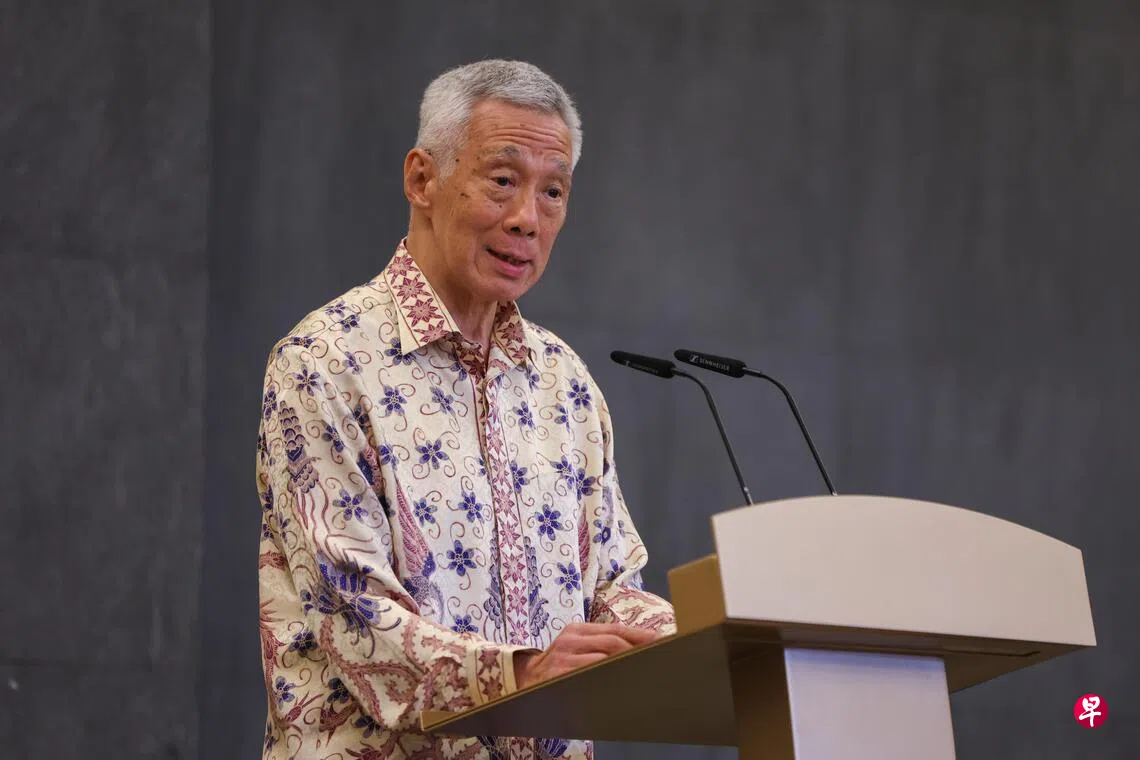
The nature of relationships between the US and its allies and partners has undergone a fundamental shift; nations are seeking greater self-reliance even as they continue to advance their ties with the US, and similar calls have also emerged in Australia. Senior Minister Lee Hsien Loong has pointed out that self-reliance does not preclude the need for friends and partners, and urged Australia to deepen its ties with Asia, particularly Southeast Asia, to create more space for pursuing its own interests.
SM Lee was invited to deliver a lecture in the Australian Broadcasting Corporation’s (ABC) annual Boyer Lectures series. In his address, he analysed changes in the international strategic environment and discussed how Australia might deepen its engagement with Asia to navigate an increasingly complex geopolitical landscape. The pre-recorded lecture was broadcast on ABC radio at about 5am Singapore time on Sunday (8 November).
This year’s Boyer Lectures are themed “Australia’s engagement with Asia in the 21st century”. SM Lee’s lecture is titled “Engaging Asia from Down Under”.
SM Lee noted that “great power rivalry is intense, multilateralism is breaking down, and the US... is reassessing its role in the world”. Countries are placing increasing emphasis on national security and resilience. Economic interdependence, once valued as a source of stability and mutual benefit, is now viewed as a strategic vulnerability. As China’s strategic and economic weight in the Asia-Pacific grows, “Pax Americana” is no longer uncontested.
Nevertheless, SM Lee said, the US will always be a Pacific power, but its relationships with allies and partners have fundamentally altered.
On security, the US now expects its allies to shoulder more responsibility for their own defence. On trade, the shift is even sharper. The US used to champion free trade and the World Trade Organisation (WTO). Now it rejects the WTO multilateral framework and levies tariffs on almost every country in the world, including allies and partners, he said. “This is no longer the international order that underpinned Asia’s stability and prosperity for decades.”
In response to these changes, countries still hope the US will stay engaged in the Asia-Pacific. This will make for a better regional balance and create more space for smaller countries to chart their own destinies. Countries are also working out how best to advance their ties with the US while becoming more self-reliant and protecting their strategic interests.
Citing Singapore as an example, SM Lee noted that Singapore is not a treaty ally of the US, but a Major Security Cooperation Partner. Singapore has always worked “on the basis that in extremis”, Singaporeans will have to rely on themselves to fight and defend their homes and families.
Australia is a treaty ally of the US and a member of the Australia-UK-US security partnership, AUKUS. Yet in recent years, there have also been calls within Australia for greater self-reliance.
SM Lee quoted former Australian Prime Minister Malcolm Turnbull, who said Australians needed “to be more self-reliant… to chart [your] own futures, and [to] do so recognising that your interests may not always be coextensive with that of the US”.
SM Lee noted that this was a very different tone from the Australian weekly The Bulletin, which suggested in 1999 that Australia should be the “deputy sheriff” to the US.
However, “self-reliance needs to be complemented by friends and partners”. SM Lee said Australia’s regional partners, apart from New Zealand, are in Asia, and especially Southeast Asia. “The deeper your relationships are across Asia, the more space you will have to pursue your own interests.”
He suggested that Australia engage Asian countries through win-win projects in areas such as the digital and green economies, public health and counterterrorism. The more dimensions these projects encompass, the more countries will see each other as partners in development, and not solely through the prism of US-China rivalry.
Australia urged to stay engaged in regional security and strengthen cooperation
On how Australia should deepen its engagement with Asia, SM Lee urged it to stay present in regional defence and security affairs, and to grow and enhance its existing partnerships with like-minded countries.
“With countries where ties are more complicated, we hope you will nevertheless maintain contact and pragmatic working arrangements.”
He noted that these countries include Australia’s most important export markets, and their influence in regional affairs cannot be overlooked. Even though issues of security and mutual trust will inevitably arise, both sides should still work to deepen understanding and maintain stable relations.
He also noted that working channels of communication between armed forces are important, especially should incidents occur. However, regional security depends not just on a balance of military power, but also on a sound regional architecture.
He noted that Australia had helped establish the Asia-Pacific Economic Cooperation forum (APEC) and played an important role in bringing about the Comprehensive and Progressive Agreement for Trans-Pacific Partnership (CPTPP). These efforts demonstrated its ability to bring countries together and build frameworks for cooperation.
He said Australia could continue to draw on these strengths to build practical arrangements on trade, pandemic preparedness and climate change. “In a fragmented world, this role will become even more valuable.”
Australia’s investment in ASEAN remains limited, with considerable scope for economic cooperation
SM Lee urged Australia to keep its economy open and strengthen its trade and investment links with Asia.
He noted that ASEAN is the fifth largest economy in the world, a market of 700 million people with a growing middle class. Although Australia’s trade with Southeast Asia continues to grow, it invests no more in the ASEAN countries put together than it does in New Zealand, showing considerable scope to invest more in Southeast Asia.
Australian Bureau of Statistics figures show that as of the end of 2025, Australia’s total investment in ASEAN countries stood at about A$103.6 billion (S$91.2 billion), less than half the A$221.6 billion it had invested in New Zealand.
SM Lee noted that Australia has strong capabilities in critical minerals, agri-business, renewable energy, and digital and deep tech, which complement those of Southeast Asian companies. By investing more in the region, Australian businesses can strengthen both their competitiveness and their supply chains.
He said countries should not give up on the multilateral trading system, but must also be pragmatic. Where global consensus is not possible, they should pursue next-best solutions. This means making full use of existing trade agreements, updating and extending them, and linking them up with other major economic groupings, such as the EU.
SM Lee stressed that staying open and strengthening connections with other countries would, in fact, make Australia more resilient.
He cited the recent arrangement on the supply of essential goods between Singapore and Australia. The two countries agreed to keep goods such as diesel, petrol and natural gas flowing in both directions during a crisis or supply disruption. Similar arrangements could also help safeguard food supplies. “These are practical ways to secure our supply chains through mutual trust and cooperation.”
He also stressed that Australia should continue to nurture its people-to-people ties with Asian countries. Educational exchanges and migration have built deep personal networks between them and helped foster mutual understanding.
However, he noted that the issue of immigration needed to be handled with care. “Citizens need to feel that their interests are being looked after, and that they continue to have a stake in their own society.” He said Australia’s ties with the region would be stronger when Asian tourists feel welcome, Asian students feel safe and at home, and residents of different backgrounds live harmoniously together.
On Singapore-Australia relations, SM Lee noted that while the two countries differ greatly in land area and natural resources, both societies are “egalitarian and informal”, their cultures are “open and direct”, and they have “compatible strategic perspectives”.
By comparison, “Australia is less similar to many other Asian countries than to Singapore. Yet it is possible, and necessary, for Australia and Asia to understand each other better and make common cause in an uncertain world”, he said.
“Singapore’s successful partnership with Australia points the way for your broader regional engagement.”
