

The Ministry of Social and Family Development (MSF) will work with the National Council of Social Service (NCSS), institutes of higher learning and the social service sector to develop the workforce for the One Family Service (OFS) model. Education and training programmes will be aligned with the new model’s requirements, equipping social service workers with both deep specialist skills and cross-disciplinary knowledge so they can work effectively in teams to support families with multiple needs.
In its report released on Thursday (26 November), the Family Services Review Committee said implementing OFS would require social service workers at all levels in the family services sector to adapt.
The report noted that social service workers in the family services sector currently develop their expertise around individual programmes or the groups they serve. Under OFS, they will need to broaden and deepen their professional capabilities.
The committee recommended establishing a new skills framework. Under it, OFS practitioners must develop deep expertise in one of three core disciplines: social work, psychology or counselling. They must also be proficient in at least one of three practice areas: “family systems and family support”, “protection and reintegration”, or “community development and engagement”. They will also need the ability to collaborate across disciplines and agencies.
Associate Professor Vincent Ng, Dean, School of Social Work and Social Development, Singapore University of Social Sciences, said in an interview that details of the OFS skills framework were still being finalised, with further discussions to be held between the social service sector and MSF.
Ng is also co-chair of the Practice and People Working Group of the Family Services Review Committee. He noted that students in social work, counselling or psychology at the Singapore University of Social Sciences can currently take interdisciplinary courses to learn about social service work in different fields. The school will build on this to strengthen students’ ability to collaborate across disciplines.
The committee also recommended that the MSF plan and project future workforce needs for OFS. As the developer of the social service sector, NCSS can work with professional bodies and educational institutions to ensure that pre-employment training, mid-career conversion training and on-the-job training programmes align with the requirements of the OFS model.
At least 150 internship places a year
The report estimated that, once the model reaches a steady state, educational institutions and social service agencies implementing OFS should provide at least 150 internship places each year. NCSS should help bring about 50 graduates into the sector annually by funding scholarships or awards, while the sector can support about 90 mid-career entrants a year in joining OFS through training programmes.
Asked about the caseload each caseworker would handle under OFS, an MSF spokesperson said the details had yet to be finalised. The spokesperson said MSF recognises that integrated practice brings coordination, learning and capability-building demands for social service agencies, particularly during transition.
“Additional resources will be provided for new and expanded areas of work, including regional coordination, preventive work and deeper therapeutic work.”
Allkin to pilot multidisciplinary teams next year in move towards integrated family support
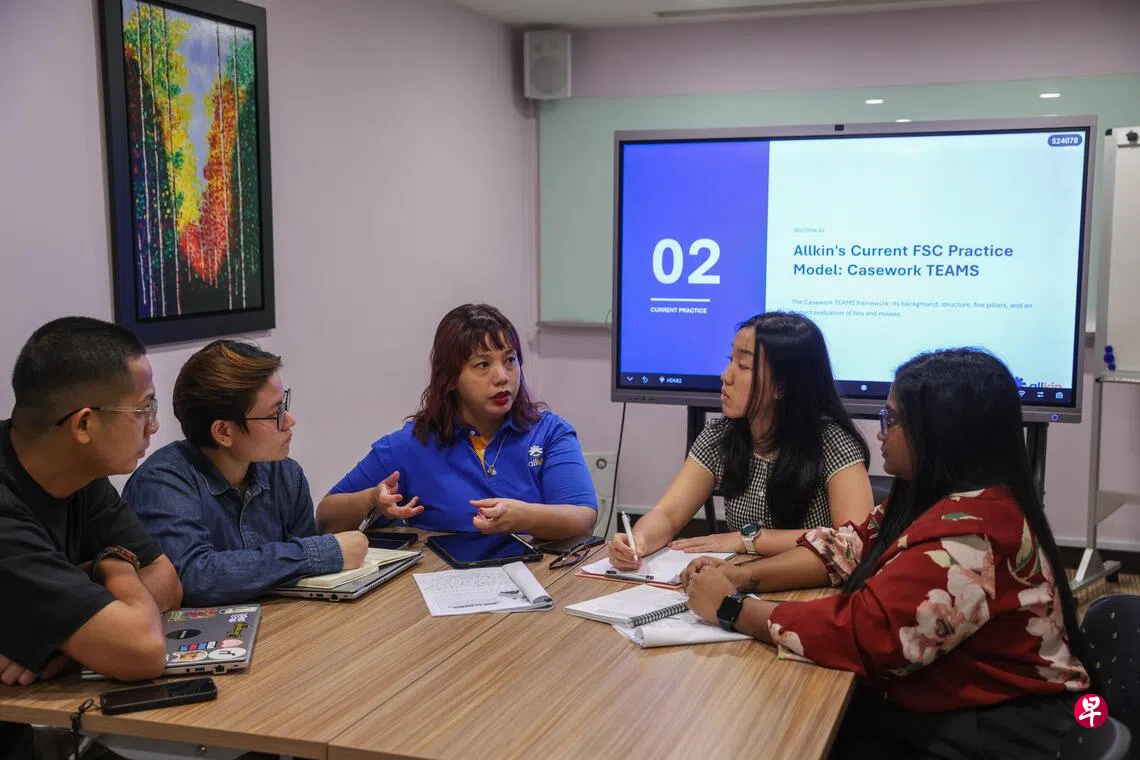
Allkin began having social workers work in teams and share responsibility for family cases in 2020, with positive results. From the first quarter of next year, the social service agency will pilot an internal multidisciplinary team model to coordinate specialist services for families, taking an important step towards an eventual transition to OFS.
Siti Noor Adilla Binte Daud, head of Allkin’s Family Service Centre at Block 616 Punggol Drive, said in an interview that the agency began adopting team-based case management about six years ago, mainly after observing that family cases were not only increasing in number but also often involved multiple challenges.
“We recognised that the risks and demands associated with increasingly complex cases should not rest solely on the shoulders of one practitioner.”
The centre organises social workers into teams of six or seven, who meet weekly to discuss their cases. By learning from one another’s experience and providing mutual support, they work together to help families overcome challenges and achieve tangible benefits.
Adilla cited a family in which another incident of domestic violence occurred while the lead social worker was on leave. As the team was already familiar with the family’s circumstances, it could quickly support the wife who had suffered the abuse, without requiring her to recount her past experiences.
From next year, Allkin will introduce internal cross-disciplinary collaboration, bringing social workers, youth workers, psychotherapists and others together in a team to provide comprehensive support for families.
Adilla said they had seen the benefits of the existing model in helping families. However, they also recognised that one in five cases handled by the centre required support from other professionals, underscoring the need for greater coordination across programmes and disciplines.
She said bringing professionals from different disciplines into a coordinated team to jointly assess cases and develop a unified case plan would enable more comprehensive support for families.
“This also provides an opportunity for the team to test and refine its practices to support the future implementation of the OFS model.”
