

Advanced materials underpin key industries such as semiconductors, manufacturing and energy, and determine the quality of products we use every day. Yet developing materials is like looking for a needle in a haystack, requiring lengthy, labour-intensive rounds of testing that often stretch the process over several years.
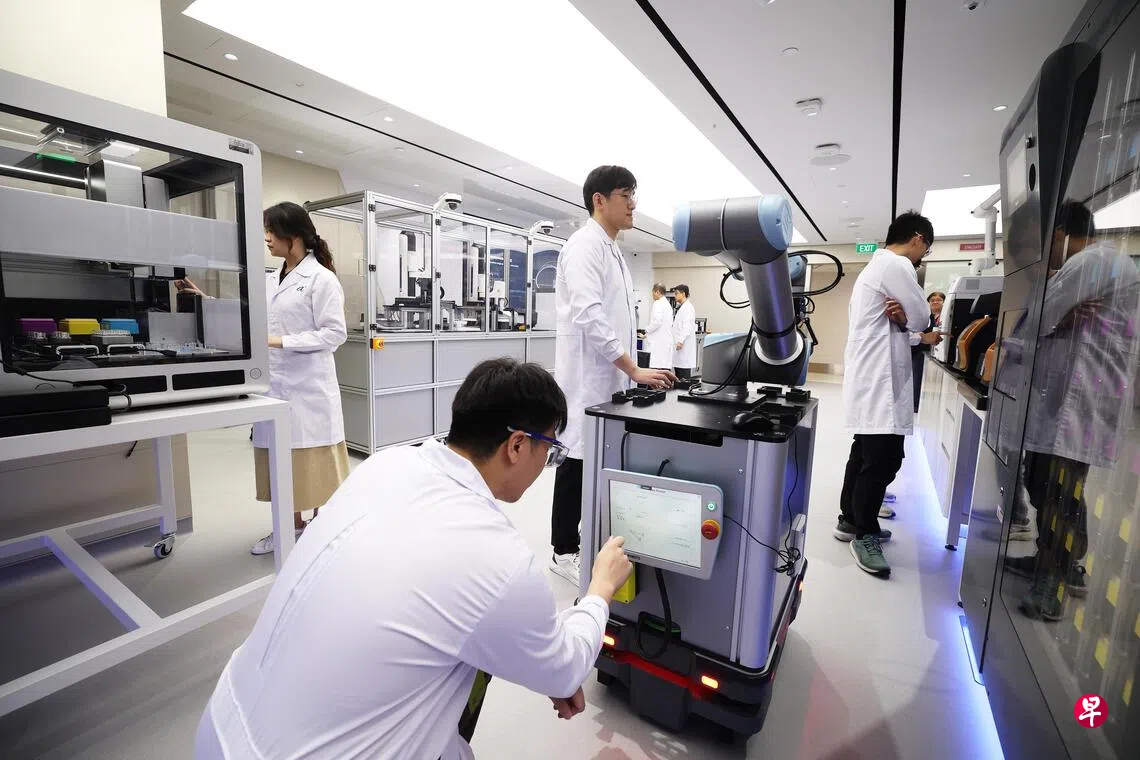
To overcome this bottleneck, Singapore has launched the Materials Accelerator for Research and Venture Enterprise Launchpad (MARVEL-AI) and established a new automated laboratory powered by artificial intelligence (AI) at the Agency for Science, Technology and Research (A*STAR).
By combining AI predictions with automated processes, the laboratory aims to slash materials development times from years to months, more efficiently delivering advanced, higher-performance materials for Singapore’s semiconductor, electric vehicle and aerospace sectors.
Traditionally, identifying or designing promising materials has largely relied on manual work. Faced with countless possible combinations, scientists often have to test them one by one, making progress through trial and error.
MARVEL-AI uses AI to analyse vast amounts of data and literature, identifying highly promising candidate materials and guiding subsequent experiments. This can substantially reduce the guesswork in manual trial and error.
In traditional research and development, materials also undergo multiple rounds of time-consuming manual validation after synthesis. In contrast, the new laboratory’s automated processes can rapidly produce and test large numbers of samples in parallel, while running efficiently around the clock without supervision.
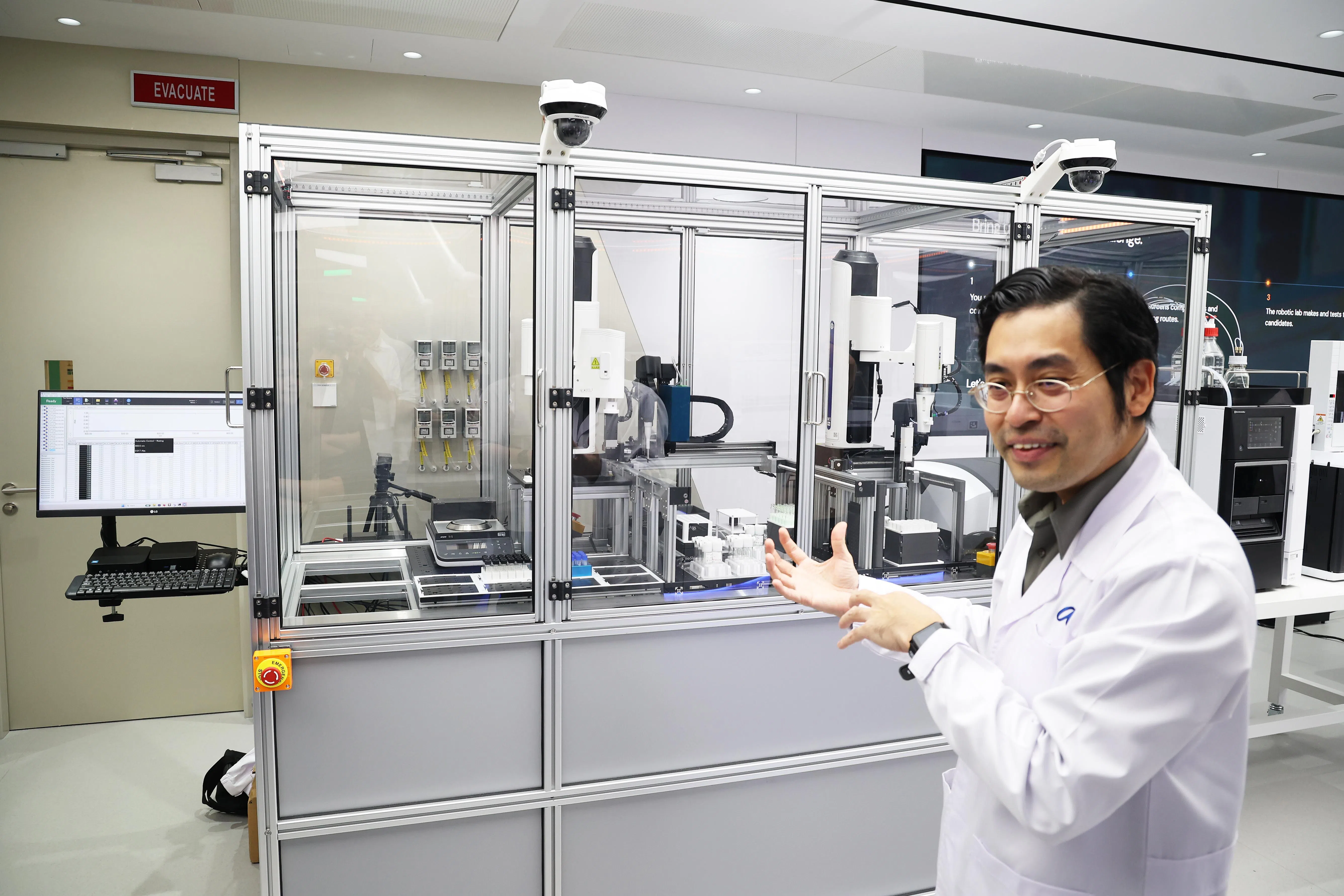
Loh Xian Jun, executive director of the Institute of Material Research and Engineering at A*STAR, said one of the central challenges in traditional materials innovation was scaling up, and AI could help address this.
“Taking a material going from gramme scale to kilogramme scale is actually not very straightforward. Using AI, we are able to have connections or inferences which are previously not easily identifiable......we are now able to create the links between discovery data and try to port it towards pilot and scale up.”
The new laboratory has successfully developed a prototype hydrogen storage tank for vehicles using a novel composite material. Driven by AI, the development process was shortened from three or four years to just nine months. The prototype is also half the weight and has achieved a fourfold improvement in durability.
ST Engineering is one of MARVEL-AI’s partners. Group chief strategy and sustainability officer and president new ventures of ST Engineering Cheryl Chan cited aerospace as an example, noting that many aircraft components today use specialised metal alloys, including engines, structural frame brackets and seat tracks.
Chan said finding alternative metal alloys was crucial to the future of aerospace. Developing ever-lighter alloys, for example, could significantly improve aircraft fuel efficiency.
“This entire process of looking for the different alloy compositions has never been a short process to begin with. So hoping that this collaboration with the MARVEL-AI will enable us to do things more efficiently.”
Deputy Prime Minister and Minister for Energy, Trade and Industry (Trade) Gan Kim Yong announced the launch of MARVEL-AI at the Singapore Week of Innovation and Technology 2026 (SWITCH 2026), which he opened on Tuesday (27 October).
The project has received S$150 million in funding under the Research, Innovation and Enterprise 2030 (RIE2030) plan. Led by A*STAR, it is jointly supported by the Ministry of Energy, Trade and Industry, Enterprise Singapore, the Economic Development Board and the National Research Foundation.
