

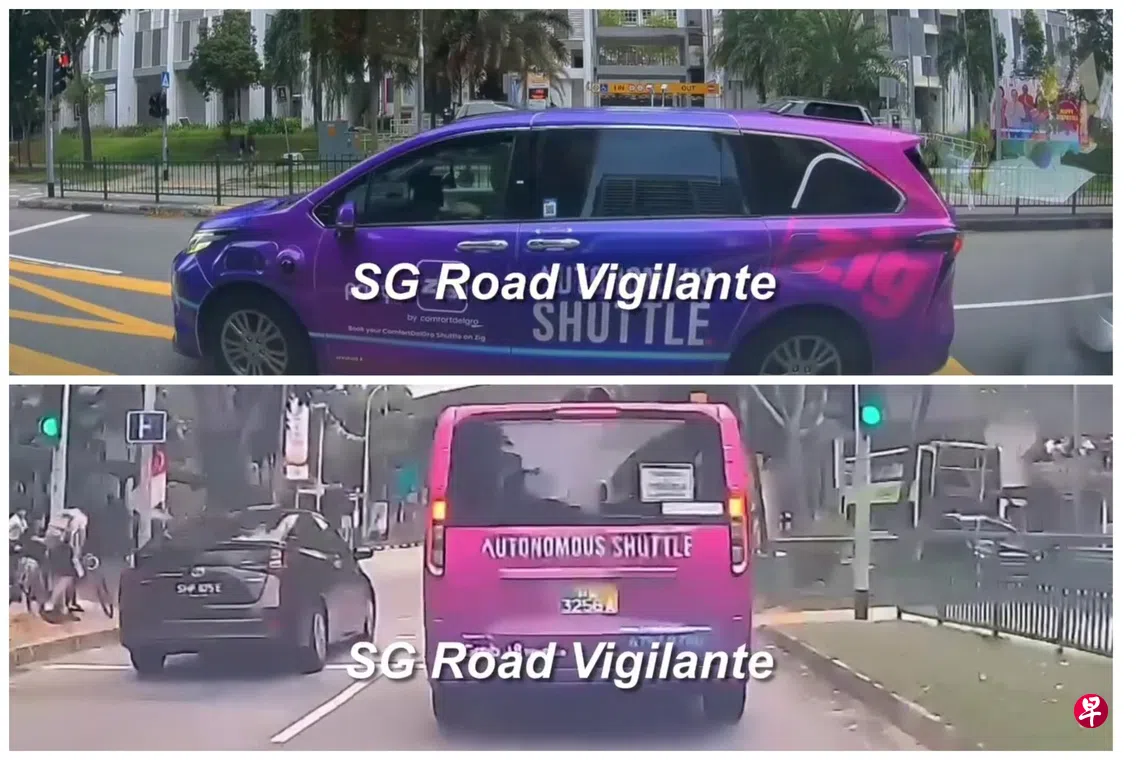
After two incidents last Thursday (5 November) in which self-driving cars nearly hit a pedestrian and another vehicle respectively, members of the public have shared more videos showing a near-collision with a self-driving car and an apparent traffic violation by another.
A video posted in the Facebook group “SGRV ADMIN” on Monday shows a Grab self-driving car braking sharply for unknown reasons before a junction along Punggol Field at 11.14am on 13 August, despite a green light ahead and clear road conditions. Fortunately, the vehicle behind maintained a safe following distance, avoiding a rear-end collision. The footage is believed to have come from that vehicle’s dashboard camera.
The video shows the Grab self-driving car travelling straight ahead under a green light, approaching a pedestrian crossing. There were no pedestrians on the crossing or approaching it from either side, nor were there any obstacles on the road. However, the car suddenly braked to a stop before the crossing, nearly causing the vehicle behind to hit it. It then accelerated and continued on its way.
Commenting on the video, some netizens said they had repeatedly seen self-driving cars stop abruptly on the road, including braking suddenly while passing through yellow box junctions. Others asked who would be held responsible if a self-driving car caused an accident.
Zig self-driving car draws attention after entering yellow box at red light and stopping for 10 seconds
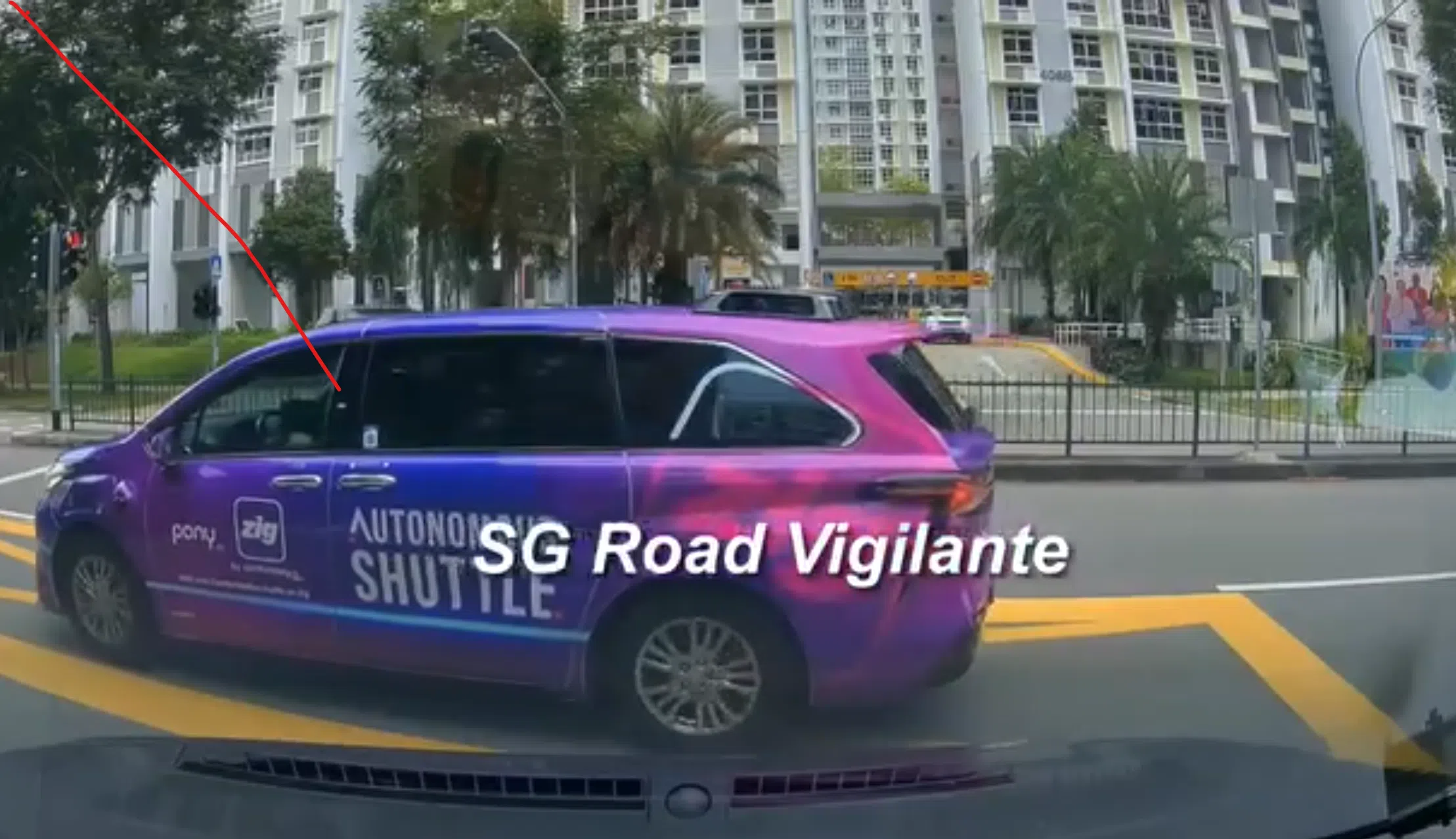
Another alarming incident involving a self-driving car occurred at 12.23pm on 31 October along Northshore Drive in Punggol. A self-driving car operated by ComfortDelGro’s Zig entered a yellow box, where stopping is prohibited, while the traffic light was red. It remained there for at least 10 seconds, moving off only after the light turned green.
Under Singapore’s traffic rules, vehicles must not enter a yellow box junction and obstruct traffic. Drivers should enter only if the exit road or lane ahead is clear, allowing them to leave the junction without stopping in the yellow box.
Some netizens also asked how fines and demerit points would be imposed for traffic violations involving self-driving cars.
Responding to queries from Lianhe Zaobao (LHZB), Michael Huang, head of Singapore point-to-point mobility at ComfortDelGro’s Zig, said: “Our onboard safety operator had also promptly flagged the matter. We are adjusting the vehicle’s software to improve its handling of such junctions in accordance with traffic rules.”
LHZB has also contacted the Land Transport Authority and Grab to ask what measures the authorities and companies involved are taking as a series of incidents involving self-driving cars comes to light.
Frequent safety incidents involving self-driving cars overseas
Overseas, sudden emergency braking by self-driving cars is not uncommon.
According to technology news outlet TechCrunch, sharp “brake jabs” are a common cause of workplace injuries among test operators at US self-driving car service providers Waymo and Zoox. Such sudden braking is often triggered when the system mistakenly detects an obstacle on the road. Some test operators have suffered sprains and muscle strains when vehicles brake abruptly at high speeds.
A 2022 report by the University of California, Irvine and the University of California, Los Angeles also found that self-driving cars often brake dangerously when they detect harmless roadside objects.
In March this year, China’s Apollo Go robotaxi service suffered a large-scale system failure in Wuhan. Multiple vehicles suddenly stopped in the middle of roads, trapping passengers and causing traffic congestion. China temporarily halted the issuance of new self-driving vehicle licences, gradually resuming approvals only in late June.
There have also been cases of self-driving cars “ignoring” traffic rules. On 9 November local time, the US National Highway Traffic Safety Administration announced a recall investigation involving nearly 3,000 Waymo self-driving cars over repeated violations of school bus safety rules. These included continuing to drive and illegally passing school buses when their red warning lights were flashing or their stop signs were extended. Waymo recalled vehicles and updated their software in December last year to ensure they slowed down appropriately and stopped when encountering school buses, but the problems persisted after the update.
