

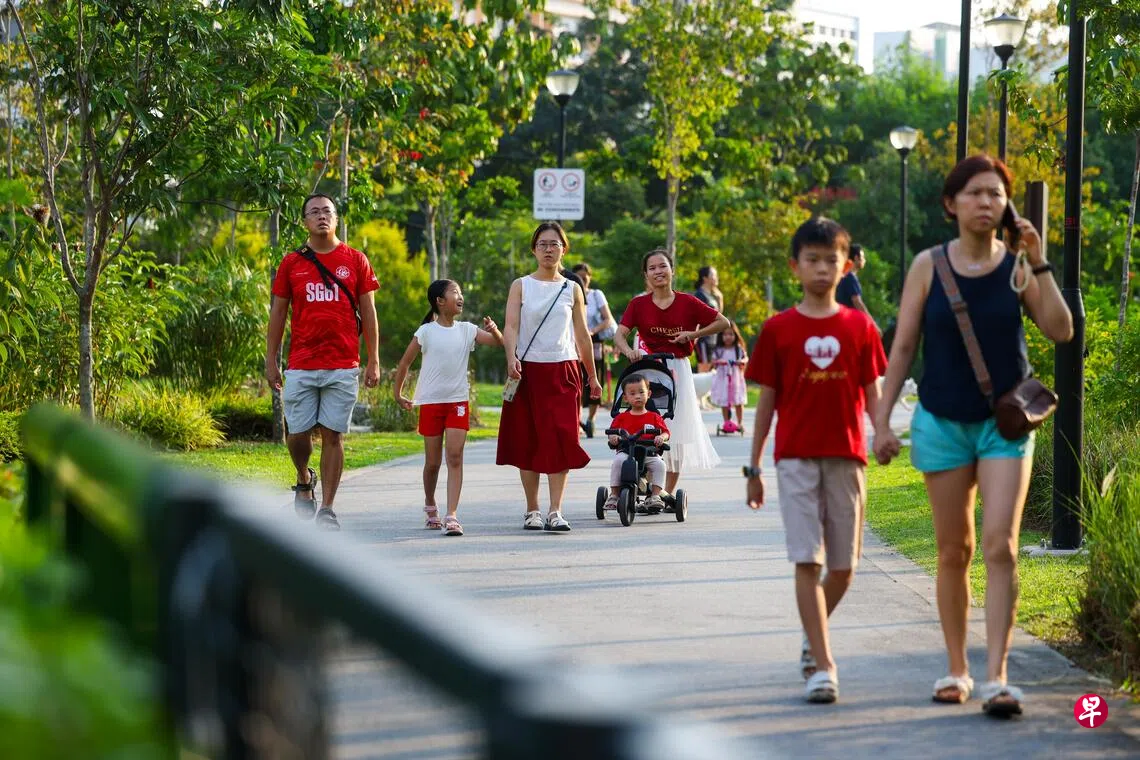
Tampines’ resident population grew by more than 14% over the past 10 years to 296,060, overtaking Bedok as the most populous planning area.
Sengkang’s resident population rose by more than 21% over the same period to 265,830, lifting it from sixth to third place. Punggol’s population grew by nearly 57% to 204,490, placing it eighth and giving it the largest increase among the top 10 planning areas.
With more Build-To-Order flats being completed, Tengah has just 34,340 residents this year but also the country’s highest proportion of children under 15, at 20.3%. The resident population comprises citizens and permanent residents.
The Singapore Department of Statistics released these figures on Wednesday (28 October) in an article titled Geographic Profiling of Singapore’s Resident Population (《新加坡居民人口地理空间分析》). Published in the department’s twice-yearly electronic newsletter, the article examines changes in population size, age composition, educational qualifications and household income levels across planning areas over the past decade or so.
Planning areas are development and statistical units designated by the Urban Redevelopment Authority (URA). Singapore has 55 such areas, used for land-use planning, infrastructure development and population statistics. Their boundaries do not necessarily coincide with those of towns or electoral constituencies.
The Department of Statistics noted that Singapore’s resident population grew from 3.9 million in 2016 to 4.2 million in 2026. This growth was accompanied by changes in population structure and socio-economic profiles at the national level, as well as shifts across geographical areas.
In 2026, the 10 largest planning areas by resident population collectively housed more than 2.3 million residents, or 55.6% of Singapore’s resident population. The five largest — Tampines, Bedok, Sengkang, Woodlands and Jurong West — each had more than 250,000 residents. Tampines and Sengkang rose two and three places respectively from their 2016 rankings.
Downtown Core records highest average annual resident population growth
Areas such as Punggol, Sengkang and Sembawang, which were developed from the late 1990s to the early 2000s, saw rapid resident population growth in the past decade. However, their average annual growth rates were lower than that of the Downtown Core.
The Downtown Core’s resident population grew by an average of 5.3% a year over the same period, the highest rate nationwide. It was followed by Punggol (4.6%), Sembawang (4.1%), Newton (3.8%) and River Valley (3.6%).
The Department of Statistics said the Downtown Core’s leading average annual growth rate was partly due to adjustments to the planning area’s boundaries in the URA’s master plans between 2014 and 2025. Tengah was excluded from the ranking because, as a new town, its population growth rate over the past 10 years was exceptionally high.
Meanwhile, as fertility rates fell, the proportion of residents aged under 15 declined from 15.2% in 2016 to 13.3% in 2026.
In 2026, Tengah had the highest proportion of residents aged under 15, followed by Punggol (19.6%), Tanglin (17.3%), Newton (17.2%), Bukit Timah (17.1%) and Sengkang (16.3%). Woodlands, Bukit Panjang and Jurong West, which were in the top 10 in 2016, were no longer among the top 10 this year.
Outram has highest proportion of older residents
The proportion of residents aged 65 and above rose from 12.4% in 2016 to 19.5% in 2026. Population ageing was most pronounced in older areas.
This year, the five planning areas with the highest proportions of older residents were, in descending order: Outram (28.9%), Ang Mo Kio (26.9%), Jurong East (26.2%), Bukit Merah (25.8%) and Rochor (25.2%). In each of these five areas, one in four residents was aged 65 or above.
Outram also had the highest median resident age nationwide, at 50. It was followed by Ang Mo Kio and Jurong East (49), Bukit Merah and Rochor (48), Bedok and Kallang (47), Serangoon and Queenstown (46), and Marine Parade (45).
Over the past 10 years, Outram, Ang Mo Kio, Jurong East, Jurong West and Bukit Panjang recorded the largest increases in median resident age, ranging from six to eight years.
