


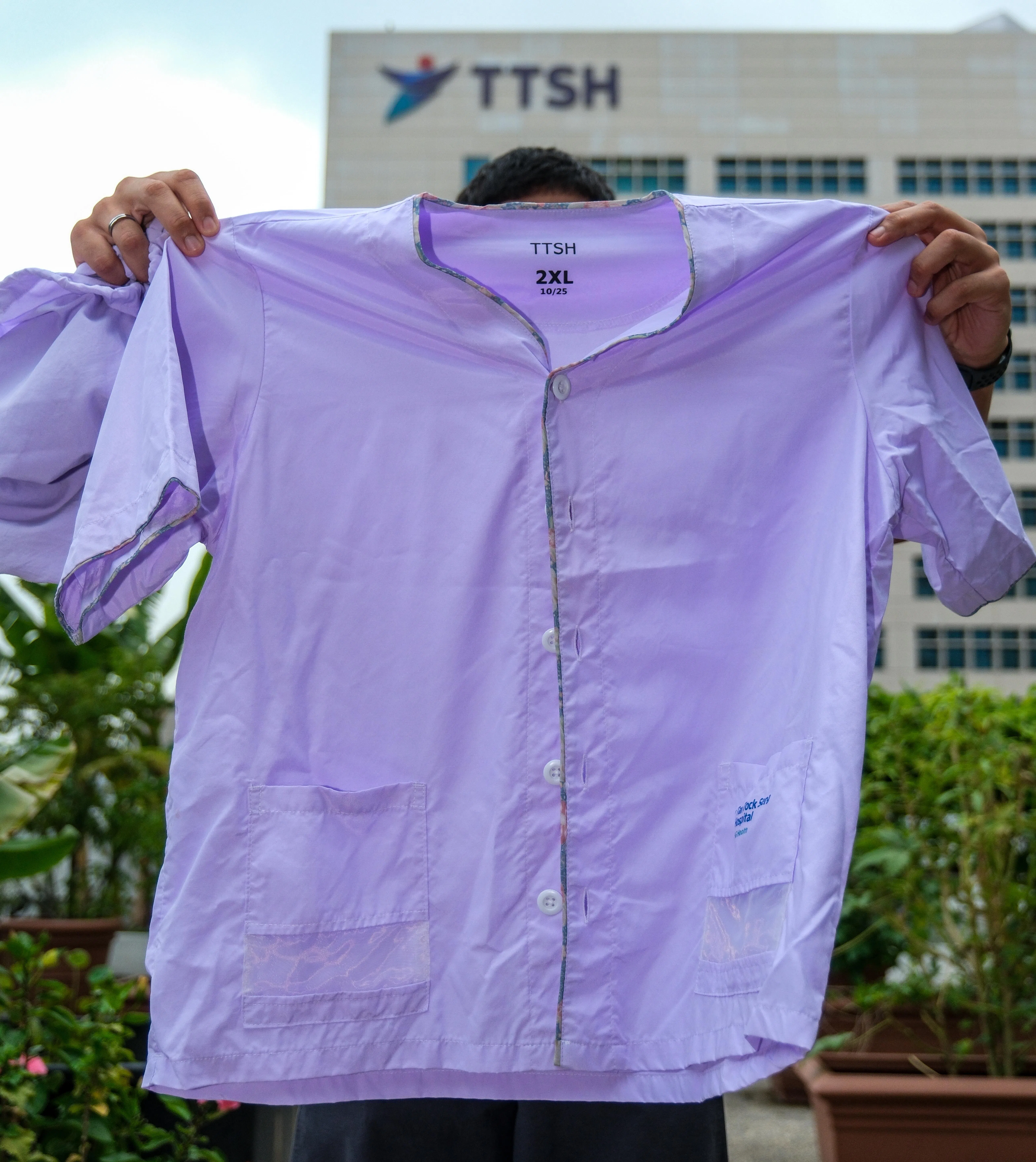
Tan Tock Seng Hospital plans to progressively replace thousands of its existing patient gowns with recyclable ones over the next one to two years. This move allows worn-out gowns to be recycled rather than incinerated, cutting down on waste.
The hospital admits about 6,000 patients each month. Patient gowns requires frequent washing and high-temperature disinfection. On average, more than 100 pieces are discarded each month because they are worn out, and are eventually incinerated with other rubbish. Recycling is difficult because the existing garments are made from a blend of cotton and polyester, which are hard to separate.
To give old gowns a new lease of life, the hospital is working with local sustainable materials start-up Lumatera to develop new hospital gowns that meets medical requirements and is easy to recycle, for use across its 2,200 beds.
Saurabh Mangla, founder of Lumatera, told Lianhe Zaobao (LHZB) that the new garments, made from recycled polyster, can also undergo washing at high temperature for infection control, matching the same same criteria as the old garments.
He explained that pure cotton would undoubtedly be ideal if comfort and recyclability were the only considerations. However, patient clothing must be washed and disinfected at temperatures above 70 degrees Celsius after each use. Pure cotton tends to lose its shape after repeated high-temperature treatment, making it unsuitable for long-term use. Polyester, by contrast, withstands repeated high-temperature washing better than cotton and can be recycled into new garments.
He said: “We are still in early stages of costing, but our target is the current costing, and we try to be as close as we can be.”
Christopher Soh, deputy director of Nursing of Tan Tock Seng Hospital, said the hospital and Lumatera have produced a prototype of the new patient gown. Two more designs will be developed over the next two months, after which patients will try them on. Their feedback will help determine the final design and replacement plan.

Soh said the project is still at the materials and prototype testing stage, and the design has yet to be finalised. If the trial goes well, he hopes it can eventually be rolled out nationwide and even beyond ASEAN.
Although patient trials have yet to begin, some members of the public have expressed support after learning about the plan.
Richard Soh, 63, who works in the sustainable building materials business, said: “For hospitals to use recyclable patient clothing is a good idea... Some people are allergic to certain fabrics, so as long as the trials confirm that the clothing does not affect their skin, the plan is feasible.”
Food service assistant Siah Siow Mee, 72, said: “Throwing away old clothes is wasteful. If synthetic materials can withstand high-temperature disinfection, there is no problem.”
Tan Tock Seng Hospital and Lumatera signed an agreement on 28 October to establish a strategic partnership to develop sustainable wards for the future. Under the partnership, they will jointly assess, trial and adopt new sustainable materials in healthcare to reduce waste, cut carbon emissions and improve resource efficiency.
Besides patient gowns, they also plan to use similar recycled materials to make textiles such as ward curtains and quilts.

Medical consumables are another focus of the partnership. Tan Tock Seng Hospital uses more than 2.5 million cleaning and disinfectant wipes of various kinds each month. The partners have therefore also developed biodegradable alcohol wipes, patient care wipes and paper cleaning pads made from plant fibres.
Tan Tock Seng Hospital is part of the National Healthcare Group. During the group’s inaugural Sustainability Week in late October, it joined the National University Health System and SingHealth in pledging to reduce the environmental impact of healthcare services while maintaining the quality of patient care.
The three public healthcare clusters also pledged to explore low-carbon clinical alternatives, reduce unnecessary tests and treatments, and improve the segregation of medical waste to promote the recycling of materials such as stainless steel, textiles and plastics.
