

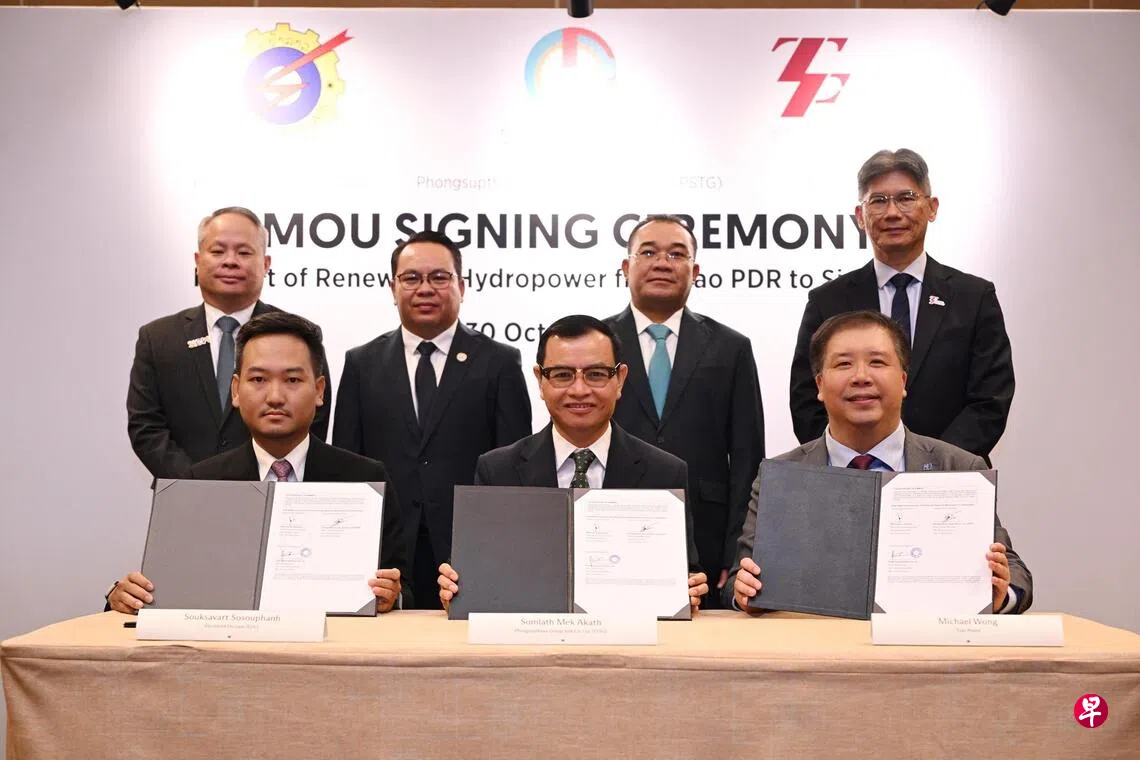
Tuas Power Generation is exploring imports of renewable hydropower from Laos, with supply expected to rise from 100 megawatts to 500 megawatts within three years to strengthen Singapore’s energy security.
Tuas Power Generation, Laos’s state-owned electricity company Électricité du Laos (EDL) and the Lao firm Phongsupthavy Group (PSTG) signed a memorandum of understanding on Friday (30 October) at Singapore International Energy Week.
Under the plan, hydropower supplies from Laos will rise from 100 megawatts in the first year of the contract to 300 megawatts in the second year, then to 500 megawatts in the third year and beyond. The contract is currently expected to run for five to 15 years.
Tuas Power also plans to give customers the option of buying electricity bundled with renewable energy certificates (RECs), helping businesses reduce indirect carbon emissions from electricity use. T-RECs Energy will assist with certifying the RECs.
All certificates issued for use in the Singapore market will be retired only once, ensuring they cannot be reused or claimed more than once. Corporate customers can also verify the certificates’ authenticity through the T-RECs Energy platform.
Michael Wong, chief operating officer of Tuas Power, said in a statement that the three-way partnership would not only enable the company to offer customers renewable hydropower paired with certified environmental attributes, but also allow Laos’s hydropower resources to contribute to regional clean-energy integration under the ASEAN Power Grid vision.
Wong said he believed the partnership “supports our long-term roadmap for customers’ decarbonisation and sustainable regional energy transition to a net zero carbon future”.
He also told Lianhe Zaobao (LHZB) that Tuas Power Generation had contacted EDL as early as the beginning of 2023. However, Laos’s hydropower supply was not sufficiently stable, as the country experiences six months of dry conditions each year.
The company eventually connected with PSTG, which has solar photovoltaic and wind power generation, as well as energy storage equipment, to supplement hydropower and stabilise electricity supply. This led to the three-way partnership.
Wong said work was needed in three areas to advance the partnership. The first was to ensure a stable electricity supply from the Lao partners. The second involved securing approvals from government agencies in the countries connected by the regional grid, which would take some time. Progress was expected in the first half of 2027.
He said he was confident of obtaining an electricity export permit from Laos, and that EDL was also responsible for liaising with the Thai and Malaysian authorities. He believed the project could secure support from Singapore’s Energy Market Authority (EMA).
“We signed the memorandum today and have already held preliminary meetings with EMA. Our next step is to submit an application. Of course, whether we succeed will also depend on our final proposal and the authorities’ concerns and feedback.”
The company will also sign long-term power supply agreements lasting five to 15 years with local customers that need green electricity, such as data centres and semiconductor companies. It will work with T-RECs Energy to help these businesses obtain RECs for their use of clean energy.
Wong said the company currently has more than 150,000 industrial, commercial and residential customers, including many long-term green electricity customers.
If the project to import between 100 megawatts and 500 megawatts of hydropower goes ahead, it will increase the company’s total green electricity supply, giving it greater flexibility to meet customers’ needs and accelerate progress towards carbon neutrality.
“In my view, this project benefits multiple parties and can get green electricity flowing across the region. Large-scale flows can help develop the regional power grid in future, benefiting transit countries such as Thailand and Malaysia.”
