

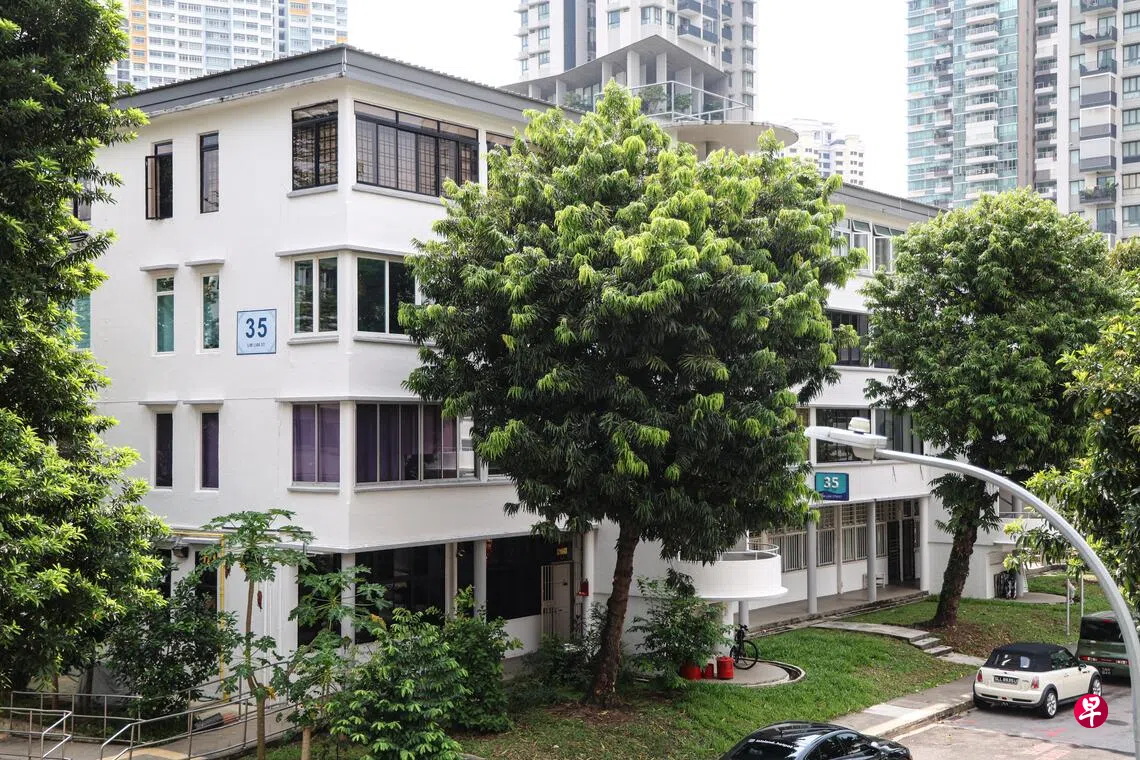
Two old HDB blocks in Tiong Bahru, built in 1949, missed out on the Home Improvement Programme last year by one and two votes respectively. After nearly a year of efforts to secure support, both blocks have approved the programme in a fresh vote. Upgrading works are expected to begin in November and be completed by the end of January next year.
Tanjong Pagar GRC MP Foo Cexiang said in a Facebook post on Tuesday (27 October) that support at Block 34 Kim Cheng Street, which has 24 flats, had risen from 66.67% in November last year to 75%. At Block 35 Lim Liak Street, which has 15 flats, support rose from 73.33% to 87%.
The two blocks are among 29 old four-storey blocks built by the Singapore Improvement Trust in Tiong Bahru’s Seng Poh precinct. In last November’s Home Improvement Programme (HIP) vote, the other 27 blocks qualified with support from at least 75% of eligible Singapore citizen households.
Foo, who is also Minister of State for Manpower and for Energy, Trade and Industry, held a town hall meeting with residents of both blocks last December. He pledged not to let residents miss out on the upgrading opportunity and said he would apply to the Housing Board for a fresh vote if enough support could be secured.
Foo said on Facebook that over the past year, the Housing Board, Seng Poh Residents’ Network and volunteers had actively reached out to residents of both blocks, successfully contacting several who had previously been uncontactable. The team also arranged for residents whose homes had undergone HIP works to open their doors so that residents of the two blocks could see the improvements.
Following these efforts, a preliminary poll in July this year showed that support at both blocks had reached 75%. Foo then applied to HDB for a fresh vote and received approval. Both blocks finally reached the approval threshold in the second vote last Sunday (25 October).
Foo noted that many residents in the area were elderly and might not be able to afford renovations on their own without HIP subsidies.
The two blocks’ failure to secure approval last year sparked widespread public discussion. The authorities subsequently said they were studying the possibility of combining blocks with fewer flats into voting groups to ensure that enough households take part in HIP voting.
Lau Kha Gek, a 50-year-old secretary who has lived at Block 34 Kim Cheng Street for about 21 years, said the block’s toilets and sewage pipes were old, while the roof also leaked. She had long hoped that HIP would improve living conditions. When she learnt last year that the block could not undergo upgrading because it lacked enough votes in favour, she felt disappointed and helpless.
She thanked everyone involved in securing another chance for residents to vote. “We finally passed in this second vote. With the prospect of improvements to our old toilets and other facilities, I can finally breathe a sigh of relief.”
Mary Lee, a 58-year-old training manager who lives at Block 35 Lim Liak Street, voted in favour to help her neighbours.
She bought two three-room flats in the same block, one in 2007 and the other in 2023, and combined them into a single home. The flats were renovated five and three years ago respectively, so she had no need for further renovations herself. Nevertheless, she voted in favour both in last year’s initial poll and in the fresh vote, hoping that neighbours in need would benefit.
Lee said neighbours were close and retained a strong kampung spirit. She also helped persuade neighbours to support the programme and cleared up some of their misconceptions about HIP, including the belief that voting in favour meant having to accept all the optional improvements.
She said: “HIP works inevitably generate dust, but overall it is still manageable.”
