

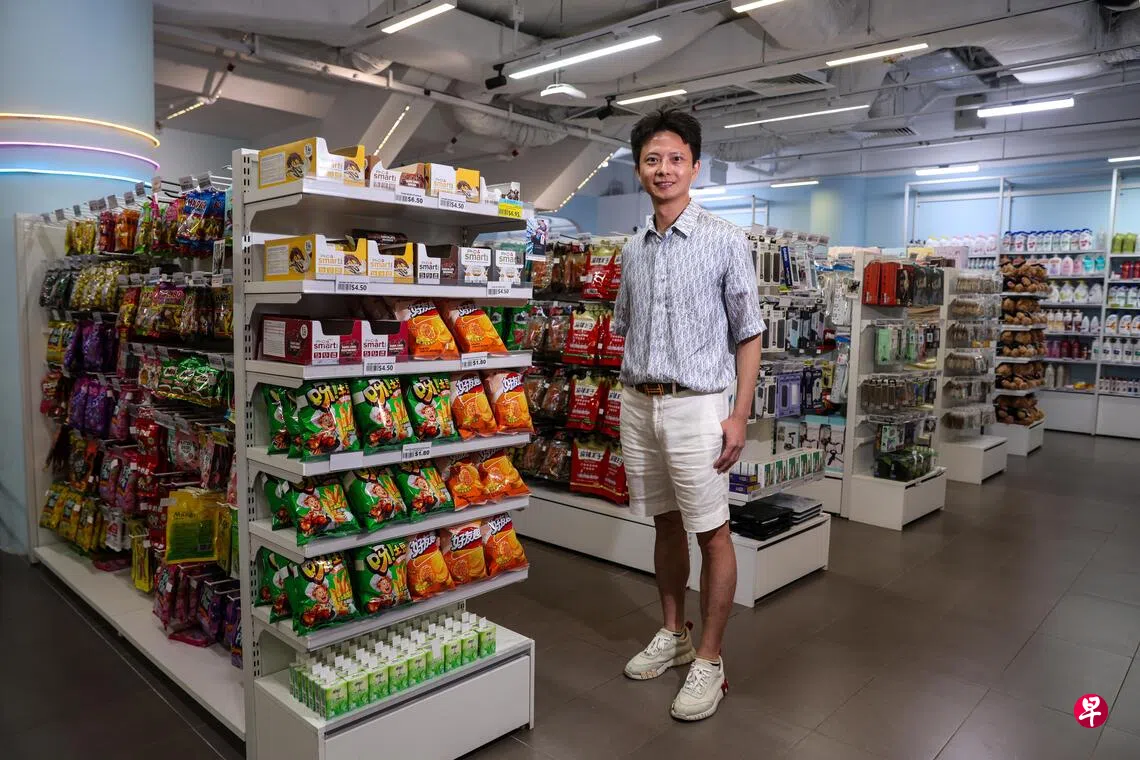
After years of trial and error, operators of unmanned stores in Singapore are now focusing more on matching locations with customer needs, rather than simply testing whether the model works. Operators interviewed said settings such as campuses and hospitals, where there is clear demand, are better suited to unmanned stores.
Octobox, Singapore’s first unmanned supermarket, has been operating for seven years and now has six outlets. Its founder and managing director, Jeffrey Sun, said years of operating experience have shown that the model works on campuses. The company next plans to explore other settings, such as condominiums and industrial estates.
All six Octobox unmanned supermarkets operate round the clock, every day of the year. Sun recalled that the first opened at the National University of Singapore (NUS) in 2019. Back then, many students did not even know how to scan a QR code to shop. Today, students are familiar with the process: seniors teach new students how to use it, and the supermarket is included in campus orientation tours.
Daily takings at the NUS unmanned supermarket have risen from a few hundred dollars when it first opened in 2019 to more than $10,000 today. The store receives about 3,000 to 5,000 visits and records around 1,000 transactions a day.
Sun said: “When I started, I never expected unmanned stores to grow so much over the years.”
Since opening its first unmanned supermarket, Octobox has opened an average of one to two stores a year. Its six outlets are at NUS University Town, Hougang Community Club, Temasek Polytechnic, Nanyang Technological University’s (NTU) North Spine Plaza, NUS’s Prince George’s Park residences and NTU’s North Hill halls of residence.
However, the supermarket at Hougang Community Club will close in November this year. Sun stressed that this did not indicate a problem with the unmanned store model, but rather insufficient footfall at the location.
Technology eases staffing pressures, but retail demand remains key
Sun said technology helps operators ease staffing pressures, but unmanned stores are still fundamentally a retail business. Stocking products that meet customers’ needs remains the key to running them.
At its campus stores, for example, about 80% of Octobox’s products were introduced following suggestions from students. These include sealing strips to keep insects from entering dormitory rooms through gaps around doors, baskets for toiletries and SIM cards for new students.
Unmanned stores do not mean an absence of interaction between operators and customers. The supermarket stays in touch with customers through social media groups, announces new products and adjusts its range based on feedback.
Sun said: “It may be an unmanned store, but it still has a human touch.”
He is optimistic about the prospects for unmanned stores, believing that demand for this business model will grow as recruitment becomes increasingly difficult in retail. Originally a supplier to conventional supermarkets, he later switched to operating unmanned stores. The company has also begun using artificial intelligence for account reconciliation, with employees reviewing the results.
“Young people have more and more career options, and few are willing to work in retail. Businesses have to use technology to address manpower challenges.”
Unmanned convenience stores expand into campuses and hospitals to meet demand
A spokesperson for FairPrice Group said its Cheers chain operates unmanned convenience stores across Singapore and has expanded into more tertiary institutions over the past year. Consumers have responded well to the model, mainly because the stores are open round the clock and offer quick, convenient checkout.
Another convenience store chain, 7-Eleven, operates an unmanned outlet at Singapore General Hospital. In an interview, 7-Eleven Singapore managing director Anushree Khosla said hospitals have specific needs, with patients, visitors and healthcare workers all requiring a convenience store that is open round the clock.
She said footfall and sales have continued to grow since the unmanned store opened. The company is open to the model and has not ruled out further expansion where there is clear customer and business demand.
Khosla said the unmanned store model suits particular locations and customer groups. The company will therefore continue to assess suitable sites and explore relevant technologies and partnerships.
However, she believes unmanned stores will become part of convenience retail rather than replace traditional stores entirely, as staff can still offer customers assistance and interaction. Products requiring age verification or additional checks are also unsuitable for sale in an unmanned setting.
To address customers’ concerns about potential problems such as being charged without making a purchase, the unmanned store has streamlined its shopping process. Customers do not need to download a specific app, register an account or link a credit card beforehand, making it significantly easier to use.
The store’s computer vision technology tracks customers anonymously to record their interactions with products, without using facial recognition. When customers enter the checkout area, the system automatically identifies their selected items and displays them in real time on a self-checkout screen. Customers simply confirm that the shopping list is correct and complete a cashless payment before leaving.
Unmanned dessert shop moves from mall to campus in search of a better customer fit
Besides opening new stores, relocating is another way for operators to find the right customer base.
Japanese dessert brand Chateraise opened its first 24-hour unmanned outlet in March 2024, initially at Le Quest Mall in Bukit Batok. Chateraise assistant manager Bryan Ho said the company moved the store to NTU in February last year because the university’s customer base was better suited to the unmanned model.
Footfall has remained steady since the unmanned store opened at NTU. He said the company is currently focused on running this outlet well and has yet to decide whether to expand its unmanned store business.
He believes unmanned stores are a viable retail model in certain locations in Singapore. Besides easing staffing pressures, they also give customers convenient access to desserts in places where running a conventional shop would be more difficult.
