

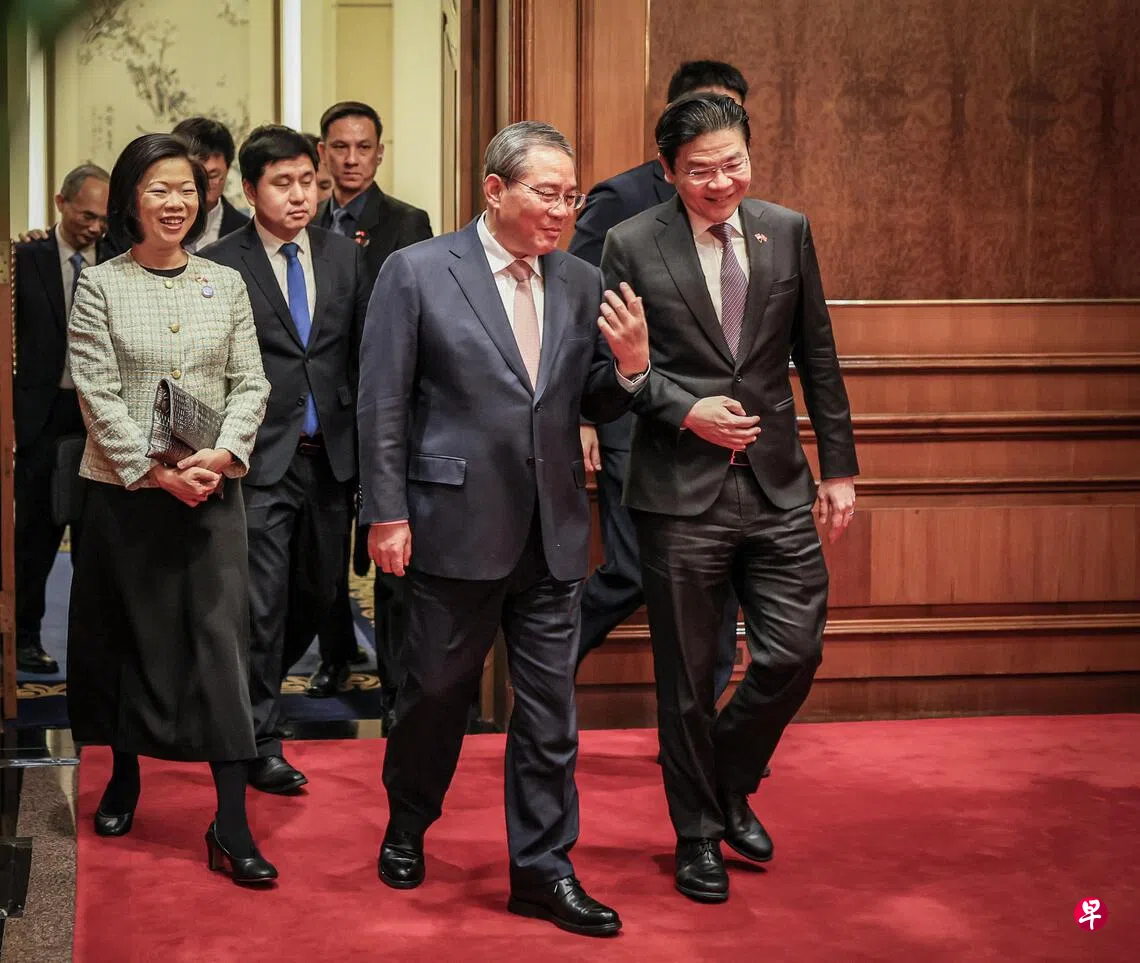
Prime Minister Lawrence Wong said intensifying US–China technology competition would increasingly split the technologies countries can access and use into two systems. While countries may inevitably have to choose between them in some cutting-edge fields, he hopes other areas will remain open, allowing countries to freely choose US, Western or Chinese technologies.
Before concluding a four-day working visit to China, Wong held bilateral talks and had lunch with Chinese Premier Li Qiang in Beijing on Saturday (21 November), before speaking to the Singapore media accompanying him.
Wong acknowledged that he was concerned US–China competition and rivalry would result in increasing bifurcation in the technologies countries could access and use. He said: “We hope this will not happen. Perhaps some of it may well be inevitable. For the very high-end technologies, countries may just have to choose one or the other.”
However, he also stressed that Singapore hoped that, aside from sensitive high-tech areas, “there will be many other aspects of technology where countries are free to use either US, Western or Chinese technologies, and there should not be exclusive arrangements or restrictions imposed on countries”.
Citing autonomous vehicles as an example, he said Chinese companies WeRide and Pony.ai were already running self-driving projects in Singapore, which also had a separate collaboration with US company Waymo.
Wong said: “That's what Singapore wants to do: to be a place that is open, where technologies from different countries can be showcased and deployed, and where we can use the best technology available for Singapore's own needs.”
Singapore and US discuss chip information-sharing mechanism
As the US–China technology rivalry continues, advanced chips have become a key area of competition. The US recently announced tighter export controls on advanced chips, designating Singapore, Malaysia, Indonesia, Thailand and Brazil as higher-risk transshipment countries and requiring prior licences for exports of the chips concerned to these five countries.
In the interview, Wong reiterated that Singapore had made its position clear to the US government. He said Washington's real concern was chips traded through or transshipped via Singapore that ultimately ended up in other countries.
Wong said Singapore understood the US's concerns. The two sides were discussing how Singapore could help, including by sharing information so the US could carry out its own enforcement, and exploring whether a mechanism could be established to address Washington's concerns.
On how the US and China manage their relationship in areas such as cutting-edge technology, artificial intelligence (AI) and semiconductor chips, Wong hoped they could build on the positive momentum from several recent meetings between US President Donald J. Trump and Chinese President Xi Jinping. He hoped they could find ways to cooperate, including discussing global issues such as AI safety and the responsible use of AI.
Over the past week, Wong met Trump in Manila and Xi in Shenzhen. He said both leaders understood Singapore's position and perspective. “So long as the two superpowers do not collide with one another — and I don't believe the two leaders will — there will be space for Singapore to navigate this complex environment and make a good living for ourselves, doing business with both of them and with countries everywhere in the world.”
World's fate cannot be decided by two or three major powers: PM Wong
Following a trilateral summit of the US, Chinese and Russian leaders in Shenzhen on Thursday (19 November), the idea of a “G3” in which the three major powers dominate international affairs has emerged.
Speaking in the interview, Wong said it was always good when leaders of major powers came together to engage in dialogue and build bridges, rather than raise barriers and have misunderstandings. However, he felt that talk of a G2 or G3 construct might not always be helpful in understanding the international order.
He said: “The world is too complex, and there are too many things happening, for any one, two or three countries to decide the fate of all of us. We are moving into a more multipolar world, so it is going to be more complex and unpredictable.”
Wong pointed out that a multipolar world did not mean all poles were equal in strength, and economic size still mattered. The US remained the world's largest economy and would continue to be the pre-eminent power for quite some time. China and the EU also had considerable economic heft and were important poles in this multipolar configuration.
Wong stressed that all the world's major economic powers mattered to Singapore, which wanted to build bridges with all of them. “From Singapore's point of view, ASEAN matters. We want to strengthen ASEAN. We want to help ASEAN grow into an economic centre in its own right.”
He noted that many countries wanted to strengthen cooperation with ASEAN. When Singapore assumes the rotating ASEAN chairmanship next year, it will seek to further deepen the bloc's ties with partners including the EU, Canada, the Gulf Cooperation Council and India.
