

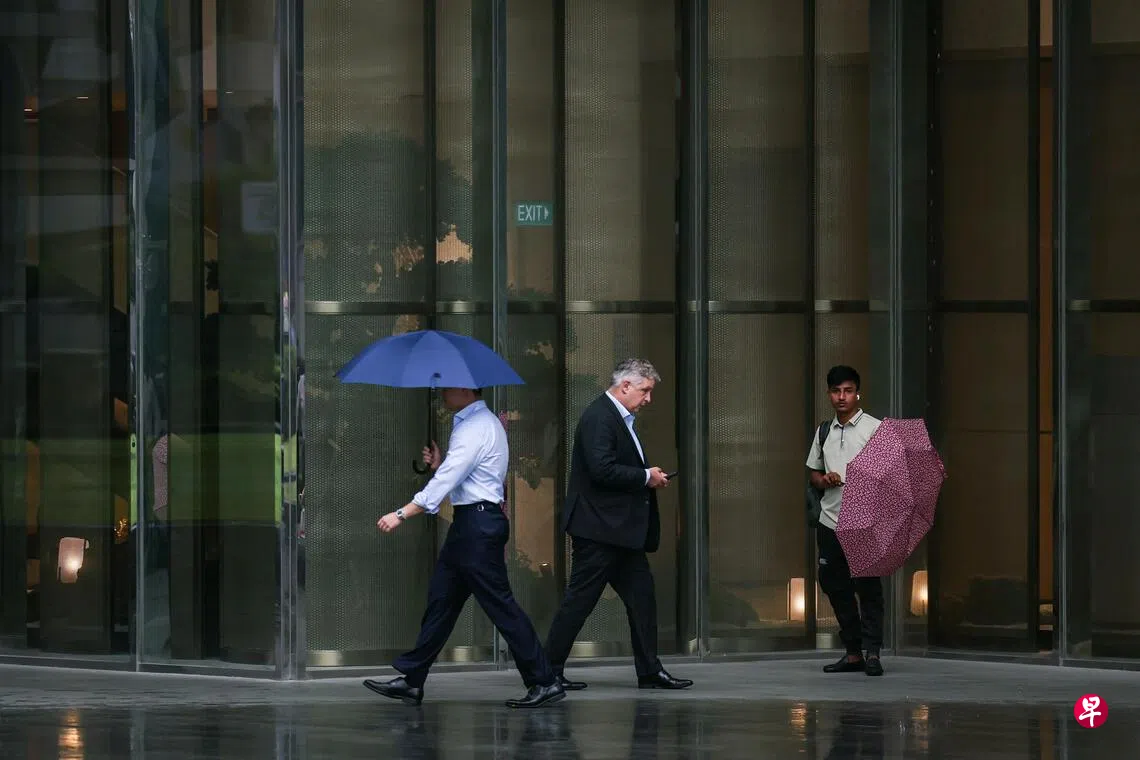
Singapore is expected to see wetter and windier weather in the final weeks of the year, with the northeast monsoon potentially bringing rain that lasts for days.
Increased rainfall and a change in wind direction mean transboundary haze is unlikely to return in the short term. Experts caution, however, that El Nino could bring dry weather back to parts of the region, so the haze risk has not been entirely eliminated.
Responding to queries from Lianhe Zaobao, the Meteorological Service Singapore said the northeast monsoon began in the second half of November, with prevailing winds shifting from northwesterly to northeasterly. The weather has also become wetter, with thundery showers possible in the afternoon.
During this period, Singapore and surrounding areas may also experience monsoon surges, bringing widespread rain lasting two to three days at a time and cooler, wetter weather.
The meteorological service said that, given current weather conditions, transboundary haze is unlikely to return in the coming weeks.
Experts: Watch for flash floods during prolonged rain
Nanyang Technological University’s Professor of Environmental Health, Steve Yim, said in an interview that November and December are usually Singapore’s two wettest months, with more short thundery showers possible in the afternoon and evening. A monsoon surge could bring two to five consecutive days of prolonged rain across the island, along with lower temperatures.
He cautioned that increased rainfall could cause brief flooding in low-lying areas or places with poor drainage, and urged the public to be mindful of the risks.
However, Adjunct Associate Professor in Atmospheric Science of the Department of Physics at the National University of Singapore, Dr. Koh Tieh Yong, believes there may be fewer monsoon surges than usual towards the end of this year as a strong El Nino develops.
El Nino is a naturally occurring climate phenomenon in which sea surface temperatures in the central and eastern tropical Pacific rise above normal levels. It typically brings hotter and drier weather to parts of Southeast Asia. The current El Nino is very likely to persist until May next year.
El Nino could worsen drought; haze risk not entirely eliminated
The dry weather brought by El Nino was one factor behind the worsening transboundary haze earlier. Koh stressed, however, that human activities remain the root cause of the haze problem.
He said: “While the drier weather brought by El Nino is an aggravating factor for transboundary haze, the root cause lies in human actions: burning of forests and cultivated peatland, and inadequate land management.”
He noted that rainfall and wind direction vary during the monsoon, and drought could return to southern Sumatra and parts of Kalimantan in Indonesia. Transboundary haze could still recur if land-clearing fires continue there or underground peat fires reignite.
Singapore was persistently affected by transboundary haze from 4 September to 25 October this year. During that period, the 24-hour Pollutant Standards Index was in the unhealthy range on 33 days and reached the very unhealthy range on another five days.
To strengthen accountability for those responsible for transboundary haze pollution, the government amended the Transboundary Haze Pollution Act in early November to introduce economic sanctions. Under the amended Act, the authorities can place companies and individuals suspected of illegal land-clearing by burning on a “restricted list”, limiting other companies’ business dealings with them or provision of loans to them.
For companies and individuals convicted of causing or contributing to haze pollution in Singapore, or condoning pollution by third parties, the maximum daily fine will rise from $100,000 to $1 million. The cap on total fines will also increase from $2 million to $20 million.
