

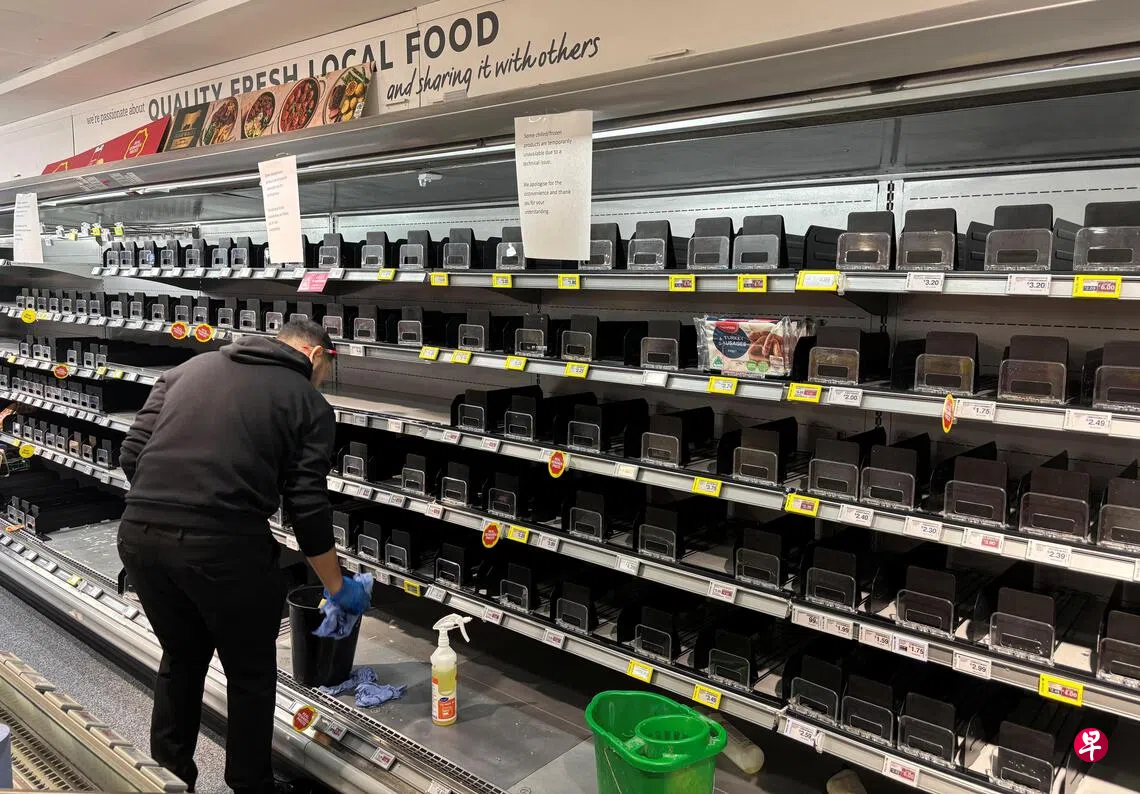
A security vulnerability discovered last month in web programming language PHP forced government and private-sector websites in several countries to go offline urgently. More recently, personal finance website MoneySmart, Singapore Airlines service provider Amadeus, telemedicine platform Doctor Anywhere and telco M1 reported a string of cybersecurity incidents, while hackers even breached refrigeration systems at supermarkets across Europe.
Although triggered by different causes, these incidents show that cyberattacks pose threats beyond data leaks: they can also disrupt everyday services and even affect food safety. Lianhe Zaobao (LHZB) spoke to four cybersecurity experts to answer five key questions on the issue.
1) What does the recent spate of cybersecurity incidents reveal?
Artificial intelligence (AI) makes it easier for hackers to find system vulnerabilities, while sharply reducing the time and cost of launching attacks. Almost any organisation holding sensitive information can now become a target.
Citing public records, Ethan Seow, founder of cybersecurity training firm Practical Cyber, said the number of newly identified security vulnerabilities worldwide had surged from about 29,000 in 2023 to more than 72,000 in the first nine months of this year. AI has undoubtedly further strengthened hackers’ capabilities, allowing them to carry out attacks more efficiently regardless of their experience.
“Singapore is not alone in this. It's now a world where vulnerabilities are aplenty, and it's a scary world out there.”
Steven Sim, general manager for ASEAN and North East Asia at cyber resilience and data protection company Commvault, said Singapore faces the same challenges as other highly digitalised economies. Cyberattacks are no longer just about stealing data; they can also disrupt business operations and essential services, undermining public trust.
2) What is connected operational technology, and where is it used in daily life?
The Cyber Security Agency of Singapore (CSA) warned on Friday (6 November) that cyberattacks on refrigeration management systems across Europe highlight the broader cybersecurity risks facing connected operational technology (OT).
OT refers to technology used to monitor and control physical equipment or processes. It is widely used in refrigerators, air-conditioning systems, lifts, factories and water supply systems. Increasingly, these systems are connected to the internet, allowing operators to monitor equipment and carry out maintenance remotely.
Abhishek Kumar Singh, head of security engineering for Singapore at cybersecurity firm Check Point Software Technologies, said hackers raising or lowering a refrigerator’s temperature without authorisation might sound trivial, but could cause food spoilage, business disruption and substantial financial losses.
Businesses must therefore protect not only their data, but also their physical equipment from manipulation by hackers, to keep services running normally.
He noted that refrigeration systems are no more vulnerable to attacks than other OT systems. Rather, the problem is that some equipment has been in use for years and cannot be easily upgraded or fitted with security patches or protective software. Once connected to the internet or a remote management system, they may face cybersecurity risks that were not considered when they were first installed.
Sim said refrigeration systems are targeted because they are widely deployed, are usually managed remotely by third parties and can immediately disrupt operations and cause financial losses if something goes wrong.
Derek Cheng, chief executive officer and country director for Thales Singapore, said some businesses may not realise that their industrial equipment and control systems are connected to the internet, leaving an opening for hackers. This often happens because suppliers enable network connections to make remote repairs and maintenance easier.
He cautioned that businesses must not assume equipment cybersecurity is solely the supplier’s responsibility. Each instance of remote access by an external party should be approved individually, with multi-factor authentication required and the duration of the connection limited.
3) Could local supermarkets and food supplies be affected?
Responding to queries from LHZB, a Sheng Siong spokesperson said its supermarkets use conventional chilled and frozen storage systems that are not connected to the internet. Although the company is conducting small-scale trials of newer refrigeration technology, store operations have not been affected.
“We will continue to assess potential risks and implement appropriate safeguards as we adopt new technologies.”
FairPrice and Cold Storage had not responded to queries by press time.
Singapore imports more than 90% of its food. Responding to queries from LHZB, the Singapore Food Agency confirmed that cyberattacks have not disrupted the country’s food supply. It is monitoring developments in Europe closely and is in touch with major retailers and food cold chain warehouses on their cybersecurity.
In response to queries, a CSA spokesperson said the agency is working with the Singapore Food Agency and supermarket operators to strengthen the security of their networks and systems.
4) What are the worst possible consequences of an attack on OT systems?
Singapore is densely populated, and daily life relies heavily on operational technology such as automated building control systems and cold chains. If systems are disrupted, the effects could spread rapidly.
Sim said the worst-case scenario is not simply data theft, but essential services remaining unavailable for an extended period. Businesses must therefore not only prevent attacks, but also ensure that systems can resume operations safely and quickly after an attack.
Seow gave the example of hackers manipulating refrigeration equipment used to store medicines or blood. If temperatures go out of control, the medicines or blood may no longer be safe to use. Hackers could also disable equipment safety alarms, preventing problems from being detected promptly.
On how concerned Singapore should be, he said: “We should take it seriously, but not panic.”
CSA confirmed that no similar attacks on OT systems have been reported in Singapore so far.
5) How do attacks on OT systems differ from data breaches?
The biggest difference lies in their impact. Data breaches generally involve personal privacy, commercial secrets and financial losses. For example, hackers may use stolen customer data to carry out scams.
Attacks on OT systems, however, can directly affect the operation of physical equipment. Besides disrupting services and causing financial losses, they can even endanger safety in severe cases.
