

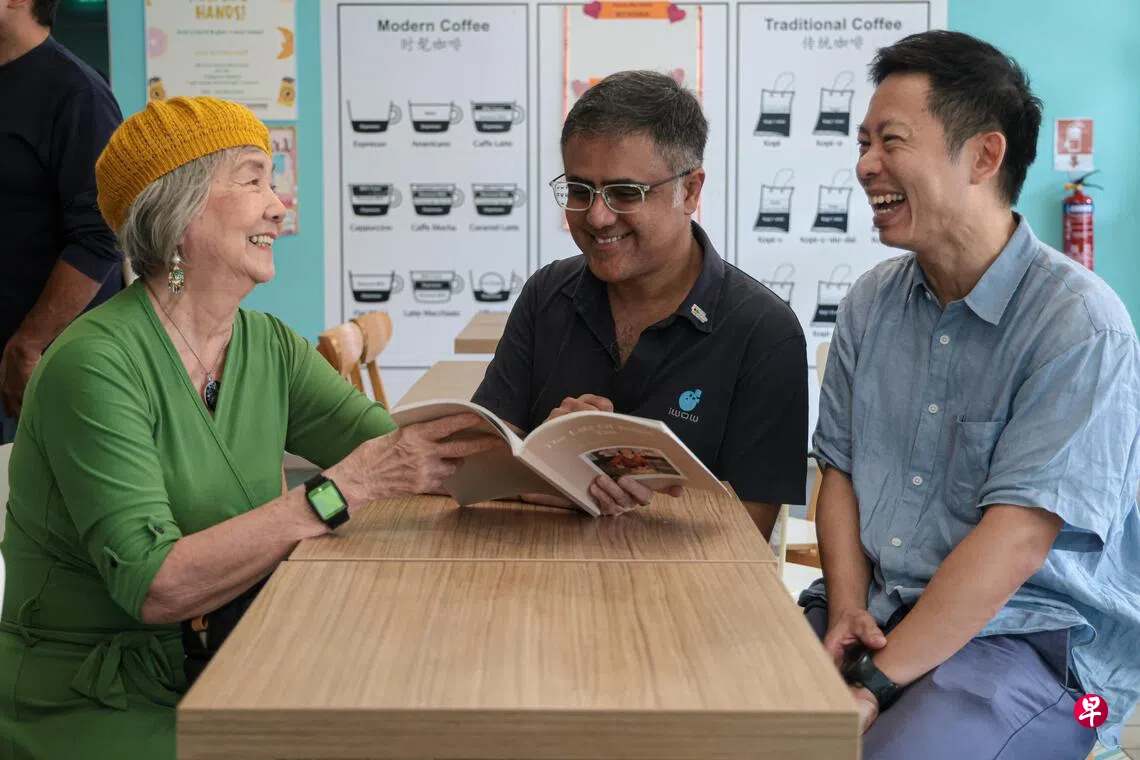
At 32, Judith Tan was forced to flee her home barefoot to escape her husband’s violence, leaving behind three young children. Fifty years later, the 82-year-old has recounted the experience in a 100-page memoir, hoping her children will understand: “I didn't leave you, I was forced to leave.”
In an interview, Tan recalled how her husband frequently beat her and even hurt her with weapons, forcing her to flee the family home. Her youngest child was just nine at the time. Not knowing why their parents’ marriage had broken down, the children harboured resentment over her departure for years, and the family always found it difficult to discuss the past face to face.
Last year, a chance encounter introduced her to Good Stories, a joint initiative by the A Good Space co-operative and Tzu Chi Foundation. With help from volunteers and artificial intelligence (AI) tools, she finally had the opportunity to tell her children openly about the hurt, pain, guilt and anguish of leaving them — feelings she had kept buried for half a century.
Eight decades of her life were distilled into a 100-page memoir, with three copies printed, one for each child. In the end, however, she did not ask how they felt after reading it. She could not bear to revisit the sensitive subject and reopen their old wounds.
“I just want to explain to them what actually happened, be we never had the time like this to talk.”
Good Stories is a community initiative supported by the Empowering Communities Fund. Volunteers serve as “Memory Guides”, helping seniors look back on their lives before using AI to turn their recollections into written accounts and compile them into books.
The $1 million Empowering Communities Fund was jointly established in 2025 by the Singapore National Co-operative Federation and the Ministry of Culture, Community and Youth. At a sharing session held by the federation on Monday (16 November), it was announced that the fund had disbursed more than $860,000 to date, supporting 19 initiatives by 16 co-operatives and benefiting about 1,900 vulnerable people.
The federation’s chief executive, Ang Hin Kee, said in an interview that there were no plans to further extend the application deadline. The remaining sum of about $140,000 would be returned to the Central Co-operative Fund, the government and the Singapore Labour Foundation.
Smart sensors watch over seniors living alone, but 60% decline over privacy concerns
Three co-operatives that received funding were invited to share the results of their initiatives at the session.
The “Guardian Angel” initiative by the Singapore Amalgamated Services Co-operative Organisation (SASCO) involves installing smart sensors in the homes of seniors living alone. These monitor their daily routines around the clock and promptly alert care staff to any unusual activity for follow-up.
SASCO’s head of community activation, Matthew Chua, said in an interview that about 60% of seniors invited to take part had declined because of privacy concerns.
“We have always assured them that the sensors are only motion and vibration sensors with no recording or camera functions.”
He observed that seniors willing to participate tended to be more familiar with technology. One of them is Violet Toh, 64.
Toh, a financial adviser who has lived alone since 2005, said that despite being very familiar with devices such as tablets, she initially had concerns about her privacy being invaded. Those concerns gradually eased after she learnt how the system worked.
“If something does happen, at least we know there is a team behind the scenes looking out for our safety.”
Doctors visit halfway houses to provide free hepatitis C treatment
Another funded initiative, run by the GP+ co-operative, sends doctors to halfway houses to provide former inmates with screening, treatment and follow-up care for hepatitis C and chronic diseases.
Mustaffa, 53, was diagnosed with hepatitis C through the initiative. After his diagnosis, he worried that the disease could lead to liver cancer or spread to his family. The initiative allowed him to receive free treatment without having to go to hospital.
“We didn’t have to go to a hospital to get a prescription. They came to provide everything for us, they gave clear instructions, and it was free.”
Speaking at the sharing session, Minister of State for Culture, Community and Youth and Manpower Dinesh Vasu Dash said co-operatives were an indispensable part of society. He encouraged them to learn from the successes of existing initiatives and continue exploring how they could contribute to the community in future.
