

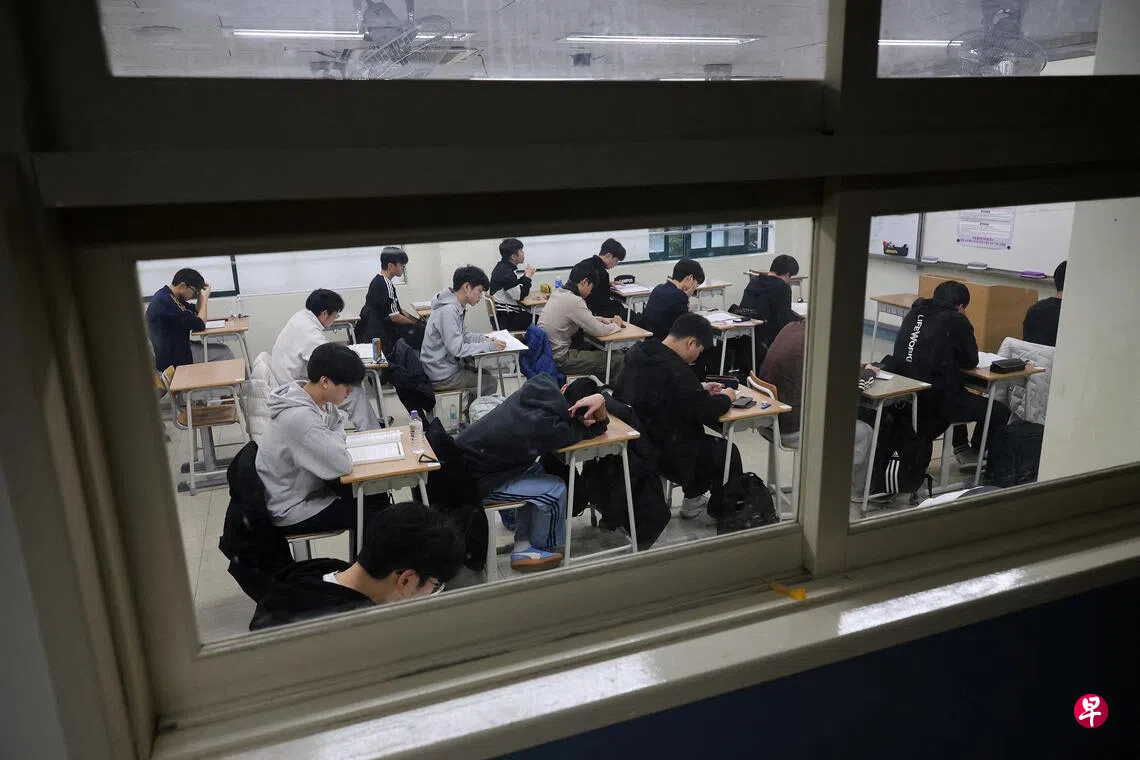
After the top scorer in South Korea’s tax accountant examination admitted using artificial intelligence (AI) to cheat and came under police investigation, another prominent candidate embroiled in cheating allegations was found dead at a Seoul motel on Thursday (19 November). Lee Jin-woo had achieved a perfect score in the Legal Education Eligibility Test (LEET). The series of scandals has not only dealt a severe blow to public confidence in South Korea’s national examinations, but also highlighted the difficulty traditional invigilation systems face in tackling AI-assisted cheating.
A 34-year-old surnamed Han, who topped this year’s tax accountant examination, admitted on 15 November to using AI to cheat in the examination. Han also acknowledged having cheated in the first stage of the certified public accountant examination.
Police investigations found that Han allegedly converted an ordinary calculator into a wireless keyboard, concealed a miniature camera in a correction tape dispenser and hid a smartphone in a lumbar support belt. Han allegedly photographed examination questions and transmitted them to a computer at home, then received AI-generated answers and copied them from a miniature display in the examination hall.
Notably, 66 candidates scored above 90 in the first stage of this year’s tax accountant examination — 33 times last year’s number. In the Introduction to Accounting paper in the first stage of the certified public accountant examination, the number scoring above 90 also surged from one last year to 66. Although the sharp increase in high scores does not directly prove widespread cheating, it has deepened public doubts about the fairness of the examinations.
Late-blooming high achiever admitted to Seoul National University dentistry programme found dead amid cheating allegations
As the tax accountant cheating scandal unfolded, internet users also began questioning the results of 32-year-old Lee Jin-woo. When he first sat South Korea’s university entrance examination 14 years ago, his grades ranged from bands six to eight across all subjects. Two years ago, however, he scored highly enough to enter Korea University’s Department of Political Science and International Relations. This year, he secured a place in Seoul National University’s dentistry programme with top-band results in every subject. He also became a bestselling author after publishing a book on study methods last year.
However, internet users examining a LEET answer sheet that Lee had previously made public found that some of his answers, before they were amended, matched those for the preceding questions, raising suspicions that he had cheated.
Lee firmly denied the allegations and announced that he would prove his innocence in a livestream on Thursday by answering questions from that day’s university entrance examination Korean-language paper. But he did not appear as promised. Police subsequently found his body at a Seoul motel. The cheating allegations against him remain unproven.
AI answers every university entrance exam question correctly in just 20 seconds; academic urges assessment reform
People in South Korea’s education sector said AI-assisted cheating devices, including miniature cameras and concealed earpieces, were being traded covertly on platforms such as Telegram as early as two or three years ago. As such devices become smaller and easier to conceal, invigilators are finding it increasingly difficult to detect them in time.
Meanwhile, rapid advances in AI’s ability to answer examination questions have made preventing cheating much harder. South Korean media tested Google’s Gemini AI model by feeding it questions from the Korean-language paper of this week’s university entrance examination. It answered every question correctly in about 20 seconds.
Lim Jung-mook, a former chairman of Seoul National University’s faculty council, said traditional examinations based on standard answers were facing a challenge. He called on the authorities to reform assessment methods and focus on testing students’ ability to use AI to solve problems. Universities including Stanford in the US have also begun experimenting with giving oral examinations greater weight to test students’ genuine understanding of their subjects.
South Korean media noted that the country, known for its intense educational competition and dubbed the “republic of exams”, faces a formidable challenge from AI. With AI able to answer difficult questions swiftly, South Korea’s education sector urgently needs to work out how traditional examinations can prevent cheating, genuinely assess candidates’ abilities and uphold fairness in society.
