

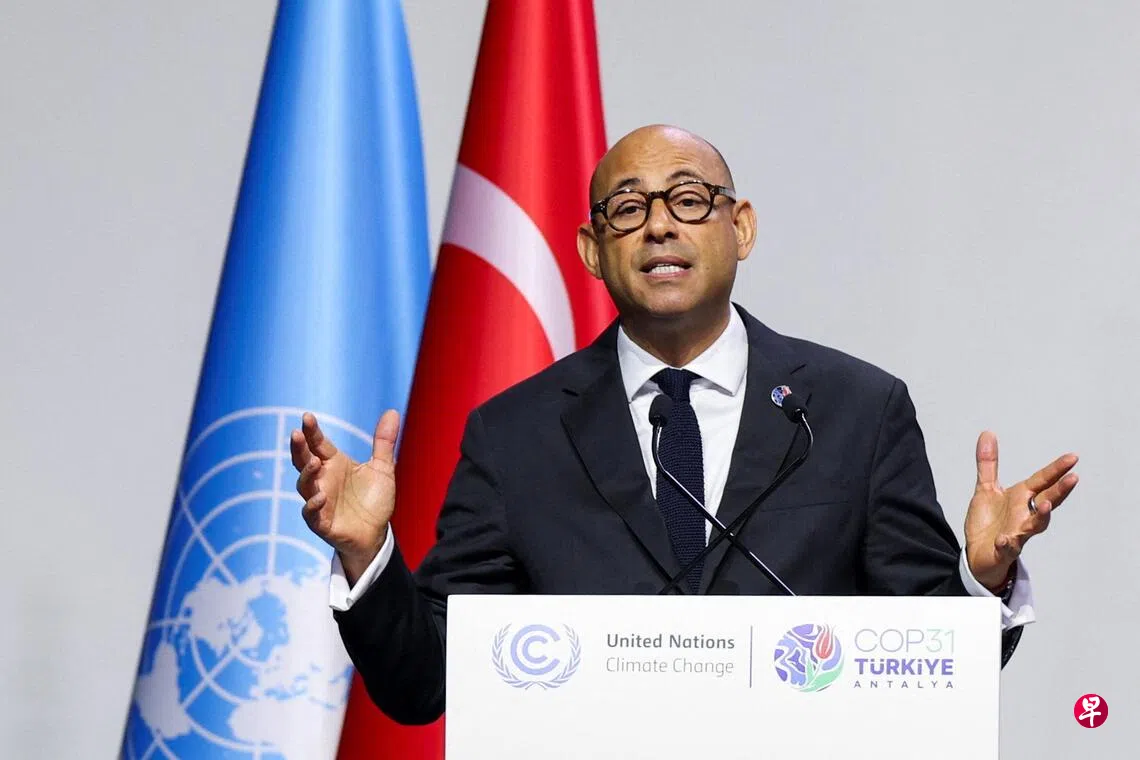
Simon Stiell, executive secretary of the United Nations Framework Convention on Climate Change, has stressed that artificial intelligence (AI) offers enormous potential for tackling global warming but also carries significant risks.
Turkey, host of the 31st UN Climate Change Conference (COP31), launched the voluntary Antalya Artificial Intelligence Pledge for countries and organisations on Monday (16 November). It aims to harness AI to find climate solutions while assessing the technology’s environmental risks.
The pledge has so far won support from 80 countries and organisations, but only nine of these are countries. The US, China and the EU — three major emitting economies — are not among them.
Stiell said, “AI and other frontier technologies are a double-edged sword... We cannot ask people to accept higher bills, more planet heating pollution and deeper inequality today in exchange for promises of a better tomorrow.”
AI is being widely used to improve weather forecasts, monitor industrial emissions and optimise renewable energy use. But the data centres that underpin the technology consume vast amounts of energy and water. This has fuelled discontent among residents facing soaring utility bills and raised concerns about the centres’ growing carbon footprint.
US hyperscale data centres’ carbon emissions rival Denmark’s annual total
International Energy Agency data shows that coal supplies about 30% of the electricity consumed by data centres, followed by renewables at 27%, natural gas at 26% and nuclear power at 15%.
A new study released on Monday put the median estimate of carbon dioxide emissions from the 403 hyperscale data centres currently operating across the US at 25.7 million tonnes for the period from May 2024 to April 2025. That is equivalent to the annual emissions of five million to six million petrol cars, and close to Denmark’s total annual carbon emissions.
Former US securities regulator: AI bubble will burst and trigger recession
The enormous investments in AI have also sparked debate over financial risks. Former US Securities and Exchange Commission chairman Gary Gensler told CNN that the AI boom was a bubble that would very likely burst before the 2028 presidential election, triggering an economic recession.
Gensler, now a professor at the Massachusetts Institute of Technology, said the scale of investment in AI infrastructure was staggering, with some estimates putting it at US$800 billion (about S$1.03 trillion) a year. “The Big Tech companies are spending five times more in 2026 than they were just three years ago…It’s just the extraordinary size of it all.”
Gensler believes money is pouring into AI faster than companies can generate profits, raising concerns that businesses may overinvest and take on too much debt.
He said, “History tells us that when you have a new technology and a significant investment…you come to a point where it plateaus. It retrenches. The only question is if it’s a soft recession or something more dramatic.”
